3rd vote for the Naroditsky pawn end game series. Amazing free content.
I just wish he'd get around to the other endgames !!
3rd vote for the Naroditsky pawn end game series. Amazing free content.
I just wish he'd get around to the other endgames !!
bunch of videos to submit to. google that and you get one reddit. and it is about videos. what a commitment.
bunch of videos to submit to. google that and you get one reddit. and it is about videos. what a commitment.
@kindaspongey said in #15:
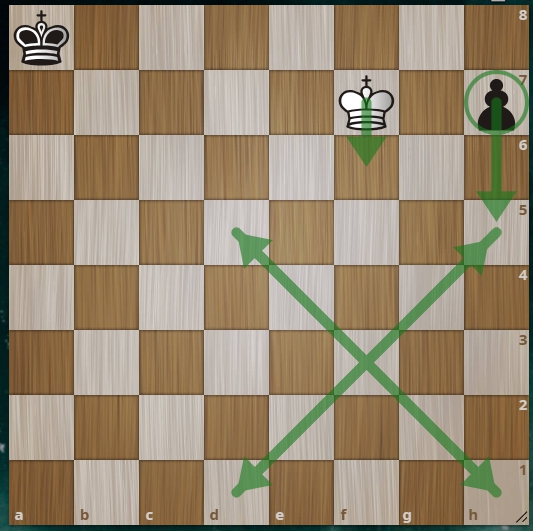
lichess.org/editor/k7/5K1p/8/8/8/8/8/8_w_-_-_0_1?color=white
I remember once confidently playing Kg7, expecting an automatic draw. Oops.
don't laugh the algebraic coordinate are so not board symmetries aware that this kind of optical illusion can happen a lot.
also turn is not visible without touching.. Kg7 does help. should have been a hint.. mind the board....if not the game history, remember the board is the environment.. there is a vertical direction bias (tropic) for each player, but what direction? good one.
and pawns are the guardians of that until their end.
@kindaspongey said in #15:
> lichess.org/editor/k7/5K1p/8/8/8/8/8/8_w_-_-_0_1?color=white
> I remember once confidently playing Kg7, expecting an automatic draw. Oops.
don't laugh the algebraic coordinate are so not board symmetries aware that this kind of optical illusion can happen a lot.
also turn is not visible without touching.. Kg7 does help. should have been a hint.. mind the board....if not the game history, remember the board is the environment.. there is a vertical direction bias (tropic) for each player, but what direction? good one.
and pawns are the guardians of that until their end.
@kindaspongey said in #15:
lichess.org/editor/k7/5K1p/8/8/8/8/8/8_w_-_-_0_1?color=white
I remember once confidently playing Kg7, expecting an automatic draw. Oops.
k*h6 enpassant luckily saves the game
@kindaspongey said in #15:
> lichess.org/editor/k7/5K1p/8/8/8/8/8/8_w_-_-_0_1?color=white
> I remember once confidently playing Kg7, expecting an automatic draw. Oops.
k*h6 enpassant luckily saves the game
how I whished that the rule was not so quirky: i.e. only allowing pawns to slow time when one of their facing one feels so primed as to jump so far.
Maybe there is a rational behind, such as only the slowest pieces and low cast ones can see each other. The king might also be slow but has other things to worry about, than an enthused enemy pawn.. prefers delegating to own side pawns, even if none around?
from https://en.wikipedia.org/wiki/En_passant
In chess, en passant (French: [̃ pas̃], lit. "in passing") describes the capture by a pawn of an enemy pawn on the same rank and an adjacent file that has just made an initial two-square advance.
edit: wait. the initial wink.. it was not about the error in pawn course direction. I had assumed a criticality in the order direction.
but it is about watching how to apply the rule of square... to put the pawn outside the square in the static picture mnemonics also fixes that case, as one has to think about immediate pawn move and place the square drawing there.. It was not the optical illusion I had because I still don't look much at the algebraic, I would rather look at the interactions, and rely of where the kings are in frequency and that one, was easily the pawn near promotion.. how training can induce assumptions.. (we start by queening problem, and thing they might be the only criticality).. enough babbling... or post-mortem. (also I wish there was a coordinate system where the (0,0) was the very center of the 8x8 in its ambient R2 space. at least the numbers could be signed we would know territory at a glance, (I guess 4.5 might do as well...) 4 on own side 5 on the other. but then flip that and you double the learning task to reach at a glance, at least descriptive had less hurdles for spatial intuition, that catches symmetries and they breaking at a glance) (from respective rim or from 0,0 at center they both carry the symmetry at a glance of the notation).
queenside and kinside have persited in narration, instead of abcd versus efgh.. (here the flip is not as doubling). really the vertical is the most arbitrary one. Sure computer don,t care.. but it was for humans.. so why put the 0,0 in some corner...? anyone with some historical insight about the coordinate traditions?
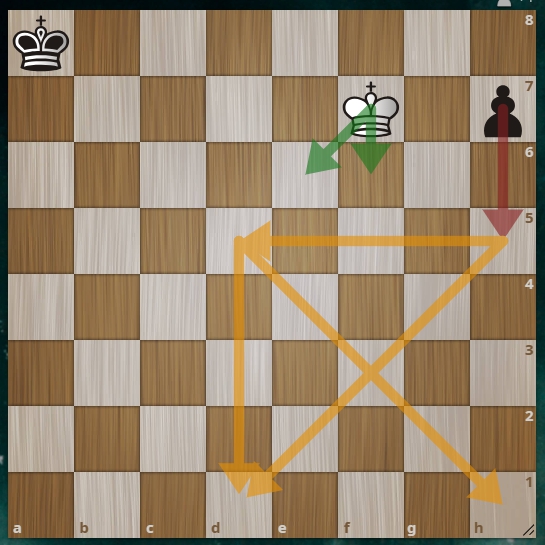
https://i.postimg.cc/sXxYpqxx/screenshot-2023-09-24-at-13-25-40.jpg (white to move) has to be adjacent at least to the following pawn move target small square (grid point of the 8x8) square of the pawn. The "square". so draw the square from the pawn next move target point, and you need the king to be at that moment (pawn color to move) adjacent to that square. This is all I need to remember. But that is not always how it is thought. I find this more compressed memory load (might just be me, I have some polarity reversal issue, that the diagram might not always solve, if I don't put the criticality in spatial terms. criticality is something we can remember, in the the alternance of side optimization. Or I do. remembering pawn or king already inside, is more foggy to me on the issue of whose turn... i would have to drill that to.... and I like to flip things in many direction (or am forced to, noisy brain).
how I whished that the rule was not so quirky: i.e. only allowing pawns to slow time when one of their facing one feels so primed as to jump so far.
Maybe there is a rational behind, such as only the slowest pieces and low cast ones can see each other. The king might also be slow but has other things to worry about, than an enthused enemy pawn.. prefers delegating to own side pawns, even if none around?
> from https://en.wikipedia.org/wiki/En_passant
> In chess, en passant (French: [̃ pas̃], lit. "in passing") describes the capture by a pawn of an enemy pawn on the same rank and an adjacent file that has just made an initial two-square advance.
edit: wait. the initial wink.. it was not about the error in pawn course direction. I had assumed a criticality in the order direction.
but it is about watching how to apply the rule of square... to put the pawn outside the square in the static picture mnemonics also fixes that case, as one has to think about immediate pawn move and place the square drawing there.. It was not the optical illusion I had because I still don't look much at the algebraic, I would rather look at the interactions, and rely of where the kings are in frequency and that one, was easily the pawn near promotion.. how training can induce assumptions.. (we start by queening problem, and thing they might be the only criticality).. enough babbling... or post-mortem. (also I wish there was a coordinate system where the (0,0) was the very center of the 8x8 in its ambient R2 space. at least the numbers could be signed we would know territory at a glance, (I guess 4.5 might do as well...) 4 on own side 5 on the other. but then flip that and you double the learning task to reach at a glance, at least descriptive had less hurdles for spatial intuition, that catches symmetries and they breaking at a glance) (from respective rim or from 0,0 at center they both carry the symmetry at a glance of the notation).
queenside and kinside have persited in narration, instead of abcd versus efgh.. (here the flip is not as doubling). really the vertical is the most arbitrary one. Sure computer don,t care.. but it was for humans.. so why put the 0,0 in some corner...? anyone with some historical insight about the coordinate traditions?
https://i.postimg.cc/sXxYpqxx/screenshot-2023-09-24-at-13-25-40.jpg (white to move) has to be adjacent at least to the following pawn move target small square (grid point of the 8x8) square of the pawn. The "square". so draw the square from the pawn next move target point, and you need the king to be at that moment (pawn color to move) adjacent to that square. This is all I need to remember. But that is not always how it is thought. I find this more compressed memory load (might just be me, I have some polarity reversal issue, that the diagram might not always solve, if I don't put the criticality in spatial terms. criticality is something we can remember, in the the alternance of side optimization. Or I do. remembering pawn or king already inside, is more foggy to me on the issue of whose turn... i would have to drill that to.... and I like to flip things in many direction (or am forced to, noisy brain).
Speaking of criticality, there are degrees to that. It might be helpful to quantify it sometimes. Like here given the specified things on the board, one could say that the degree of restriction on the white king moves to be within king walk catching distance from the escape toward queening pawn is 2 over 8. The pawn restricting at current position one of the 8 mobility admissible (in abstract of other material on board), the 3 points that the rule of the square would, in isolation as objective representation toward goal of queening, instead (given the only thing present) being intermediate to winning goal, become 2 when combining all the mobility rules and goals (kind can't go on a restricted point by opponent material).
So criticality is another chess term that might need some context spelled out sometimes, for proper communication not knowing who might be reading and not wanting to or minding not to exclude some. It is free, would not hurt any who would find such to be obvious, and the new comers might catch the common train or is it boat of the discussions. Sure a wink is also fun.. but not ending on such note. only.
I guess room can hold both the notion of criticality and the notion of lack of criticality. in counting terms one might consider branching degree at given position as basis. But that might get also compounded with various tasks on board that one might need to avoid exhaustive turn by turn calculations (which is NOT the way!). Related orderable notion is "testing". opponent what ever outcome odds, still testing while playing. Restricting the room, so that opponent always on most critical (narrow room) paths available.
https://i.postimg.cc/vDRBLHMX/screenshot-2023-09-28-at-19-58-57.jpg
Speaking of criticality, there are degrees to that. It might be helpful to quantify it sometimes. Like here given the specified things on the board, one could say that the degree of restriction on the white king moves to be within king walk catching distance from the escape toward queening pawn is 2 over 8. The pawn restricting at current position one of the 8 mobility admissible (in abstract of other material on board), the 3 points that the rule of the square would, in isolation as objective representation toward goal of queening, instead (given the only thing present) being intermediate to winning goal, become 2 when combining all the mobility rules and goals (kind can't go on a restricted point by opponent material).
So criticality is another chess term that might need some context spelled out sometimes, for proper communication not knowing who might be reading and not wanting to or minding not to exclude some. It is free, would not hurt any who would find such to be obvious, and the new comers might catch the common train or is it boat of the discussions. Sure a wink is also fun.. but not ending on such note. only.
I guess room can hold both the notion of criticality and the notion of lack of criticality. in counting terms one might consider branching degree at given position as basis. But that might get also compounded with various tasks on board that one might need to avoid exhaustive turn by turn calculations (which is NOT the way!). Related orderable notion is "testing". opponent what ever outcome odds, still testing while playing. Restricting the room, so that opponent always on most critical (narrow room) paths available.
https://i.postimg.cc/vDRBLHMX/screenshot-2023-09-28-at-19-58-57.jpg
I just messed one up ! hehe'
I just messed one up ! hehe'
I find myself also thinking about criticality. If the Black king were on h2 instead of a8, then (I think) only Kf6 would save the day for White. By the way, this game was almost 4 decades ago, so I may not have the details exactly right. For one thing, it was a simul, so I was actually playing Black with the lone king, while White had the king and the pawn. The person doing the simul was a (very young) Jeff Sarwer. I wonder if he remembers the game at all.
I find myself also thinking about criticality. If the Black king were on h2 instead of a8, then (I think) only Kf6 would save the day for White. By the way, this game was almost 4 decades ago, so I may not have the details exactly right. For one thing, it was a simul, so I was actually playing Black with the lone king, while White had the king and the pawn. The person doing the simul was a (very young) Jeff Sarwer. I wonder if he remembers the game at all.
@kindaspongey said in #5:
I once saw someone bring up this position:
lichess.org/editor/8/8/4k3/p6p/1p2K3/1Rr4P/P7/8_w_-_-_0_1?color=white
The question was whether or not White had a draw after Rxc3. My impression is that this problem is so super-easy that endgame enthusiasts would just laugh at it, but I am not confident that I could think it through over-the-board without a long time control.
^I think this is a good example, so maybe by showing the thoughts needed to solve this one quickly can give an idea for the rest? There are two bits of knowledge the player would need to solve this fast:
-
The locked pawns on the a and b files have 3 key squares - where if the black king arrived on any one of them he could win no-matter which side was to play (c3, d3, e3). Knowing this will force white to keep the black king out of those squares at all costs - making blocking calculations possible.
-
There is a short cut for understanding the rooks pawns on the h file (in relation to the final pawn on a and b, should one set of pawns trade there with both kings near the a and b file). You can find this shortcut by searching Bahr's Rule online. It is a shortcut to decide if the outside pawn on a or b can give black enough of a head start to win with the h pawn - as he has to reach and capture the white h pawn while blocking the white king from ever reaching c8 and c7.
1 and 2 can be seen in a couple seconds if you know these tricks. The only thing left to calculate by force is the race if black moves onto the f file towards the h pawns, since white can not follow him due to the b pawn queening by force after black's pawn sacrifices itself on a4 - he will have to head towards a and b - the race is on.
It took infinitely longer to type this than it did to see the method and moves. I would say I did that in roughly 20-30 seconds. This is a shamelss plug, but.. if you want to see me do a different one in real time, here is a video where I do it and then explain it: https://www.youtube.com/watch?v=-pKI-lVkxPo&list=PL_7rqFCl6f_3yUK5ATXThKuyeGvxLoM9O&index=1
@kindaspongey said in #5:
> I once saw someone bring up this position:
> lichess.org/editor/8/8/4k3/p6p/1p2K3/1Rr4P/P7/8_w_-_-_0_1?color=white
> The question was whether or not White had a draw after Rxc3. My impression is that this problem is so super-easy that endgame enthusiasts would just laugh at it, but I am not confident that I could think it through over-the-board without a long time control.
^I think this is a good example, so maybe by showing the thoughts needed to solve this one quickly can give an idea for the rest? There are two bits of knowledge the player would need to solve this fast:
1. The locked pawns on the a and b files have 3 key squares - where if the black king arrived on any one of them he could win no-matter which side was to play (c3, d3, e3). Knowing this will force white to keep the black king out of those squares at all costs - making blocking calculations possible.
2. There is a short cut for understanding the rooks pawns on the h file (in relation to the final pawn on a and b, should one set of pawns trade there with both kings near the a and b file). You can find this shortcut by searching Bahr's Rule online. It is a shortcut to decide if the outside pawn on a or b can give black enough of a head start to win with the h pawn - as he has to reach and capture the white h pawn while blocking the white king from ever reaching c8 and c7.
1 and 2 can be seen in a couple seconds if you know these tricks. The only thing left to calculate by force is the race if black moves onto the f file towards the h pawns, since white can not follow him due to the b pawn queening by force after black's pawn sacrifices itself on a4 - he will have to head towards a and b - the race is on.
It took infinitely longer to type this than it did to see the method and moves. I would say I did that in roughly 20-30 seconds. This is a shamelss plug, but.. if you want to see me do a different one in real time, here is a video where I do it and then explain it: https://www.youtube.com/watch?v=-pKI-lVkxPo&list=PL_7rqFCl6f_3yUK5ATXThKuyeGvxLoM9O&index=1
@kindaspongey said in #5:
I once saw someone bring up this position:
lichess.org/editor/8/8/4k3/p6p/1p2K3/1Rr4P/P7/8_w_-_-_0_1?color=white
The question was whether or not White had a draw after Rxc3. ... I am not confident that I could think it through over-the-board without a long time control.
@DrHack said in #29:
... maybe by showing the thoughts needed to solve this one
quickly ... The only thing left to calculate by force is the race if ...
I am afraid that I do not perceive the conclusion that you arrive at or the specific calculations that you carry out for that purpose.
@kindaspongey said in #5:
> I once saw someone bring up this position:
> lichess.org/editor/8/8/4k3/p6p/1p2K3/1Rr4P/P7/8_w_-_-_0_1?color=white
> The question was whether or not White had a draw after Rxc3. ... I am not confident that I could think it through over-the-board without a long time control.
@DrHack said in #29:
> ... maybe by showing the thoughts needed to solve this one
> quickly ... The only thing left to calculate by force is the race if ...
I am afraid that I do not perceive the conclusion that you arrive at or the specific calculations that you carry out for that purpose.