#20
The puzzle man will hardly reach any puzzle position.
Analyzing lost games is key to improve at any level.
Study of grandmaster games is the best way to learn openings, middle games, and endgames.
Openings are least useful.
#20
The puzzle man will hardly reach any puzzle position.
Analyzing lost games is key to improve at any level.
Study of grandmaster games is the best way to learn openings, middle games, and endgames.
Openings are least useful.
I’ve been thinking a lot about this question while working on my own training routine.
I do a lot of puzzles on Lichess, but I noticed something: solving many puzzles helps pattern recognition, yet I sometimes get stuck in real positions because I can’t clearly explain why one move is better than another.
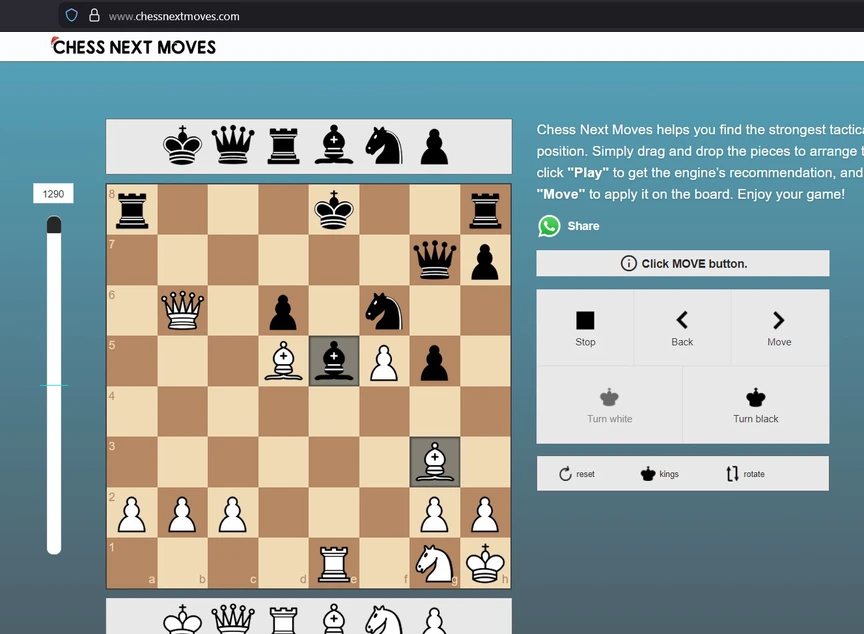
Lately, when I’m completely stuck in a puzzle or analysis position, I’ve started using an external analysis board (screenshot attached) where I manually set up the position and check the engine’s top move only after I’ve tried to calculate on my own. I don’t spam it for every move just as a confirmation tool.
What I find useful is:
Seeing alternative candidate moves I didn’t consider
Understanding when my intuition is wrong
Comparing engine logic vs my human reasoning
For me, this works best after long puzzle sessions, not instead of them. Puzzles build patterns, but occasional engine confirmation helps connect those patterns to real games.
Curious how others balance high-volume puzzles vs deeper analysis.
Do you review puzzles afterward, or just move on?
I’ve been thinking a lot about this question while working on my own training routine.
I do a lot of puzzles on Lichess, but I noticed something: solving many puzzles helps pattern recognition, yet I sometimes get stuck in real positions because I can’t clearly explain why one move is better than another.
Lately, when I’m completely stuck in a puzzle or analysis position, I’ve started using an external analysis board (screenshot attached) where I manually set up the position and check the engine’s top move only after I’ve tried to calculate on my own. I don’t spam it for every move just as a confirmation tool.
What I find useful is:
Seeing alternative candidate moves I didn’t consider
Understanding when my intuition is wrong
Comparing engine logic vs my human reasoning
For me, this works best after long puzzle sessions, not instead of them. Puzzles build patterns, but occasional engine confirmation helps connect those patterns to real games.
Curious how others balance high-volume puzzles vs deeper analysis.
Do you review puzzles afterward, or just move on?

you will see
those tactics trained and
not have to calculate them
but much more than that,
good strategy (!) is the fertile ground
for tactics in your favor to even occur
you will *see*
those tactics trained and
*not* have to *calculate* them
but much more than that,
good *strategy* (!) is the fertile ground
for tactics in your favor to even occur
@tpr said in #5:
Penalty kicks are part of a soccer player's training, but you do not become a good soccer player by penalty kicks alone.
Correct, but not quite.
The thing is, training involves practicing many other technical skills. And if you don't master them, you won't become a good football player.
https://en.wikipedia.org/wiki/List_of_association_football_skills
A penalty kick is something like a checkmate in one move. But a chess player's tactical skills include much more than just the ability to checkmate in one move. And the way to practice these skills is by solving puzzles.
This topic—whether there's any benefit to solving puzzles—has been discussed here several times. And what's surprising to me is that each time, the discussion is directed toward contrasting puzzles with other training methods.
You need to choose one thing: either solve puzzles or analyze your games. Why?!
It is quite possible to find time for different training methods.
But if we are talking about beginner chess players, then most of the time should be spent on solving puzzles.
It seems so obvious to me that it's strange why someone doesn't understand it)
Perhaps the reason lies in the different understanding of the term "beginner".
@tpr said in #5:
> Penalty kicks are part of a soccer player's training, but you do not become a good soccer player by penalty kicks alone.
Correct, but not quite.
The thing is, training involves practicing many other technical skills. And if you don't master them, you won't become a good football player.
https://en.wikipedia.org/wiki/List_of_association_football_skills
A penalty kick is something like a checkmate in one move. But a chess player's tactical skills include much more than just the ability to checkmate in one move. And the way to practice these skills is by solving puzzles.
This topic—whether there's any benefit to solving puzzles—has been discussed here several times. And what's surprising to me is that each time, the discussion is directed toward contrasting puzzles with other training methods.
You need to choose one thing: either solve puzzles or analyze your games. Why?!
It is quite possible to find time for different training methods.
But if we are talking about beginner chess players, then most of the time should be spent on solving puzzles.
It seems so obvious to me that it's strange why someone doesn't understand it)
Perhaps the reason lies in the different understanding of the term "beginner".
Rudolf Spielman was a wonderful player who said that he would find the continuations World Chess Champion Alexander Alekhine would find if he could JUST get those Positions !!
Rudolf Spielman was a wonderful player who said that he would find the continuations World Chess Champion Alexander Alekhine would find if he could JUST get those Positions !!
@tpr said in #8:
#7
Assume 5 equal beginners start training an hour per day.
A solves puzzles.
B studies openings.
C studies endgames.
D plays 15+10 rapid and analyzes lost games.
E studies annotated grandmaster games.
How would they rank after say 1 year if they play a double round robin tournament against each other?
They would all lose to F that had a balanced approach and G that had some human coaching, or at least went over games with others (i.e. a live club situation). Although not all of that stuff is of much value to true beginners and your question would work better with like 1300 and up.
@tpr said in #8:
> #7
> Assume 5 equal beginners start training an hour per day.
> A solves puzzles.
> B studies openings.
> C studies endgames.
> D plays 15+10 rapid and analyzes lost games.
> E studies annotated grandmaster games.
> How would they rank after say 1 year if they play a double round robin tournament against each other?
They would all lose to F that had a balanced approach and G that had some human coaching, or at least went over games with others (i.e. a live club situation). Although not all of that stuff is of much value to true beginners and your question would work better with like 1300 and up.
[ follow up to my #23 ]
... and tactics are only a small part of all positions in a game - most need strategic understanding and decisions, making your pieces play together well, having a solid defense, understanding & meeting the requirements of the position; last not least becoming proficient at endgames, and knowing how to continue a winning advantage into a win.
[ follow up to my #23 ]
... and tactics are only a small part of all positions in a game - most need strategic understanding and decisions, making your pieces play together well, having a solid defense, understanding & meeting the requirements of the position; last not least becoming proficient at endgames, and knowing how to continue a winning advantage into a win.
@tpr said in #8:
#7
Assume 5 equal beginners start training an hour per day.
A solves puzzles.
B studies openings.
C studies endgames.
D plays 15+10 rapid and analyzes lost games.
E studies annotated grandmaster games.
How would they rank after say 1 year if they play a double round robin tournament against each other?
My Money is on the Puzzle guy.
@tpr said in #8:
> #7
> Assume 5 equal beginners start training an hour per day.
> A solves puzzles.
> B studies openings.
> C studies endgames.
> D plays 15+10 rapid and analyzes lost games.
> E studies annotated grandmaster games.
> How would they rank after say 1 year if they play a double round robin tournament against each other?
My Money is on the Puzzle guy.
@nnjuguna
you make tactics happen moves before
that is strategy.
many good strategic moves,
handling all arising positions well, that is,
is necessary to get a ( one or two, a few ) tactical opportunity ... 95% vs 5%
@tpr
D - 'analyze errors' includes all other methods \ issues, and it's matched on your individual weaknesses
but there's better than that - a combination of pondering single positions deeply + brute force training your weakness(es) ( but you have to find these out first )
@nnjuguna
>you make tactics happen moves before
that is *strategy*.
many good strategic moves,
handling all arising positions well, that is,
is necessary to get a ( one or two, a few ) tactical opportunity ... 95% vs 5%
@tpr
D - 'analyze errors' includes all other methods \ issues, and it's matched on your individual weaknesses
but there's better than that - a combination of pondering single positions deeply + brute force training your weakness(es) ( but you have to find these out first )
#24
"It is quite possible to find time for different training methods."
- Time is limited. You should spend time on what brings most reward. Doing a bit of everything cannot be the most efficient approach.
"the term "beginner"
- A beginner is a person who has learned the Laws of Chess.
#28
"My Money is on the Puzzle guy." * He will look in vain for puzzle type moves and lose to D, E, and C. He will only win from B, as all his opponents will deviate from what he has studied in depth.
#26
"a balanced approach" What would that be? How much % of the 1 h/day during 1 year to A, B, C, D, E?
#29
"you have to find these out first" * That is by playing and analyzing lost games.
#24
"It is quite possible to find time for different training methods."
* Time is limited. You should spend time on what brings most reward. Doing a bit of everything cannot be the most efficient approach.
"the term "beginner"
* A beginner is a person who has learned the Laws of Chess.
#28
"My Money is on the Puzzle guy." * He will look in vain for puzzle type moves and lose to D, E, and C. He will only win from B, as all his opponents will deviate from what he has studied in depth.
#26
"a balanced approach" What would that be? How much % of the 1 h/day during 1 year to A, B, C, D, E?
#29
"you have to find these out first" * That is by playing and analyzing lost games.

