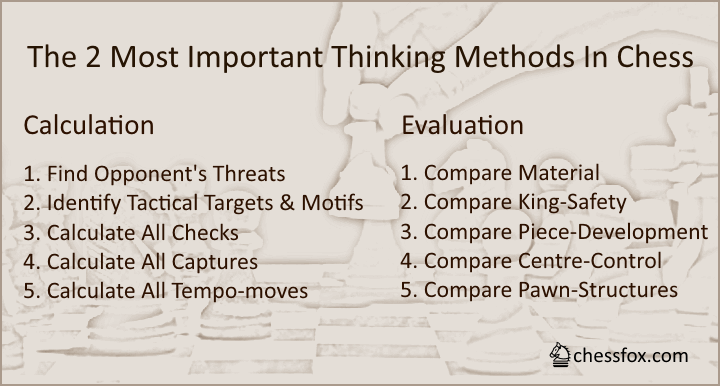
Chessfox.com gives a nice analysis of thought process. In summary it is:
- Find opponent’s threats
- Identify tactical targets and motifs
- Calculate all the checks
- Calculate all the captures
- Calculate all the tempo-moves
You can see the video for more details: https://chessfox.com/10-day-chess-challenge-day-1/
I've applied it to some puzzles and it really helped to see something I would otherwise miss. I guess after solving 10.000 puzzles with this method it just comes naturaly, you look the position and just see the solution :)
Btw, how does one drop in puzzle solving ratings? I was 2150 once and now I can't go over 1900. All in a course of few months. Am I being less careful or what? Idk..
Chessfox.com gives a nice analysis of thought process. In summary it is:
1. Find opponent’s threats
2. Identify tactical targets and motifs
3. Calculate all the checks
4. Calculate all the captures
5. Calculate all the tempo-moves
You can see the video for more details: https://chessfox.com/10-day-chess-challenge-day-1/
I've applied it to some puzzles and it really helped to see something I would otherwise miss. I guess after solving 10.000 puzzles with this method it just comes naturaly, you look the position and just see the solution :)
Btw, how does one drop in puzzle solving ratings? I was 2150 once and now I can't go over 1900. All in a course of few months. Am I being less careful or what? Idk..
Also, this is nice (from the same source):
https://chessfox.com/wp-content/uploads/2015/04/2-most-important-thinking-methods-in-chess.png
@comfortable thx for thoughtful reply, i will follow-up on the ideas i see in your post, need to think how to do that best.
I like this thread, helpful contributions, maybe not mine. I just backed off from one that i need to revise or make the subject of another thread, but this one is inspiring.
@comfortable thx for thoughtful reply, i will follow-up on the ideas i see in your post, need to think how to do that best.
I like this thread, helpful contributions, maybe not mine. I just backed off from one that i need to revise or make the subject of another thread, but this one is inspiring.
Like many masters (Kramnik, Carlsen) my thinking process is totally random. I jump between the lines and explore the tactical and positional nature iteratively. No „to-do list“ whatsoever.
Like many masters (Kramnik, Carlsen) my thinking process is totally random. I jump between the lines and explore the tactical and positional nature iteratively. No „to-do list“ whatsoever.
@Bishop1964
These studies took a lot of effort. Wow. Well done!
@Bishop1964
These studies took a lot of effort. Wow. Well done!
@Sarg0n
That is probably because you are an excellent chess player. raw talent, or very focused development, probably both.
You may never have had the need to observe yourself, and rationalize your own processes, so they look random; they may be but i doubt it. They may not be methodical, they may have become subconscious at this chess age of yours.
I wish we could ask the leela bots, about randomness in chess? They are based on statistical approaches, assuming chess is following a probability law (in some space containing the training data).
So , i keep wondering about how to improve my chess, at my age, Also, i'm curious about chess as a whole, not just my own rating. It is a good somewhat constrained world where we apply the thinking muscle, why not make study of it.
@Sarg0n
That is probably because you are an excellent chess player. raw talent, or very focused development, probably both.
You may never have had the need to observe yourself, and rationalize your own processes, so they look random; they may be but i doubt it. They may not be methodical, they may have become subconscious at this chess age of yours.
I wish we could ask the leela bots, about randomness in chess? They are based on statistical approaches, assuming chess is following a probability law (in some space containing the training data).
So , i keep wondering about how to improve my chess, at my age, Also, i'm curious about chess as a whole, not just my own rating. It is a good somewhat constrained world where we apply the thinking muscle, why not make study of it.
Your original question appears to be about visualizing positions and thus seeing the material after a move or moves have been made.
Seems like a simple matter of increasingly deeper vision. Do tactics and this vision deepens and clears. I noticed that every few hundreds puzzles I solve my ability to visualize and count up the remaining pieces (always count them on the board, not the captured ones) and seeing what else these remaining pieces can do after a move or after several moves improves.
Your original question appears to be about visualizing positions and thus seeing the material after a move or moves have been made.
Seems like a simple matter of increasingly deeper vision. Do tactics and this vision deepens and clears. I noticed that every few hundreds puzzles I solve my ability to visualize and count up the remaining pieces (always count them on the board, not the captured ones) and seeing what else these remaining pieces can do after a move or after several moves improves.
@LukaCro 5. Calculate all the tempo-moves
what are tempo-moves? sorry if i missed its mention earlier in this thread.
@LukaCro 5. Calculate all the tempo-moves
what are tempo-moves? sorry if i missed its mention earlier in this thread.
@dboing, my guess is that tempo-moves are zwischenzugs or intermediate moves that must be addressed by your opponent, or else they'll lose the game.
@dboing, my guess is that tempo-moves are zwischenzugs or intermediate moves that must be addressed by your opponent, or else they'll lose the game.
@SeniorPatzer Tempo Moves are Moves that threaten something decisive! Most effective are if minor pieces or pawns attack major pieces. For example, if a pawn attacks the queen, etc. . This is the way the opponent has to react. In our example, he moves his queen away.
I hope my English isn't too bad, lol!
@SeniorPatzer Tempo Moves are Moves that threaten something decisive! Most effective are if minor pieces or pawns attack major pieces. For example, if a pawn attacks the queen, etc. . This is the way the opponent has to react. In our example, he moves his queen away.
I hope my English isn't too bad, lol!