@Jean_Gunfighter said in #20:
Hmm... Are you sure about it or it is your assumption?
I am certain. It's been discussed several times in this forum.
I never saw that someone was flagged for cheating in puzzles.
Correct. Lichess does not flag users for cheating on puzzles. But it does discourage puzzle cheating, because that skews the ratings of the puzzles themselves, making the system less useful for the rest of us.
@Jean_Gunfighter said in #20:
> Hmm... Are you sure about it or it is your assumption?
I am certain. It's been discussed several times in this forum.
> I never saw that someone was flagged for cheating in puzzles.
Correct. Lichess does not flag users for cheating on puzzles. But it does discourage puzzle cheating, because that skews the ratings of the puzzles themselves, making the system less useful for the rest of us.
@mcgoves said in #21:
I am certain. It's been discussed several times in this forum.
So devs said it? Because in the case I provided there was no significant gap between puzzle rating (around 2000) and blitz rating (around 2000). And also I didn't see any relatively new cases when puzzle rating disappears and question mark appears. That's why I thought that disappearance of rating on old accounts is due to some changes in puzzle or puzzle rating system.
Also this would be strange because rating in puzzles can be a lot higher than rating in blitz or bullet even if puzzles were solved not long ago. And it will be shown correctly without any question mark (question mark appears only in some cases and only after long period of time). So users can still cheat in puzzles and damage the puzzle system and this question mark in some cases doesn't help the problem in any way.
@mcgoves said in #21:
Correct. Lichess does not flag users for cheating on puzzles. But it does discourage puzzle cheating, because that skews the ratings of the puzzles themselves, making the system less useful for the rest of us.
Yep, I understand that. But if what you said is true then disappearance of the rating from displayed rating doesn't fix this problem, because rating is not annulled but just disappear from profile page. Puzzles that were solved with engine use still got it's rating a bit wrong.
@mcgoves said in #21:
> I am certain. It's been discussed several times in this forum.
So devs said it? Because in the case I provided there was no significant gap between puzzle rating (around 2000) and blitz rating (around 2000). And also I didn't see any relatively new cases when puzzle rating disappears and question mark appears. That's why I thought that disappearance of rating on old accounts is due to some changes in puzzle or puzzle rating system.
Also this would be strange because rating in puzzles can be a lot higher than rating in blitz or bullet even if puzzles were solved not long ago. And it will be shown correctly without any question mark (question mark appears only in some cases and only after long period of time). So users can still cheat in puzzles and damage the puzzle system and this question mark in some cases doesn't help the problem in any way.
@mcgoves said in #21:
> Correct. Lichess does not flag users for cheating on puzzles. But it does discourage puzzle cheating, because that skews the ratings of the puzzles themselves, making the system less useful for the rest of us.
Yep, I understand that. But if what you said is true then disappearance of the rating from displayed rating doesn't fix this problem, because rating is not annulled but just disappear from profile page. Puzzles that were solved with engine use still got it's rating a bit wrong.
@Jean_Gunfighter said in #22:
So devs said it?
I don't recall if they had the dev icon, but some people pointed to the relevant code in the Scala source.
Because in the case I provided there was no significant gap between puzzle rating (around 2000) and blitz rating (around 2000). And also I didn't see any relatively new cases when puzzle rating disappears and question mark appears. That's why I thought that disappearance of rating on old accounts is due to some changes in puzzle or puzzle rating system.
Maybe you're right. It looks like something was going on when the "new puzzles" came out. I can't recall, but maybe everyone's puzzle RD was reset.
https://lichess.org/@/Lichess/blog/new-puzzles-are-here/X-S6gRUA
https://lichess.org/forum/general-chess-discussion/whats-with-this-question-mark----at-my-puzzles-
Yep, I understand that. But if what you said is true then disappearance of the rating from displayed rating doesn't fix this problem
No, but it mitigates the problem.
@Jean_Gunfighter said in #22:
> So devs said it?
I don't recall if they had the dev icon, but some people pointed to the relevant code in the Scala source.
> Because in the case I provided there was no significant gap between puzzle rating (around 2000) and blitz rating (around 2000). And also I didn't see any relatively new cases when puzzle rating disappears and question mark appears. That's why I thought that disappearance of rating on old accounts is due to some changes in puzzle or puzzle rating system.
Maybe you're right. It looks like something was going on when the "new puzzles" came out. I can't recall, but maybe everyone's puzzle RD was reset.
https://lichess.org/@/Lichess/blog/new-puzzles-are-here/X-S6gRUA
https://lichess.org/forum/general-chess-discussion/whats-with-this-question-mark----at-my-puzzles-
> Yep, I understand that. But if what you said is true then disappearance of the rating from displayed rating doesn't fix this problem
No, but it mitigates the problem.
@mkubecek said in #11:
Hover over the graph where the line for puzzle rating ends and it will show the ratings at that time. You may need to adjust the sliders for time interval if it's been farther in the past than the default graph shows.
For example, this is what it looks like for mine:
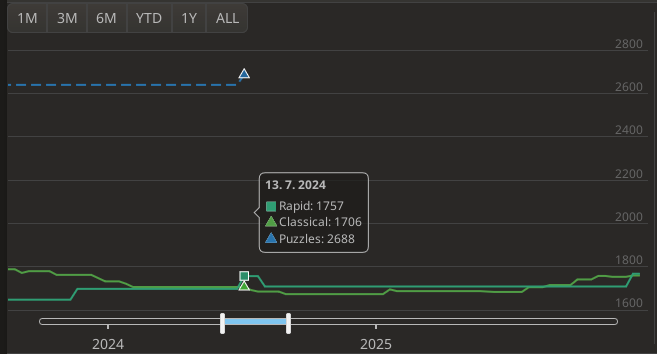
I intentionally used a "private window" to show that it works for anyone's account, not just yours.
I noticed a nuance in this graph. The thing is, it records the maximum rating even with a question mark. For example, you have 2600, you've abandoned puzzles for a long time, and after you resume, you'll get a boost to almost 3000 for correct solutions while the question mark remains.
Even after solving one problem, you'll get the same boost as for three to five solved without a question mark, or even more.
Therefore, these statistics reflect an inflated rating, not the actual rating.
That's why I wonder why this system is needed for those who simply took a break from a particular mode?
For a new account, it's fine, although I also don't think it's necessary.
I don't understand the point of these sharp jumps over the course of about 15 games/solves?
@mkubecek said in #11:
> Hover over the graph where the line for puzzle rating ends and it will show the ratings at that time. You may need to adjust the sliders for time interval if it's been farther in the past than the default graph shows.
>
> For example, this is what it looks like for mine:
> 
>
> I intentionally used a "private window" to show that it works for anyone's account, not just yours.
I noticed a nuance in this graph. The thing is, it records the maximum rating even with a question mark. For example, you have 2600, you've abandoned puzzles for a long time, and after you resume, you'll get a boost to almost 3000 for correct solutions while the question mark remains.
Even after solving one problem, you'll get the same boost as for three to five solved without a question mark, or even more.
Therefore, these statistics reflect an inflated rating, not the actual rating.
That's why I wonder why this system is needed for those who simply took a break from a particular mode?
For a new account, it's fine, although I also don't think it's necessary.
I don't understand the point of these sharp jumps over the course of about 15 games/solves?
@Italiya said in #24:
That's why I wonder why this system is needed for those who simply took a break from a particular mode?
For a new account, it's fine, although I also don't think it's necessary.
I don't understand the point of these sharp jumps over the course of about 15 games/solves?
- Because it is useful for many players who's level increased or decreased and they could align puzzle level with their current new level faster. For example, you will need to solve about 15 puzzles to reach rating that is coherent with your new level instead of 30 puzzles or more.
- Puzzle graph shows all your puzzle rating fluctuation. I don't see any problem here. If anyone will be interested in your real best result in puzzle he can just watch your rating fluctuation on a distance. Same like in blitz or rapid rating if you reached 2400 or 2500 is some time control at the start (because when you start to play new time control you will get more rating points) this doesn't mean that this is your real strength. Your real strength is the rating that you can hold. Same logic works in puzzles.
- Puzzles are made for your improvement not for competition with other users. If you use them as competition this is up to you and there is no need for Lichess to change it's puzzle mechanic because of your approach to puzzles.
@mcgoves said in #23:
No, but it mitigates the problem.
May be, if statistics says so. I just don't get how exactly it works. For example there are 2 cases:
- Someone reached 3000 in puzzles using engine and now rating 3000 is shown on their profile page.
Player's goal: Achieved
Consequences: Some puzzles has a bit distorted rating.
- Someone reached 3000 in puzzles using engine and now rating 3000 is shown on their profile page. But 1 year has passed and their rating was replaced with question mark.
Player's goal: Achieved (he still had 3000 rating for a year)
Consequences: Some puzzles has a bit distorted rating.
From logic point of view it could even provoke those people to cheat again to get rid from question mark and return their rating which will results in more damage to puzzle rating system.
But may be I miss something.
@Italiya said in #24:
> That's why I wonder why this system is needed for those who simply took a break from a particular mode?
> For a new account, it's fine, although I also don't think it's necessary.
> I don't understand the point of these sharp jumps over the course of about 15 games/solves?
1. Because it is useful for many players who's level increased or decreased and they could align puzzle level with their current new level faster. For example, you will need to solve about 15 puzzles to reach rating that is coherent with your new level instead of 30 puzzles or more.
2. Puzzle graph shows all your puzzle rating fluctuation. I don't see any problem here. If anyone will be interested in your real best result in puzzle he can just watch your rating fluctuation on a distance. Same like in blitz or rapid rating if you reached 2400 or 2500 is some time control at the start (because when you start to play new time control you will get more rating points) this doesn't mean that this is your real strength. Your real strength is the rating that you can hold. Same logic works in puzzles.
3. Puzzles are made for your improvement not for competition with other users. If you use them as competition this is up to you and there is no need for Lichess to change it's puzzle mechanic because of your approach to puzzles.
@mcgoves said in #23:
> No, but it mitigates the problem.
May be, if statistics says so. I just don't get how exactly it works. For example there are 2 cases:
1. Someone reached 3000 in puzzles using engine and now rating 3000 is shown on their profile page.
Player's goal: Achieved
Consequences: Some puzzles has a bit distorted rating.
2. Someone reached 3000 in puzzles using engine and now rating 3000 is shown on their profile page. But 1 year has passed and their rating was replaced with question mark.
Player's goal: Achieved (he still had 3000 rating for a year)
Consequences: Some puzzles has a bit distorted rating.
From logic point of view it could even provoke those people to cheat again to get rid from question mark and return their rating which will results in more damage to puzzle rating system.
But may be I miss something.
@Italiya said in #24:
That's why I wonder why this system is needed for those who simply took a break from a particular mode?
The puzzle ratings use the same system as game ratings. Just as with your playing stength, if you take a long break (on lichess), there is no way to know if your rating still reflects your strength (in this case, puzzle solving ability). Therefore your rating deviation is high after a long period of inactivity so that your rating can adjust quickly.
As explained as early as in comment #2, puzzle ratings are even less suitable for comparing users to each other than game ratings. Therefore checking other users' puzzle ratings and complaining what is (not) shown or how is pointless.
@Italiya said in #24:
> That's why I wonder why this system is needed for those who simply took a break from a particular mode?
The puzzle ratings use the same system as game ratings. Just as with your playing stength, if you take a long break (on lichess), there is no way to know if your rating still reflects your strength (in this case, puzzle solving ability). Therefore your rating deviation is high after a long period of inactivity so that your rating can adjust quickly.
As explained as early as in comment #2, puzzle ratings are even less suitable for comparing users to each other than game ratings. Therefore checking other users' puzzle ratings and complaining what is (not) shown or how is pointless.
@mkubecek said in #26:
That's why I wonder why this system is needed for those who simply took a break from a particular mode?
The puzzle ratings use the same system as game ratings. Just as with your playing stength, if you take a long break (on lichess), there is no way to know if your rating still reflects your strength (in this case, puzzle solving ability). Therefore your rating deviation is high after a long period of inactivity so that your rating can adjust quickly.
As explained as early as in comment #2, puzzle ratings are even less suitable for comparing users to each other than game ratings. Therefore checking other users' puzzle ratings and complaining what is (not) shown or how is pointless.
The thing is, in blitz, for example, a rating with a question mark isn't recorded as a record, but in puzzles, it is.
This is because puzzles don't have detailed statistics, only a graph on the main profile page.
This means it's impossible to know what the highest rating a user had without a question mark was.
This is simple from a statistics collection perspective.
But thanks to you, I also learned that a task's rating can even be tied to the game's rating, and if there's too much of a difference, it's hidden. Consequently, a direct comparison is made with the player's playing skill, so it's not surprising to pay attention to this. Wherever there's a rating, there's a competitive and comparative element.
So, what's the need to add or subtract a bunch of points in blitz?
And if the player's playing skill hasn't changed and they win 15 games in a row against equally or inferior opponents, is that a fair adjustment? Or, conversely, if he loses 15 times in a row, say, in a Berserker tournament, he'll lose 7-12 points in one case, and 50-100 in another.
The rating will change anyway, so what's the point in rushing it?
@mkubecek said in #26:
> > That's why I wonder why this system is needed for those who simply took a break from a particular mode?
>
> The puzzle ratings use the same system as game ratings. Just as with your playing stength, if you take a long break (on lichess), there is no way to know if your rating still reflects your strength (in this case, puzzle solving ability). Therefore your rating deviation is high after a long period of inactivity so that your rating can adjust quickly.
>
> As explained as early as in comment #2, puzzle ratings are even less suitable for comparing users to each other than game ratings. Therefore checking other users' puzzle ratings and complaining what is (not) shown or how is pointless.
The thing is, in blitz, for example, a rating with a question mark isn't recorded as a record, but in puzzles, it is.
This is because puzzles don't have detailed statistics, only a graph on the main profile page.
This means it's impossible to know what the highest rating a user had without a question mark was.
This is simple from a statistics collection perspective.
But thanks to you, I also learned that a task's rating can even be tied to the game's rating, and if there's too much of a difference, it's hidden. Consequently, a direct comparison is made with the player's playing skill, so it's not surprising to pay attention to this. Wherever there's a rating, there's a competitive and comparative element.
So, what's the need to add or subtract a bunch of points in blitz?
And if the player's playing skill hasn't changed and they win 15 games in a row against equally or inferior opponents, is that a fair adjustment? Or, conversely, if he loses 15 times in a row, say, in a Berserker tournament, he'll lose 7-12 points in one case, and 50-100 in another.
The rating will change anyway, so what's the point in rushing it?
@Italiya said in #27:
The thing is, in blitz, for example, a rating with a question mark isn't recorded as a record, but in puzzles, it is.
There is no record section in puzzles. On the graph any rating deviations are recorded after 3 rated games played or 3 rated puzzles are solved. So if you don't play for some time in any time control and question mark appears then when you will play this time control and your rating will change it will be updated automatically and shown on the graph even if it will not be shown in the Record section (that doesn't exist for puzzles).
@Italiya said in #27:
This means it's impossible to know what the highest rating a user had without a question mark was.
Why it is a problem? Puzzles are not made for competition, they are made for your improvement. And if you want to know how good user is in solving a puzzle you still can see user puzzle solving strength based on the graph. As I said - you just need to analyze rating deviation on a distance. If he can hold his rating then this is his strength. At least for particular time period.
@Italiya said in #27:
And if the player's playing skill hasn't changed and they win 15 games in a row against equally or inferior opponents, is that a fair adjustment?
If player can do something that he could not do before then his skill was changed whether it is temporarily or not. So it will be fair adjustment. But in most cases if your strength increased you will win most games, but not all of them and that's why it would be longer to reach your current strength if there was not special approach to adjust rating faster.
@Italiya said in #27:
Or, conversely, if he loses 15 times in a row, say, in a Berserker tournament, he'll lose 7-12 points in one case, and 50-100 in another.
I already explained it to you in details in other topic that playing with Berserk is allowed and rating deviations that occurs when you play with berserk mode activated are within Lichess rules regulations if you don't have pattern that could be considered as sandbagging.
@Italiya said in #27:
Wherever there's a rating, there's a competitive and comparative element.
Not exactly. Rating only shows numerical value of some parameter or set of parameters. If there are no special mechanic involved that encourages and simplifies competition with other users then competition is not intended even if it is possible. How you use this rating is up to you. Not every rating is meant for competition; some ratings exist purely for personal use, to make it easier to provide you with suitable data or services.
Of course every numerical value can be used as comparative element even hair's length. But if particular rating is not intended to be competitive then there is no need to adjust system so that it would treat this rating same like ratings where competition is implied.
Also puzzles are not protected from cheating. This is also because they are not made for competition even if you use them this way.
@Italiya said in #27:
The rating will change anyway, so what's the point in rushing it?
Because not anyone likes wasting time to get to the goal. If you like to do 2 steps instead of 1 step to reach the goal it doesn't mean that everyone else has the same approach.
@Italiya said in #27:
> The thing is, in blitz, for example, a rating with a question mark isn't recorded as a record, but in puzzles, it is.
There is no record section in puzzles. On the graph any rating deviations are recorded after 3 rated games played or 3 rated puzzles are solved. So if you don't play for some time in any time control and question mark appears then when you will play this time control and your rating will change it will be updated automatically and shown on the graph even if it will not be shown in the Record section (that doesn't exist for puzzles).
@Italiya said in #27:
> This means it's impossible to know what the highest rating a user had without a question mark was.
Why it is a problem? Puzzles are not made for competition, they are made for your improvement. And if you want to know how good user is in solving a puzzle you still can see user puzzle solving strength based on the graph. As I said - you just need to analyze rating deviation on a distance. If he can hold his rating then this is his strength. At least for particular time period.
@Italiya said in #27:
> And if the player's playing skill hasn't changed and they win 15 games in a row against equally or inferior opponents, is that a fair adjustment?
If player can do something that he could not do before then his skill was changed whether it is temporarily or not. So it will be fair adjustment. But in most cases if your strength increased you will win most games, but not all of them and that's why it would be longer to reach your current strength if there was not special approach to adjust rating faster.
@Italiya said in #27:
>Or, conversely, if he loses 15 times in a row, say, in a Berserker tournament, he'll lose 7-12 points in one case, and 50-100 in another.
I already explained it to you in details in other topic that playing with Berserk is allowed and rating deviations that occurs when you play with berserk mode activated are within Lichess rules regulations if you don't have pattern that could be considered as sandbagging.
@Italiya said in #27:
> Wherever there's a rating, there's a competitive and comparative element.
Not exactly. Rating only shows numerical value of some parameter or set of parameters. If there are no special mechanic involved that encourages and simplifies competition with other users then competition is not intended even if it is possible. How you use this rating is up to you. Not every rating is meant for competition; some ratings exist purely for personal use, to make it easier to provide you with suitable data or services.
Of course every numerical value can be used as comparative element even hair's length. But if particular rating is not intended to be competitive then there is no need to adjust system so that it would treat this rating same like ratings where competition is implied.
Also puzzles are not protected from cheating. This is also because they are not made for competition even if you use them this way.
@Italiya said in #27:
> The rating will change anyway, so what's the point in rushing it?
Because not anyone likes wasting time to get to the goal. If you like to do 2 steps instead of 1 step to reach the goal it doesn't mean that everyone else has the same approach.
@Italiya said in #27:
The rating will change anyway, so what's the point in rushing it?
This morning I was playing a guy who has been been repeatedly defeating 1800-1900 rated opponents since last season and his teammates estimate his strength somewhere between 2000 and 2100. However, his official rating is... 1230. (National; he is not FIDE rated.) Even with K=25 it would take years before his rating gets anywhere close to his actual performance; and once he is 18 (next year), he'll have K=15 so that it's likely going to take even longer unless he plays 27 or more rated games in one 4 month rating period.
This is exactly why more modern rating systems with dynamic reliability evaluation (like Glicko-2) handle outdated ratings way better than the traditional ones (like Elo) which "don't rush it".
@Italiya said in #27:
> The rating will change anyway, so what's the point in rushing it?
This morning I was playing a guy who has been been repeatedly defeating 1800-1900 rated opponents since last season and his teammates estimate his strength somewhere between 2000 and 2100. However, his official rating is... 1230. (National; he is not FIDE rated.) Even with K=25 it would take years before his rating gets anywhere close to his actual performance; and once he is 18 (next year), he'll have K=15 so that it's likely going to take even longer unless he plays 27 or more rated games in one 4 month rating period.
This is exactly why more modern rating systems with dynamic reliability evaluation (like Glicko-2) handle outdated ratings way better than the traditional ones (like Elo) which "don't rush it".
@mkubecek said in #29:
The rating will change anyway, so what's the point in rushing it?
This morning I was playing a guy who has been been repeatedly defeating 1800-1900 rated opponents since last season and his teammates estimate his strength somewhere between 2000 and 2100. However, his official rating is... 1230. (National; he is not FIDE rated.) Even with K=25 it would take years before his rating gets anywhere close to his actual performance; and once he is 18 (next year), he'll have K=15 so that it's likely going to take even longer unless he plays 27 or more rated games in one 4 month rating period.
This is exactly why more modern rating systems with dynamic reliability evaluation (like Glicko-2) handle outdated ratings way better than the traditional ones (like Elo) which "don't rush it".
Hmm, an outdated system? 2200 is a Candidate Master's rating. Do you think an instant jump from 1230 to 2000-2100 is normal? It's his problem that he hasn't played for a long time. So, everyone else gained points by playing a bunch of tournaments, and he only needs to play one?
This isn't an "outdated rating"; it's just that he was resting while everyone else was working hard. If we're talking about sports.
It's like cheating to get to 3000 because I feel like I'm playing for it, I just don't want to waste time. I have to prove everything by going through the stages.
Well, if we go back to online chess and apply this situation here, you can imagine how quickly someone could go from 1200 to 1900 if they're playing at 2100. If that's really the case. It's literally a matter of one or two attempts. Giving him even 2000 right away is simply wrong, because he'll have to work hard to achieve that rating. Just because he can get it doesn't mean he should be given it.
It's the same with brain teasers. If you, with a rating of 2700, solve three problems correctly and get a rating of around 3000, would you consider that rating deserved? After all, solving one or three problems correctly isn't particularly difficult; the whole point is that you have to overcome a series of problems, winning and losing, gradually reaching new heights or getting stuck, treading water.
@mkubecek said in #29:
> > The rating will change anyway, so what's the point in rushing it?
>
> This morning I was playing a guy who has been been repeatedly defeating 1800-1900 rated opponents since last season and his teammates estimate his strength somewhere between 2000 and 2100. However, his official rating is... 1230. (National; he is not FIDE rated.) Even with K=25 it would take years before his rating gets anywhere close to his actual performance; and once he is 18 (next year), he'll have K=15 so that it's likely going to take even longer unless he plays 27 or more rated games in one 4 month rating period.
>
> This is exactly why more modern rating systems with dynamic reliability evaluation (like Glicko-2) handle outdated ratings way better than the traditional ones (like Elo) which "don't rush it".
Hmm, an outdated system? 2200 is a Candidate Master's rating. Do you think an instant jump from 1230 to 2000-2100 is normal? It's his problem that he hasn't played for a long time. So, everyone else gained points by playing a bunch of tournaments, and he only needs to play one?
This isn't an "outdated rating"; it's just that he was resting while everyone else was working hard. If we're talking about sports.
It's like cheating to get to 3000 because I feel like I'm playing for it, I just don't want to waste time. I have to prove everything by going through the stages.
Well, if we go back to online chess and apply this situation here, you can imagine how quickly someone could go from 1200 to 1900 if they're playing at 2100. If that's really the case. It's literally a matter of one or two attempts. Giving him even 2000 right away is simply wrong, because he'll have to work hard to achieve that rating. Just because he can get it doesn't mean he should be given it.
It's the same with brain teasers. If you, with a rating of 2700, solve three problems correctly and get a rating of around 3000, would you consider that rating deserved? After all, solving one or three problems correctly isn't particularly difficult; the whole point is that you have to overcome a series of problems, winning and losing, gradually reaching new heights or getting stuck, treading water.

