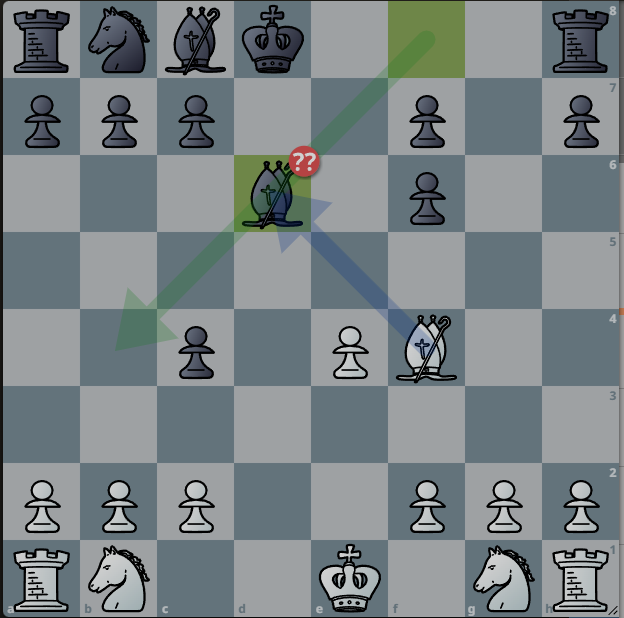
Hi there,
Stockfish says that the last move of my opponent (Bd6) was a blunder, and if I played now Bxd6, my position would be about +2.4 .
Could some1 please tell me: Why is that? I thought, my opponent would just get rid of the double pawn on the c-file, and everything would be fine for him...
Thanks in advance :)
Vollheinz

Hi there,
Stockfish says that the last move of my opponent (Bd6) was a blunder, and if I played now Bxd6, my position would be about +2.4 .
Could some1 please tell me: Why is that? I thought, my opponent would just get rid of the double pawn on the c-file, and everything would be fine for him...
Thanks in advance :)
Vollheinz
that d pawn after taking will be isolated, so if You casle queenside after knight developing , You easily attack it and f6 pawn too is in danger
that d pawn after taking will be isolated, so if You casle queenside after knight developing , You easily attack it and f6 pawn too is in danger
Its not necessarily the pawn alone, its many factors combined, but all of them have to do with the pawn structure.
As you can see, white has 7 connected pawns divided in 2 islands. Say the bishop exchanges happen and black plays c5 to get rid of the double pawn and that exchange also happens eventually.
Black has 3 islands, and 2 of them are alone. Those are possible targets. Specially the h pawn, if it falls, ill be hard to stop white's h pawn.
Black will have a a backwards d pawn. Is not that is alone, as is grouped with the c pawn, is the fact that its backwards on the open file. If it was advanced, it doesnt matter the f pawn gets attacked, it can be defended by the b pawn and the structure remains the same, but since its backwards, it will be a target and you will need to defend with a piece which wont be able to move. Also wont be able to advance, as c3 will do 2 things. The first one is to put the white pawns on darksquares, rendering the lightsquare bishop useless on the queen side. More often than not, usually the bishop is a tad stronger than the knight, but given that the pawn structure is not fixed yet, all the pawns will go to darksquares, making the bishop totally useless , the second is that it will prevent the d pawn from advancing as well.
And finally, the h and f pawn are going to be targets as well, as they are in separated islands alone. Im not saying that I would be able to convert if I was white, but it looks like the only one playing for a win is white in that situation.
Its not necessarily the pawn alone, its many factors combined, but all of them have to do with the pawn structure.
As you can see, white has 7 connected pawns divided in 2 islands. Say the bishop exchanges happen and black plays c5 to get rid of the double pawn and that exchange also happens eventually.
Black has 3 islands, and 2 of them are alone. Those are possible targets. Specially the h pawn, if it falls, ill be hard to stop white's h pawn.
Black will have a a backwards d pawn. Is not that is alone, as is grouped with the c pawn, is the fact that its backwards on the open file. If it was advanced, it doesnt matter the f pawn gets attacked, it can be defended by the b pawn and the structure remains the same, but since its backwards, it will be a target and you will need to defend with a piece which wont be able to move. Also wont be able to advance, as c3 will do 2 things. The first one is to put the white pawns on darksquares, rendering the lightsquare bishop useless on the queen side. More often than not, usually the bishop is a tad stronger than the knight, but given that the pawn structure is not fixed yet, all the pawns will go to darksquares, making the bishop totally useless , the second is that it will prevent the d pawn from advancing as well.
And finally, the h and f pawn are going to be targets as well, as they are in separated islands alone. Im not saying that I would be able to convert if I was white, but it looks like the only one playing for a win is white in that situation.
Thank you for your excellent and helpful answer! :D Yes, the backward pawn in particular would certainly be bad for Black...
Thank you for your excellent and helpful answer! :D Yes, the backward pawn in particular would certainly be bad for Black...
When one can think ahead as far as Stockfish can (not that anyone actually can), a weak pawn structure can spell doom in the distant future.
When one can think ahead as far as Stockfish can (not that anyone actually can), a weak pawn structure can spell doom in the distant future.
@Vollheinz_TrashMode said in #1:
Could some1 please tell me: Why is that? I thought, my opponent would just get rid of the double pawn on the c-file, and everything would be fine for him...
U could find a good d5 or f5 outpost for your horses & that after you exchange blacks white squared bishop.
The reason behind Bxd6 will ease the possibility of these outposts as pawn to c3 will no longer be possible.
@Vollheinz_TrashMode said in #1:
> Could some1 please tell me: Why is that? I thought, my opponent would just get rid of the double pawn on the c-file, and everything would be fine for him...
U could find a good d5 or f5 outpost for your horses & that after you exchange blacks white squared bishop.
The reason behind Bxd6 will ease the possibility of these outposts as pawn to c3 will no longer be possible.
What lines does SF give after the bishop trade? That's the most important thing to consider...
What lines does SF give after the bishop trade? That's the most important thing to consider...
Black has a worse pawn structure, in exchange he has the bishop pair, which is oftenly sufficient compensation.
Black is now giving up the bishop pair to get rid of 1 problem, the doubled pawn, but he creates another: the backward pawn.
- The white knights will have extra good time in the black squares, black can deal with only 1 of them
- knights play very well against backward pawns and doubled pawns, a lot of times better than bishops, because they can run in both color squares while bishops need the pawns fixed in a specific color square
- White can even trade off pieces if he wants to, black has more pawn islands to take care
- Once even trading pieces favours white, it's hard to find a plan for black, if only the traded bishop was the white square one, black could try to get into a bishop ending once they would be opposite colours, but it's not the case
Hard time for black
Black has a worse pawn structure, in exchange he has the bishop pair, which is oftenly sufficient compensation.
Black is now giving up the bishop pair to get rid of 1 problem, the doubled pawn, but he creates another: the backward pawn.
1) The white knights will have extra good time in the black squares, black can deal with only 1 of them
2) knights play very well against backward pawns and doubled pawns, a lot of times better than bishops, because they can run in both color squares while bishops need the pawns fixed in a specific color square
3) White can even trade off pieces if he wants to, black has more pawn islands to take care
4) Once even trading pieces favours white, it's hard to find a plan for black, if only the traded bishop was the white square one, black could try to get into a bishop ending once they would be opposite colours, but it's not the case
Hard time for black


