...and I will try to solve them :)
#1: https://lichess.org/forum/off-topic-discussion/post-your-math-problems-here
...and I will try to solve them :)
#1: https://lichess.org/forum/off-topic-discussion/post-your-math-problems-here
...and I will try to solve them :)
#1: https://lichess.org/forum/off-topic-discussion/post-your-math-problems-here
C=5/9(F-32)
The equation above shows how temperature F, measured in degrees Fahrenheit, relates to a temperature C, measured in degrees Celsius. Based on the equation, which of the following must be true?
A) I only
B) II only
C) III only
D) I and II only
This is one of the hardest SAT math questions, Good luck
@Samboy2023 said in #2:
[...]
:D
edit:
This is one of the hardest SAT math questions, Good luck
no way, it is? I should retake the SAT, i'd get a 100% lol
ok bro
@Samboy2023 said in #2:
C=5/9(F-32)
The equation above shows how temperature F, measured in degrees Fahrenheit, relates to a temperature C, measured in degrees Celsius. Based on the equation, which of the following must be true?
- A temperature increase of 1 degree Fahrenheit is equivalent to a temperature increase of 5/9 degree Celsius.
- A temperature increase of 1 degree Celsius is equivalent to a temperature increase of 1.8 degrees Fahrenheit.
- A temperature increase of 5/9 degree Fahrenheit is equivalent to a temperature increase of 1 degree Celsius.
A) I only
B) II only
C) III only
D) I and II only
Answer: (D) I and II only
Explanation:
We have:
C = 5/9 (F - 32)
or, F - 32 = C x 9/5
or, F = 1.8C + 32
Differentiating with respect to C (not required but just displaying lol)
dF/dC = 1.8
Thus, for a 1 degree rise in temperature in the Celsius scale, we have a 1.8 degree rise in temperature in the Fahrenheit scale.
Conversely, dC/dF = 1/1.8
or, dC/dF = 1/(9/5)
or, dC/dF = 5/9
Thus, for a 1 degree rise in temperature in the Fahrenheit scale, we have a 5/9 degree rise in temperature in the Celsius scale.
Therefore, statements I and II are correct.
Statement III is false because it obviously contradicts statement II.
Alternate method (without calculus):
Assume C' = C + 1, and F' = F + 1, assuming 1 degree increase in temperature of both scales, and then substitute both seperately into the equation, along with C and F, respectively.
This method is simpler but longer.
nah with those questions you will get bored, time for fun questions.
The isosceles trapezoid ABCD with bases AB and CD is responsible for the circle with the equation x^2 + y^2 = 10x – 6y – 9 . This circle intersects the sides BC and CD of this trapezoid at the points E = (8,1) and F = (2,1) respectively. Calculate the coordinates of the vertices A, B, C and D of this trapezoid
@Samboy2023
you wanna see my one of hardest problem in my exam in highschool?
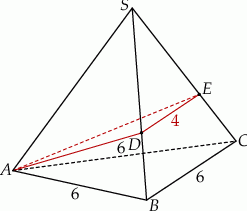
The base of the pyramid of the lattice ABCS is an equilateral triangular ABC with side length 6. On the lateral edges BS and CS are located points D and E, respectively, such that |BD | = |CE | and |DE | = 4 (see figure). The plane ADE is perpendicular to the plane of the lateral face BCS of the pyramid.
https://img.zadania.info/zad/1199830/HzadT10x.gif
have fun
by the way, the link for exam with I took form
https://zadania.info/d1771/96841
Whats 1+1?
This topic has been archived and can no longer be replied to.