Occasionally, I need to export Lichess game notations for printed material. Currently, when exporting a PGN, you get the default English notation.
For print purposes it would be very handy to have a native Lichess export feature to get notation in figurine algebraic notation, the style you see in classic chess books. All chess symbols are included in the Unicode: https://en.wikipedia.org/wiki/Chess_symbols_in_Unicode Currently, if you aim the notation to become nice-looking and understandable for everyone, you have to exchange the letters by hand. This easily leads to some errors.
Thanks for your great work!
PS: In a further step, you might also introduce multi-lingual PGN exports as some people are used to a different notation language, such as German or Russian.
Occasionally, I need to export Lichess game notations for printed material. Currently, when exporting a PGN, you get the default English notation.
For print purposes it would be very handy to have a native Lichess export feature to get notation in figurine algebraic notation, the style you see in classic chess books. All chess symbols are included in the Unicode: https://en.wikipedia.org/wiki/Chess_symbols_in_Unicode Currently, if you aim the notation to become nice-looking and understandable for everyone, you have to exchange the letters by hand. This easily leads to some errors.
Thanks for your great work!
PS: In a further step, you might also introduce multi-lingual PGN exports as some people are used to a different notation language, such as German or Russian.
@sorinnakichku , there are two different contexts you are talking about: PGN, which is a standard: portable game notation and which is using a specific set of letters for the pieces, and notation for printing or for different languages, which is a game notation, but not a portable one.
That being said, have you tried this: https://www.pgntranslator.com/ ?
@sorinnakichku , there are two different contexts you are talking about: PGN, which is a standard: portable game notation and which is using a specific set of letters for the pieces, and notation for printing or for different languages, which is a game notation, but not a portable one.
That being said, have you tried this: https://www.pgntranslator.com/ ?
@TotalNoob69 Thanks for the tip! I understand the difference between PGN an notation. pngtranslator does help when you need notation in a different language, so it does meet the idea in my PS.
However, my main point was that Lichess itself prefers using icons instead of letters in its visual notation (by the way, you can't easily copy that notation from the web interface itself).
I saw this discussion on StackExchange: https://chess.stackexchange.com/questions/40116/is-there-a-tool-to-convert-the-lines-from-a-pgn-file-to-figurine-notation. It mentions python-chess, which was contributed by @niklasf, one of the Lichess builders. Maybe it's even not that hard to incorporate into Lichess.
An export to figurine notation would just be a sweet little Lichess feature that I haven't seen anywhere else :)
@TotalNoob69 Thanks for the tip! I understand the difference between PGN an notation. pngtranslator does help when you need notation in a different language, so it does meet the idea in my PS.
However, my main point was that Lichess itself prefers using icons instead of letters in its visual notation (by the way, you can't easily copy that notation from the web interface itself).
I saw this discussion on StackExchange: https://chess.stackexchange.com/questions/40116/is-there-a-tool-to-convert-the-lines-from-a-pgn-file-to-figurine-notation. It mentions python-chess, which was contributed by @niklasf, one of the Lichess builders. Maybe it's even not that hard to incorporate into Lichess.
An export to figurine notation would just be a sweet little Lichess feature that I haven't seen anywhere else :)
Actually, the notation is either pieces or letters, based on your Preferences in the Display section. I set it to letters a long time ago and didn't think about it until now :)
Actually, the notation is either pieces or letters, based on your Preferences in the Display section. I set it to letters a long time ago and didn't think about it until now :)
why does it always have to be "instead". I hate figurine notation. You need to zoom in to make at a glance "discrimination" of the visual signal. Even if I loath SAN in general, I prefer the longer evolved natural language scripts to have done so toward being caught at a glance.. with serifs would even be better (just to hammer down the visual signaling knowledge manifest in all our font ecosystem from ages ago).
It might be my age, and need for reading glass, and other declining things (yep things do decline, others persist, some improve, like not finding glory in discomfort.....)
but big world. and possibly young eyes might have been trained with that SAN variant encoding (go figure), so I won't argue against, and would say read previous post (I did not, initially, sorry, impulsive that I may be).
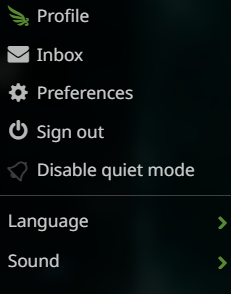
For the multilingual. I think that might be bound to your language preference.. So maybe you are asking, that in spite of our language preference (which might not be for any reason the language you prefer your PGN SAN secret microfilms to be in) that we could choose different languages for the PGN.. PGN and lichess UI, not being necessarily of same language needs.
Well, duh (about myself). When getting ready to do a PGN export.. maybe swithcing language from user menu. for that momemnt would work.. for now..
https://i.postimg.cc/RhvTvnYR/screenshot-2023-12-06-at-14-59-19.png
https://i.postimg.cc/xdHGHRD5/screenshot-2023-12-06-at-14-59-19.png
I hope some information in my post was complementary, or at least fun to decrypt or read.
why does it always have to be "instead". I hate figurine notation. You need to zoom in to make at a glance "discrimination" of the visual signal. Even if I loath SAN in general, I prefer the longer evolved natural language scripts to have done so toward being caught at a glance.. with serifs would even be better (just to hammer down the visual signaling knowledge manifest in all our font ecosystem from ages ago).
It might be my age, and need for reading glass, and other declining things (yep things do decline, others persist, some improve, like not finding glory in discomfort.....)
but big world. and possibly young eyes might have been trained with that SAN variant encoding (go figure), so I won't argue against, and would say read previous post (I did not, initially, sorry, impulsive that I may be).
For the multilingual. I think that might be bound to your language preference.. So maybe you are asking, that in spite of our language preference (which might not be for any reason the language you prefer your PGN SAN secret microfilms to be in) that we could choose different languages for the PGN.. PGN and lichess UI, not being necessarily of same language needs.
Well, duh (about myself). When getting ready to do a PGN export.. maybe swithcing language from user menu. for that momemnt would work.. for now..
https://i.postimg.cc/RhvTvnYR/screenshot-2023-12-06-at-14-59-19.png
https://i.postimg.cc/xdHGHRD5/screenshot-2023-12-06-at-14-59-19.png
I hope some information in my post was complementary, or at least fun to decrypt or read.
Nice views, @dboing. I agree with you that those little chess symbols are sometimes hard to determine on screen.
Unfortunately, changing language does not help out.
PS: I'm not demanding changing the PGN format (since it's designed to be portable), I was just talking about an option to copy/export the notation in different format, e.g. with other letters.
Nice views, @dboing. I agree with you that those little chess symbols are sometimes hard to determine on screen.
Unfortunately, changing language does not help out.
PS: I'm not demanding changing the PGN format (since it's designed to be portable), I was just talking about an option to copy/export the notation in different format, e.g. with other letters.
It wouldn't be a valid PGN anymore as PGN uses SAN (Standard Algebraic Notation).
4.1: Character codes:
Printing character codes outside of the seven bit ASCII range may only appear in string data and in commentary. They are not permitted for use in symbol construction.
8.2.3.2: Piece identification:
A later section of this document gives alternative piece letters, but these should be used only for local presentation software and not for archival storage or for dynamic interchange among programs.
https://ia902908.us.archive.org/26/items/pgn-standard-1994-03-12/PGN_standard_1994-03-12.txt
You have figurine algebraic notation, English descriptive notation, ICCF notation, long algebraic, coordinate and probably a few more and, unfortunately, you can't have them all. And PGN export must adhere to the standard.
What you can, however, do is download PGN and convert it to whatever format that suits your needs.
pgn-extract: https://www.cs.kent.ac.uk/people/staff/djb/pgn-extract/ can translate the symbols to a different language, like for example German:
pgn-extract -WsanBSLTDK ...
Doesn't support Russian, the mappings are one to one character and Russian uses "Kp" for the King.
One can easily code a program to do this as well though or replace with unicode figurines.
Or you can dive into the world of LaTeX: https://www.latex-project.org/get/ since you've mentioned print purposes.
And notezik's MPchess: https://lichess.org/forum/general-chess-discussion/chess-latex-metapost-package-inspired-by-lichess
https://ctan.org/pkg/mpchess
Or:
https://ctan.org/pkg/chessboard
https://ctan.org/pkg/xskak
It wouldn't be a valid PGN anymore as PGN uses SAN (Standard Algebraic Notation).
4.1: Character codes:
>Printing character codes outside of the seven bit ASCII range may only appear in string data and in commentary. They are not permitted for use in symbol construction.
8.2.3.2: Piece identification:
>A later section of this document gives alternative piece letters, but these should be used only for local presentation software and not for archival storage or for dynamic interchange among programs.
https://ia902908.us.archive.org/26/items/pgn-standard-1994-03-12/PGN_standard_1994-03-12.txt
You have figurine algebraic notation, English descriptive notation, ICCF notation, long algebraic, coordinate and probably a few more and, unfortunately, you can't have them all. And PGN export must adhere to the standard.
What you can, however, do is download PGN and convert it to whatever format that suits your needs.
pgn-extract: https://www.cs.kent.ac.uk/people/staff/djb/pgn-extract/ can translate the symbols to a different language, like for example German:
pgn-extract -WsanBSLTDK ...
Doesn't support Russian, the mappings are one to one character and Russian uses "Kp" for the King.
One can easily code a program to do this as well though or replace with unicode figurines.
Or you can dive into the world of LaTeX: https://www.latex-project.org/get/ since you've mentioned print purposes.
And notezik's MPchess: https://lichess.org/forum/general-chess-discussion/chess-latex-metapost-package-inspired-by-lichess
https://ctan.org/pkg/mpchess
Or:
https://ctan.org/pkg/chessboard
https://ctan.org/pkg/xskak
@sorinnakichku , LiChess Tools as a command called copypgn. Just type /copypgn and you will get the PGN. From version 2.2.19 you can add the parameter "unicode" so that you get unicode chess pieces instead of letters.
TLDR: type '/copypgn unicode'
For other languages you can just search and replace 5 times for the unicode characters.
@sorinnakichku , LiChess Tools as a command called copypgn. Just type /copypgn and you will get the PGN. From version 2.2.19 you can add the parameter "unicode" so that you get unicode chess pieces instead of letters.
TLDR: type '/copypgn unicode'
For other languages you can just search and replace 5 times for the unicode characters.
@bufferunderrun Wow, thanks for this overview. Definitely something to look at. Again, I'm not asking about changing the default PGN :)
@TotalNoob69 This is very interesting. I will keep this in mind. Thanks for your work!
Another thought I had was that you could make the moves list (containing piece icons) on any game page easily selectable. Currently, you cannot select this part of the webpage separately. How about that?
All in all, I don't need this feature that frequently, but worth mentioning, IMHO.
@bufferunderrun Wow, thanks for this overview. Definitely something to look at. Again, I'm not asking about changing the default PGN :)
@TotalNoob69 This is very interesting. I will keep this in mind. Thanks for your work!
Another thought I had was that you could make the moves list (containing piece icons) on any game page easily selectable. Currently, you cannot select this part of the webpage separately. How about that?
All in all, I don't need this feature that frequently, but worth mentioning, IMHO.
Again, I'm not asking about changing the default PGN :)
So what else if not PGN? PGN is the only portable format out there.
Another thought I had was that you could make the moves list (containing piece icons) on any game page easily selectable. Currently, you cannot select this part of the webpage separately. How about that?
The text there doesn't actually have any icons. What happens is that the browser is told to use a special font that replaces the piece letter with a glyph. So you can't just copy it and paste it elsewhere and have the text with glyphs.
One could technically replicate this by creating your own font that you install on your system, but it also would only work in programs that would allow you to pick this font.
Frankly, LaTeX would be a better-looking solution.
>Again, I'm not asking about changing the default PGN :)
So what else if not PGN? PGN is the only portable format out there.
>Another thought I had was that you could make the moves list (containing piece icons) on any game page easily selectable. Currently, you cannot select this part of the webpage separately. How about that?
The text there doesn't actually have any icons. What happens is that the browser is told to use a special font that replaces the piece letter with a glyph. So you can't just copy it and paste it elsewhere and have the text with glyphs.
One could technically replicate this by creating your own font that you install on your system, but it also would only work in programs that would allow you to pick this font.
Frankly, LaTeX would be a better-looking solution.