
CoPilot
Chess and Newton's Cradle

Have you ever heard of Newton's Cradle? It's a simple collision experiment demonstrating the conservation of momentum and energy. A few days earlier, a very creative idea occurred to me when I was racking my notebook, trying to come up with ways to convert FEN values into DTM values. And that idea is...
What if we think of a chess position as a Newton's Cradle?
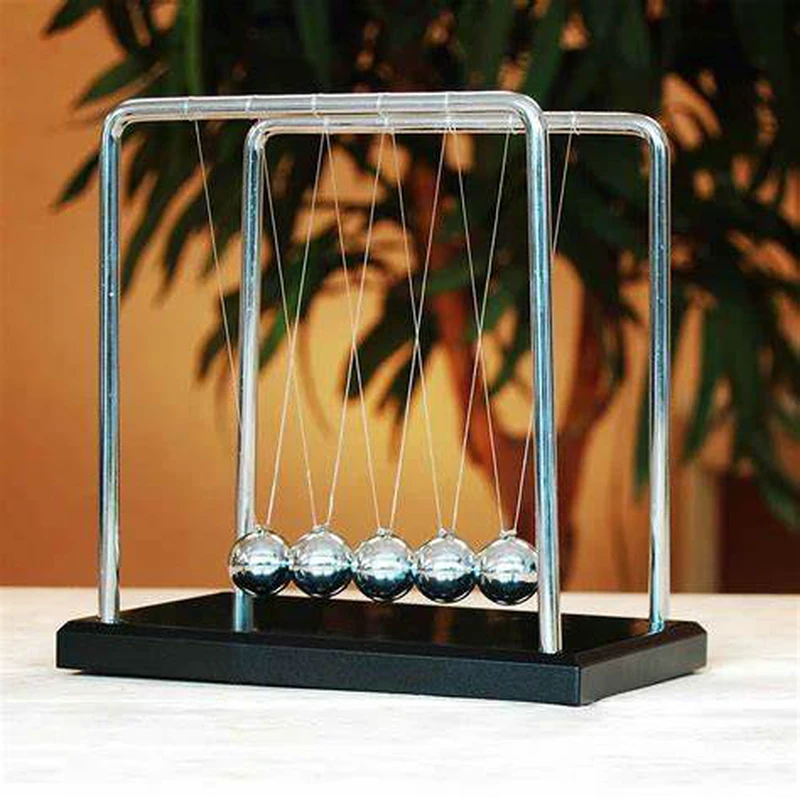
It's a pretty strange idea, but hear me out. If we can calculate the energy loss per collision and the mechanical energy given to a metal ball (we'll consider air resistance to be 0 for now), we can calculate which ball will hit the cradle last. But how does this apply to chess?
As you all are well aware, chess is solved when the number of pieces left on the board is less than 8. This collection of answers for chess positions is called Tablebase. Tablebase shows the DTZ (Depth to the Zeroing position) and DTM (Depth to the Mating position) values for any given move in such positions. But since this shows the Depth to n "position", we'll have to add one to each of these values to get the "Moves to Zeroing" or "Moves to Mate" values. When this MTM value is an odd number (2n-1), the side to move always wins. But if it is even (2n), then the side to move always loses.
This is exactly how Newton's Cradle works. In a cradle with an energy loss per collision of 1 J (joules), if the mechanical energy given to a metal ball is an odd number, that ball ALWAYS hits the cradle last, winning the game. If the mechanical energy is an even number or a decimal number, the ball on the other side of the cradle will be the last to hit and win the game. It is logical to take energy loss as 1 J because only 1 move is played in a chess position before a new position is created. When the air resistance is 0, and the energy loss per collision remains constant (at 1 J), if we know the height that the first ball is lifted, we can predict the last ball to hit the cradle in the following manner (we'll take kinetic energy as the form of mechanical energy):
1/2 x mv^2 = Kinetic energy
If this is an odd number, the starting ball wins. If it's even, the starting ball loses.
We can take 1kg as the mass because all the masses of the balls are equal anyway. So the only variable we'll have to know is the initial velocity given to the ball (note: here I am talking about a cradle with only two balls)
Now let's try substituting:
1/2 x mv^2 = 1/2 x 1 x 4^2 = 8
8 is an even number. Hence, the starting ball loses.
1/2 x mv^2 = 1/2 x 1 x 3^2 = 4.5
4.5 is a decimal number. Hence, the starting ball loses.
1/2 x mv^2 = 1/2 x 1 x (√22)^2 = 11
11 is an odd number. Hence, the starting ball wins.
But what happens when the position is a draw according to the tablebase? Then, the energy loss per collision becomes 0, and the cradle goes on forever. Of course, this won't happen in real life, but this is how we have to visualise it.
So all we have to do now is come up with a way to find the "kinetic energy" of a position. I have tried setting up various mate in 1 positions and mate with two knights against pawn positions, and finding patterns and connections between the MTM values and FEN values. I have even tried coming up with my own ways of representing chess positions and finding connections between those representations and MTM values, but I still got nowhere. But now I know that I don't need to find the exact MTM value for a position. I just need to figure out whether it is 2n-1 (odd) or 2n (even). I will be trying to find a way to do this, and I hope you will also give it some thought. With the invention of tablebase, I don't think this is impossible. I believe we can find a connection.
I hope this article restored at least some hope in you about the chances of the human race against the machines. I am a true believer in the human race, and that is the reason I decided to create the Club of Believers so that we can try to find our way to reclaim our dominance against machines in cooperation. There's no pressure to join, but with more members, our task will be much easier. We have an active forum for everyone to share their chess journey and ask questions, and it's a place from which everyone can benefit. On that note, we come to the end of today's article. See you next time!


