
Petr Zewlakk Vrabec
PICF 2025 First Round: A Battle Against the Clock
“World chess heads back to Prague“. This is the motto of the 7th edition of the Prague International Chess Festival, once again welcoming top players from around the world. Fans of the royal game can enjoy days of matches up until March 7th.
“World chess heads back to Prague“. This is the motto of the 7th edition of the Prague International Chess Festival, once again welcoming top players from around the world. Fans of the royal game can enjoy days of matches up until March 7th.
Guests and chess fans enjoyed an opening ceremony hosted by Jakub Stařík. The gala was inaugurated by former Czech President Václav Klaus, who recalled his chess experience in his speech. Mathematician and social innovator Karel Janeček praised the Festival and its organization and extended a special thanks to its director, Petr Boleslav. The evening also featured the premiere of Inter(play), a dance performance offering a unique artistic take on chess duels.
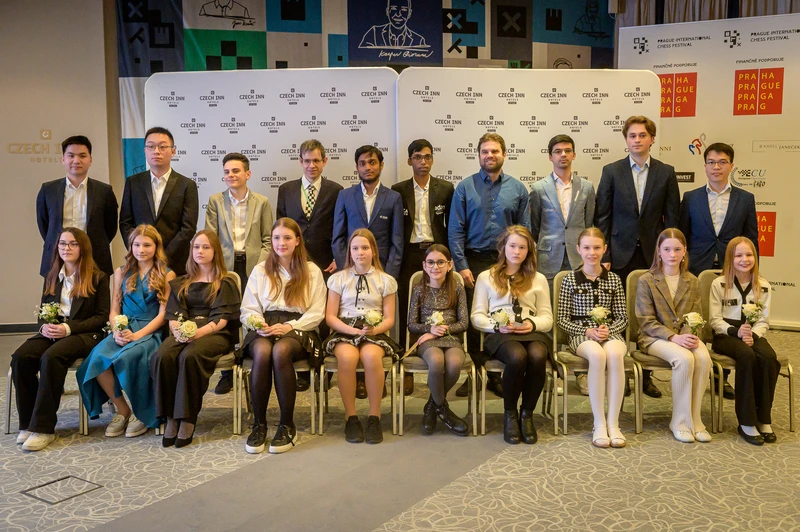
Players of the Masters and Futures tournaments at the opening ceremony
Let’s take a look at the highlights from the first round!
Masters
Nguyen Thai Dai Van got off to an excellent start in his game. In a symmetrical opening, he outplayed his opponent and reached a position where he could maneuver for a long time and improve his pieces. At the crucial moment, he correctly opened up the position and gained a decisive advantage. Unfortunately for him, the long maneuvering cost him most of his time, which he lacked in the decisive moments.
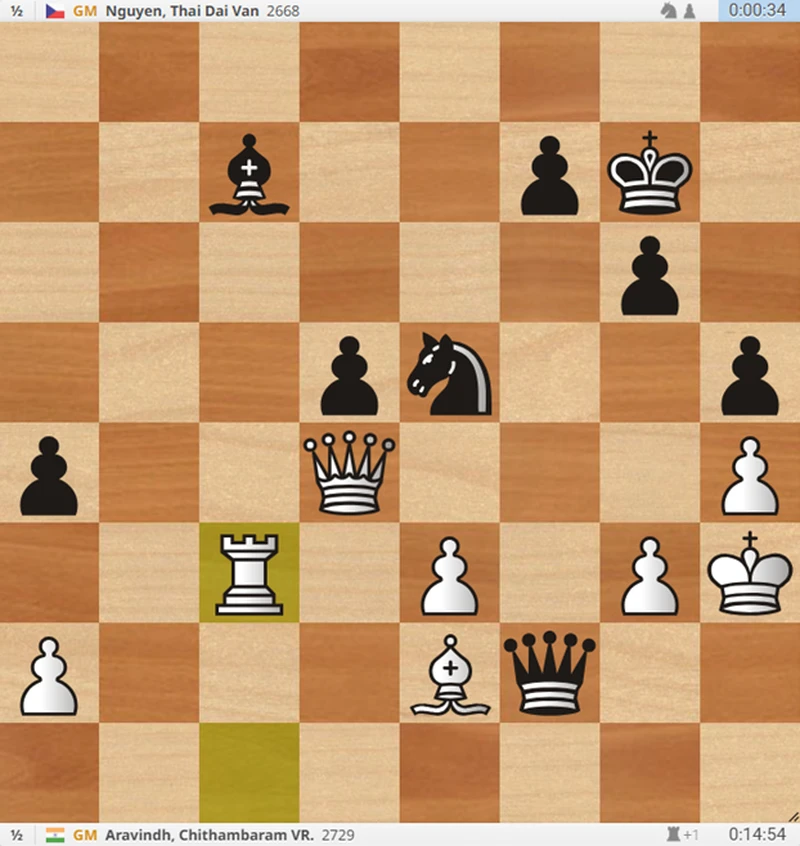
After 70.Rxc3, black needs to find a quiet move, but had only 30 seconds to do so. Van continued with 70..Qxe2, but after 71.Rxc7, he had no choice but to repeat moves. The decisive advantage would have been secured by the move 70..Bd6! White must cover several threats simultaneously – the bishop on e2 is hanging, and Kh7 is threatening with Ng4 to follow, creating a double threat of mate on g3 and h2.
Sam Shankland began his sixth Masters tournament with a convincing performance. Against the winner of last year's Challengers category Ediz Gurel, he prepared an aggressive variation in the London System.
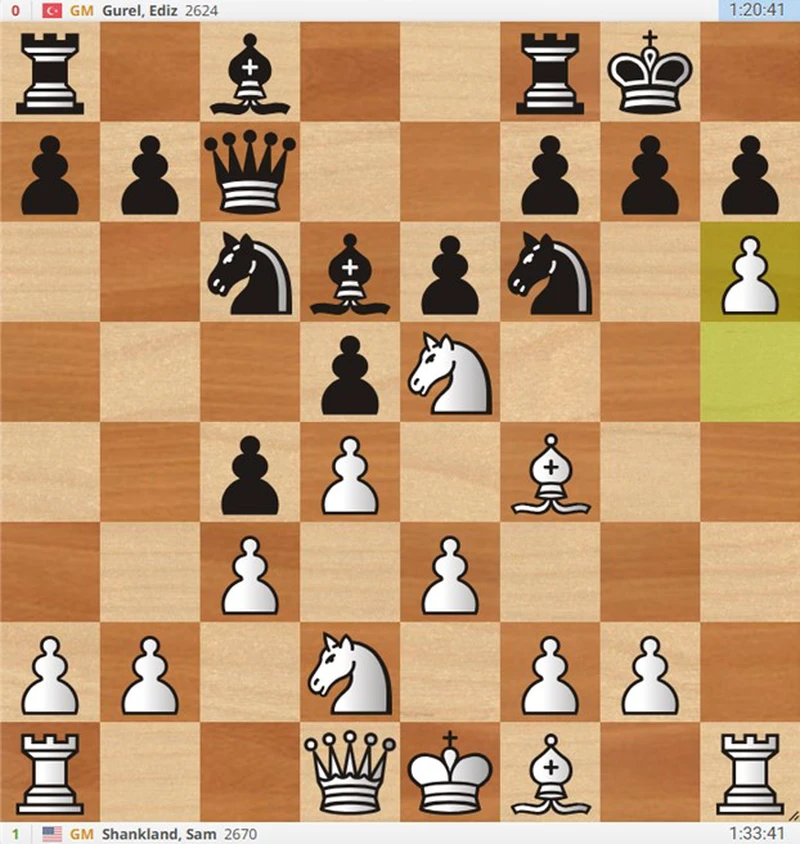
After just 10 moves, White's pawn had marched all the way to h6, where it restricted black's king throughout the entire game. Ediz Gurel defended well for a long time and objectively even managed to equalize the position, however, one poor move was enough for his position to quickly fall apart. In the resulting endgame with an extra piece, Shankland confidently found a way for his king to escape opponent‘s queen from perpetual check.
Anish Giri's opening didn't go as planned. However, in the following phase, he demonstrated his experience and managed to create counterplay on the opposite side of the board.
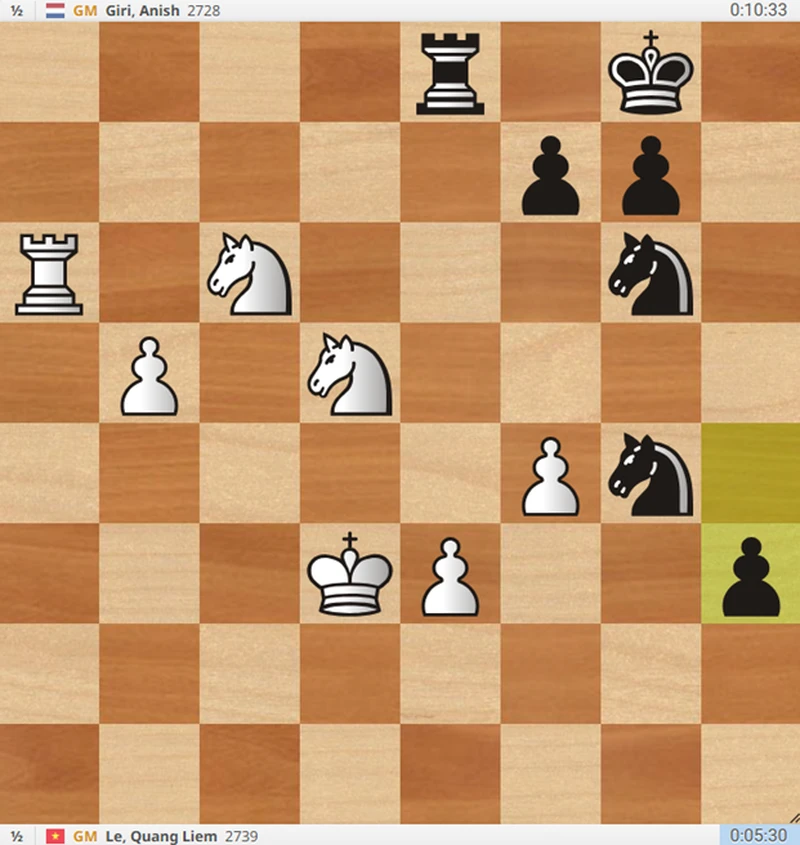
At the end of the game, a frenzied race of pawns toward the coveted last rank of the board ensued. To the commentators' disappointment, the most logical moves led to a forced draw. Both sides would promote to queens at the same moment, only to lose them immediately.
Being paired against Praggnanandhaa, the recent Tata Steel Masters winner, in the first round - and with the black pieces - would not be anyone's wish. This was the challenge David Navara had to face. His young opponent indeed started the game promisingly and gained slight but long-lasting pressure. However, Navara navigated the queenless position masterfully and managed to reach the well-known rook endgame 'three versus four'. From there, it was enough to demonstrate the knowledge the correct pawn structure, and the game soon ended in a draw.
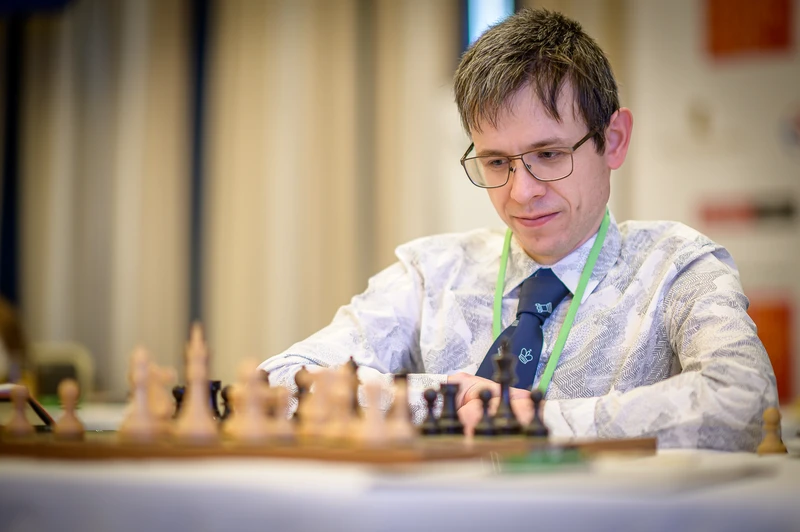
David Navara
Tournament top seed Wei Yi had to face Vincent Keymer's inventive play from the very first moves. In sharp complications, he demonstrated precise defense for a long time. The position transitioned into an endgame where he had to defend with an exchange down against two white rooks. Keymer's sustained pressure finally paid off when Wei Yi played an inaccurate bishop move on move 47. His minor pieces became awkwardly tangled in the center of the board. A few precise attacking moves were all it took for Vincent Keymer to win the game.
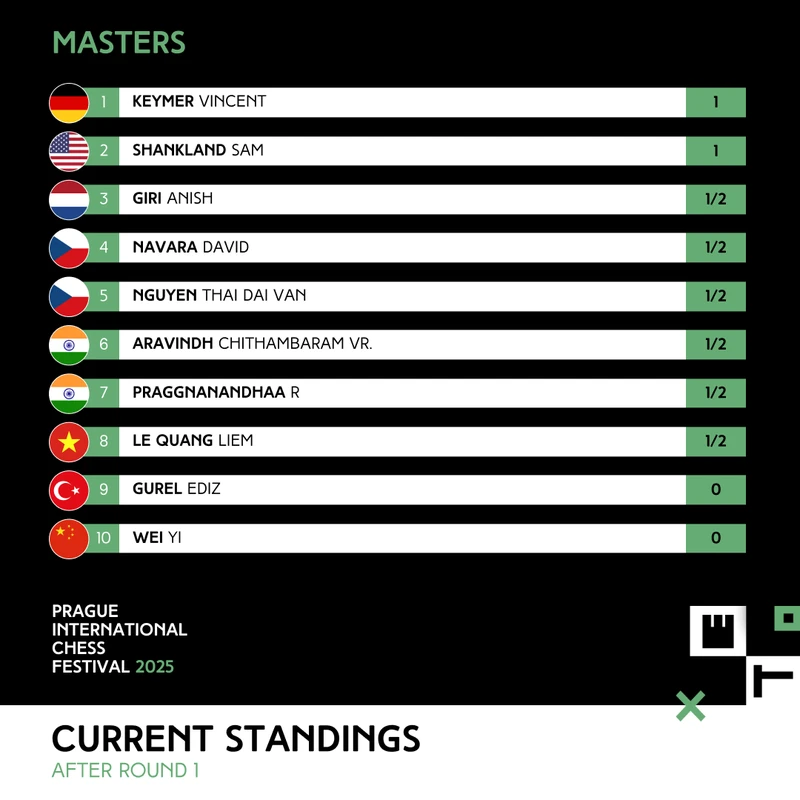
Challengers
Richard Stalmach had a successful opening game. His opponent was Marc'Andria Maurizzi, who recently shone with a victory at the Djerba Masters tournament with a 2900 performance rating! The very modern opening style with an early h5-h4 pawn advance caught Richard by surprise, and he had to invest time to avoid getting into trouble in the complications. Maurizzi tried to hastily capitalize on his time advantage but ended up in difficulties himself.
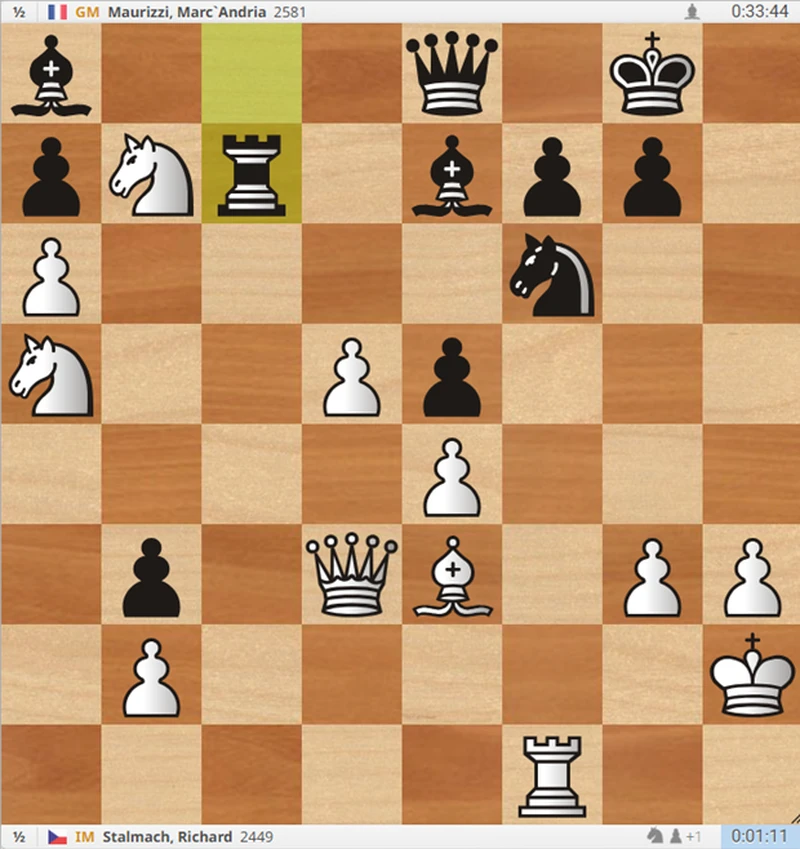
White's decision was affected by time pressure, and he played 33.Bxa7?, which allowed Black to save himself with the active 33..Rc2+ and Qa4! Instead, after 33.d6! or 33.Rc1, black would have had to fight for survival.
That chess games between humans can sometimes end in a clean draw without any mistakes or inaccuracies was demonstrated in the battle between Jáchym Němec and Václav Finěk. In the opening, Finěk surprised his opponent by choosing the Nimzo-Indian Defense. Němec therefore also deviated from his usual repertoire, however, both players were excellently prepared. Similarly perfect opening knowledge with the black pieces was demonstrated by Ma Qun against Nodirbek Yakubboev. In a sideline of the Tarrasch Defense, he precisely knew the complex critical variation and safely drew the game.
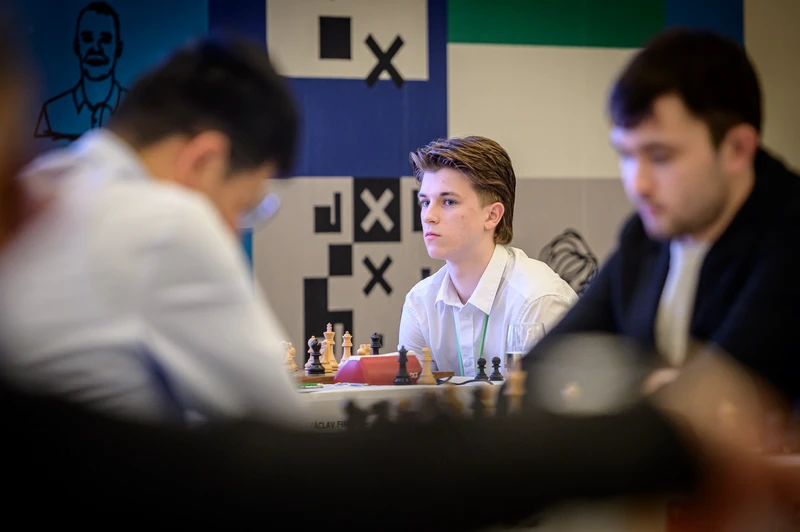
Jáchym Němec
Jonas Buhl Bjerre demonstrated excellent knowledge of the Najdorf Sicilian and quickly outplayed last year's open tournament winner Kourkoulos-Arditis.
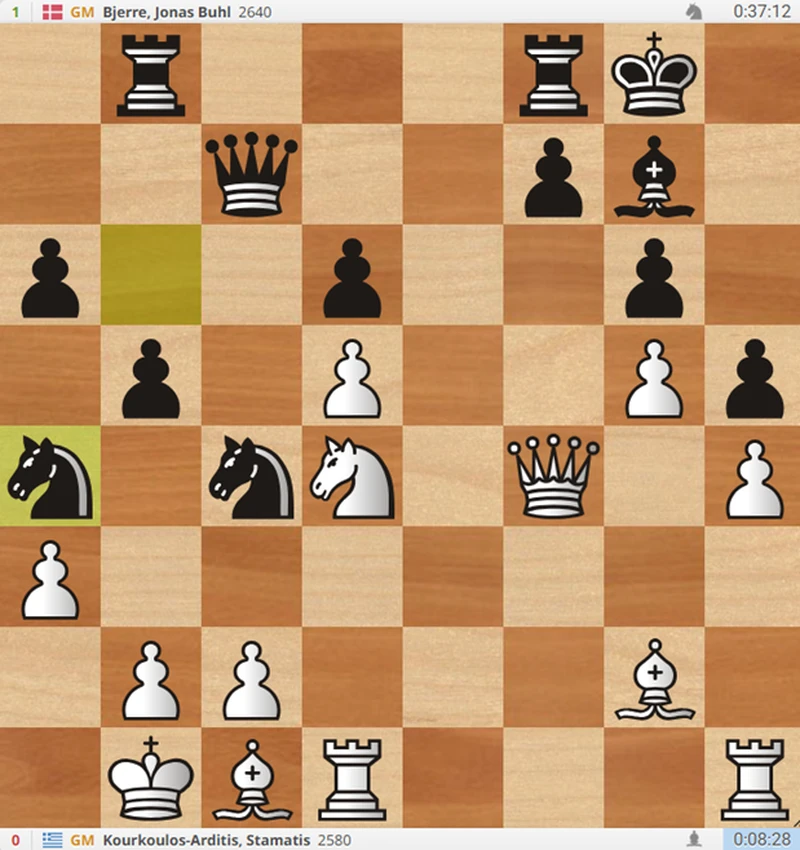
Although the material is equal on the board, white's position is hopeless. Five pieces are targeting his king, and several different sacrifices are possible. In the game, Kourkoulos-Arditis tried to involve his rook in the defense via h3. However, even this couldn't prevent further opening of the position after b5-b4, and he was forced to resign within a few moves.
The world's best junior female player, Divya Deshmukh, started her game against Ivan Salgado at a high level. During the transition from middlegame to endgame, Salgado demonstrated his years of experience and managed to better coordinate his pieces in the center of the board. He used his active position to secure an endgame with two pieces against a rook, which was already hopeless for the Indian player. After the first round, he joined Bjerre at the top of the current standings.
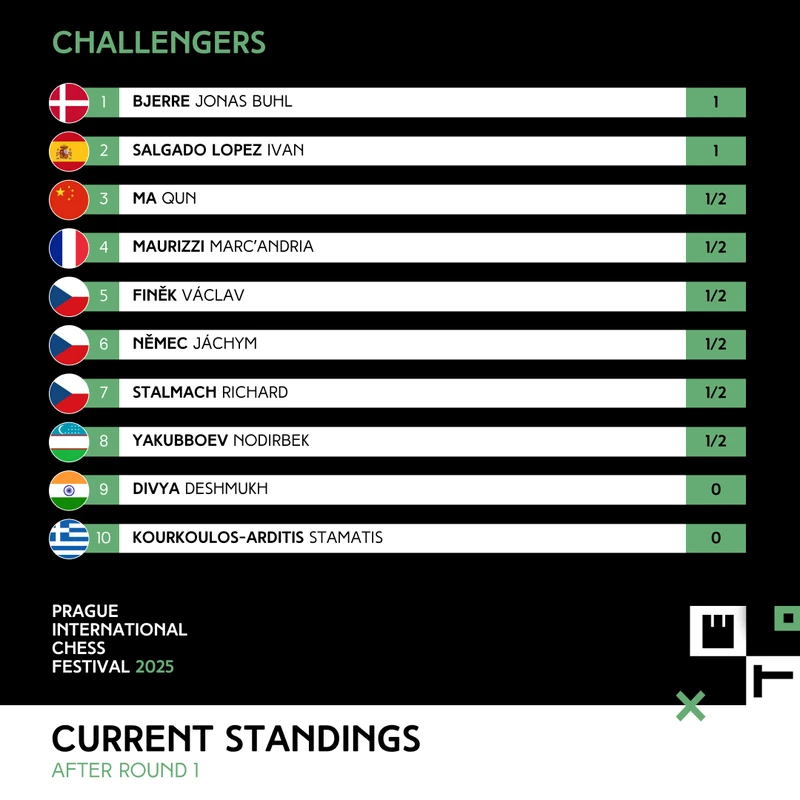
Official website: https://praguechessfestival.com/en/2025
Author: Richard Mládek
All photos by Petr Zewlakk Vrabec
You may also like
 BenjiPortheault
The War on Attention
I’m done consuming chess content Limouzi2024
The Petrosian Project - Introduction and a First King March
I am embarking on a journey to reach 2300 FIDE by adopting the subtle, prophylactic style of Tigran … ebk1976