
A complete analysis of a single tactic
In this blog I will go through all my thoughts during the process of solving a tactic. This is, let us be fair, not a particularly pleasent experience for any of the parties involved.The idea
Lately, I have been obsessed again with chess tactics. Not actually doing any of them of course... That’s way too stressful and confronting. Just the general idea is interesting, I realized. The objective (for a properly generated tactic) is to find the only available sequence of moves that leads to a substantial advantage. Easy enough right? The algorithm to follow is obvious: just look at every possible move sequence, and pick the best one, generally the only one leading to material advantage or mate. You don’t even need any knowledge about chess to be honest, technically. That’s why computers are so good at doing tactics.
So, why would we ever fail a tactic then? As long as we just calculate everything, nothing can go wrong. I guess we humans train ourselves to stop thinking after a while, to safe brain power and time. It goes like “this variation looks good, let’s just assume it’s winning”, which is a rather subjective criterion that probably works most of the time, but does lead to errors in more tricky situations.
Therefore, I have a plan. I want to solve a single tactic, fully work out all lines to conclusions I’m pretty confident about (as good as my abilities allow me), and then write down all my findings and thoughts. Just to see how complicated and long it really gets; how much there actually is to think about. The tactic-websites I know all have a little chat-box next to the board where you can communicate your amazing findings and (more often) your even more amazing blunders to other users. (Or use it to do some good old-fashioned cursing, or write a secret love letter, nobody really minds what you put there anyways.) But of course, this limited space is never enough to realistically grasp any of the real depth a position can hold.
I’m going to use an old favorite website of mine: chesstempo.com. It is free, it is simple to use and it is just doing what is promises to do: provide tactics. It works almost identically to Lichess’ puzzle feature, with the exception that you are actually expected to take your time, which Lichess users, for some weird reason, are less keen to do. An average time-to-solve above 10 minutes is quite common there. Also, the rating system is way more realistic. Here on Lichess, you just vaguely need to understand how the horsey moves and you’ll reach 3000 rating easily. Also, the website is 15 years old, so whenever you fail, you can always use your 2024-super-neural-network-nuclear-fusion-powered-computer to quarrel with other users that your solution is superior and the tactic is obviously flawed and sooooo 2009. Trust me, it’s fun.
The tactic
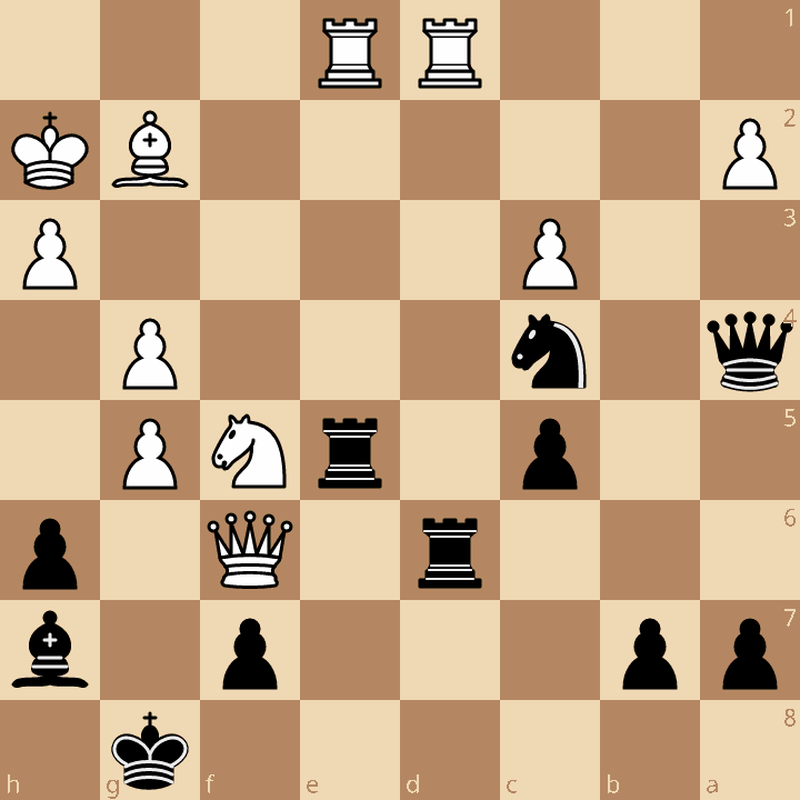
Here we go... This is the tactic I have solved. I just took the first one the computer presented to me. Give it a go if you want to try it for yourself. Black to play and win. It is rated 1880, to give some idea of difficulty. Average solve time is 4:59 and tactic ID is 68166857 on chesstempo as by 17 Sep 2024.
My thoughts and calculations
Alright, I made some notes during the thinking process, here follows a reconstruction. The upcoming text reads much easier with the position above in another tab next to it. [Warning: This part might get very dry and/or confusing]
“Oh dear, so many pieces hanging everywhere, this is a complete mess.” [Editors note: stop complaining now, will you!!!... You think that about basically all tactics. Start thinking for once, please. Life ain’t so bad.] “So, d1 is hanging twice, the queen on f6 hangs, the rooks on d6 and e5 are hanging. So, what’s wrong with just taking stuff? Taking d1 leads to mate on g7. Besides that, Nxh6 also is really problematic. What about taking the queen then? Rxf6 allows Rd8+, which happens to be mate, because the king has no escape square. Either piece blocking on e8 will just get captured into mate.
So, if these moves fail, how do we stop mate? Taking the knight on f5 should at least stop mate. Bxf5 possibly, or Rxf5 possibly. Rxf5 is a funny move, because it attacks the queen twice, and because both rooks are defended, the queen cannot take either of them, while she probably wants to find some safety. Also, e8 is defended by the queen, so there is no back rank mate, at least not immediately. Are there any other moves defending against mate? Kf8 technically, but that feels really bad. Qg7+ and white has initiative to make the next threat.
Wait a second, maybe I should take a look at the material balance before I continue. [count, count, count...] Seems equal. Just winning some material is enough to solve it. Also, I don’t have any checks available in the position. So I don’t have to worry about any in-between checks.
Were was I? Oh yeah, let’s exclude Kf8 first. So, Kf8 Qg7+ Rxe5+ Nxe5 Qxe5+ wins the rook, whites attack continues, more material will fall, it seems. No, Kf8 is terrible, probably there are thousands of other wins too. Let’s check one more time the Rxf6 line too. Nope, that’s just a simple mate after Rd8+. Nothing to further calculate there.
So, after Rxf5 white has no useful checks, so where does the Q go? Qd8+ sacrificing doesn’t work, I’ll just capture the queen and the king goes to g7. There is no mate there at all. I don’t see any other reasonable sacrifices with the queen. As mentioned, both rooks are defended.
Just a silent move then, Qe7. Having to make a silent move in this position doesn’t feel right, as black just took a piece already, and probably will continue to take stuff. In the spirit of taking stuff, let’s check the free piece Rxd1 first then. Rxd1 Qxd1. White only has one useful check. Qe8+ Kg7. Again, only one useful check. gxh6+ Kxh6. White may check again on f8, but the king starts running away. [One good look again...] Yes, worst case we run to f4. Maybe the bishop blocks on g6 one day. White has really lost quite a lot of material already, so even after taking the rook on f5, we are still a piece up. The king is open, but not in any danger. This should be an easy win for black then. So, to conclude, I think Rxf5 just wins.
Let’s check Bxf5 too, to exclude it. [Editors note: only one move (clearly) wins in chesstempo, so checking why other moves fail, is a fair solving strategy. Obviously, in a real game multiple lines could be winning.] The queen is attacked, so Rxd6 makes sense. I don’t see any other options. Hmm, first impression here is that it’s way more tricky for black. Taking back with Nxd6 allows Rxe5 and white is both up material and having an attack. That’s just 1-0.
So, perhaps we play Rxe1 in that case, taking material. White has such an initiative still. Rd8+ Re8 is not mate, but what about playing gxh6 first, threatening mate on g7? There’s almost no defense there. Does Kf8 survive? Wait a second, white isn’t even down so much material there. We can choose so many things. Rd8+ Re8 trading rooks. After that, take on f5 with either piece. Perhaps insert Qg7+. White isn’t even down any material there, and the h-pawn turns into a queen soon, after the bishop on f5 dies. No, no way this is the solution we are looking after.
One last check. Yeah, Rxf5 is really my only guess. I think the computer goes Qe7 Rxd1 Qe8+ queen trading. Qxe8 Rxe8+ Kg7 gxf5. A silly line just ending in a piece down.
[Plays Rxf5; is correct; computer plays gxf5] Wait, that’s also a possibility? Okay, what option do I have. Rxd1 just runs into the mate threat gxh6 we’ve seen before. This time even Kf8 doesn’t even delay mate. So just the obvious Rxf6, right? We excluded the computers reply because the queen was in danger, so this must have been our idea. Rd8+ check is nothing, the king just steps up.
[Plays Rxf6 computer replies gxf6; tactic ends.] Hmm. Glad I got the correct answer, but this position is tricky enough that I should have checked it. How do we defend mate? Bxf5 should just be it, simply. Not too difficult. But shame on me for missing this. Do we have any other defenses? Kh8 looks terrible after Rd8+ Bg8 Re8. Maybe Nd6 which you cannot take because of Qf4+. Feels really artificial, putting your own piece under attack and in a pin. Anyways, doesn’t matter, Bxf5 solves blacks problems easily.
[Solved in 18 minutes 28 seconds]
Things I missed
Checking with the engine afterwards, I don’t think I missed any essential lines. Only, as mentioned, the main line played by the computer I didn’t consider. Despite is being black-to-move whilst being up in material, the white threat is actually pretty menacing, so this position must be analyzed as well. But then again, the process of elimination worked very well here. The only real moves to consider at the start were Bxf5 and Rxf5, to prevent mate. Bxf5 was really bad, so Rxf5 is the only real candidate left. After that, the most difficult part was over, as Rxf6 was kinda the only move.
I missed some details is some lines, but nothing severe. It’s like mathematics: if you want to prove something doesn’t work, you only need one example. The line Bxf5 Rxd6 Rxe1 gxh6 just mates for white. You don’t need to go into an endgame. But in these positions, the winning endgame is plenty of reason to disregard the whole line. The line Rxf5 Qe7 Rxd1 Rxd1 Qxd1 Qe8+ Kg7 gxh6+ is slightly more dangerous than I gave it credit for. You cannot move to g6 with you king, because f5 falls with check. It’s one of these things you kinda see and kinda don’t see. Black has so many options with the king there, it just feels that one must be safe enough. Indeed, Kxh6 as running over the dark squares is fine.
By the way, the automatic retake on d1 is something I shouldn’t do. I don’t think I really checked other options carefully. I’m not too mad about this oversight, because I did check white doesn’t have any sensible checks (besides trading queens on e8), and then Rxd1 recapturing is really the only normal reply.
It took me a loooong time to solve, but I blame that on makes notes while calculating.
Conclusion
Well, that was fun. It’s funny how clear everything feels now. Just two moves: Bxf5 or Rxf5. Why did that take me 18 minutes? But fair enough, every line I had to check all kinds of moves. Most of them not even worth writing down here, but every detail has to be checked. Did you notice for example, that black has a check on h1 after we take on e1? I bet you didn’t. Of course, it’s a completely totally dumb move, but my brain considered it worth noticing, during that time.
Reading what I just wrote, I must admit it’s hard to follow. So many tiny details. Checking, double checking, just generally coming up with candidate moves. The calculation is more broad than deep, I would say, which comes as a slight surprise.
Perhaps I’ll try this again with a more difficult tactic. It might get interesting when I get stuck somehow. Or when I fail horribly.
You may also like
 WFM fla2021
Consequences of Not Applying the Opening Principles in Chess
In this post, I will show some positions where players ignored opening principles and the negative e… DaBassie
A mildly funny observation in the King’s Indian
Something about Be2 and Bd3. Admittedly, this is probably not the funniest thing you have ever read … WFM fla2021
Attacking the King When Both Are Castled on the Same Side
This post provides key strategies and considerations for successfully attacking your opponent's king… CM HGabor
Effective training methods - calculation training
A post about improving your calculation skills. DaBassie
Can I random walk myself to 2300?
Instead of relying on actual skill, I wondered whether random rating fluctuations are sufficient to … DaBassie