
Background picture: https://pixabay.com/illustrations/wood-texture-dark-black-wall-1759566/
Beating the Delayed London
A bizzare sideline, you probably didn't know of
This is the last post of 4 part the London Saga. In part 2, against the London System (1. d4 d5 2. Nf3 Nf6 3. Bf4) I recommended 3... c5, but White has a rare way of preventing this idea with 3. c3!?
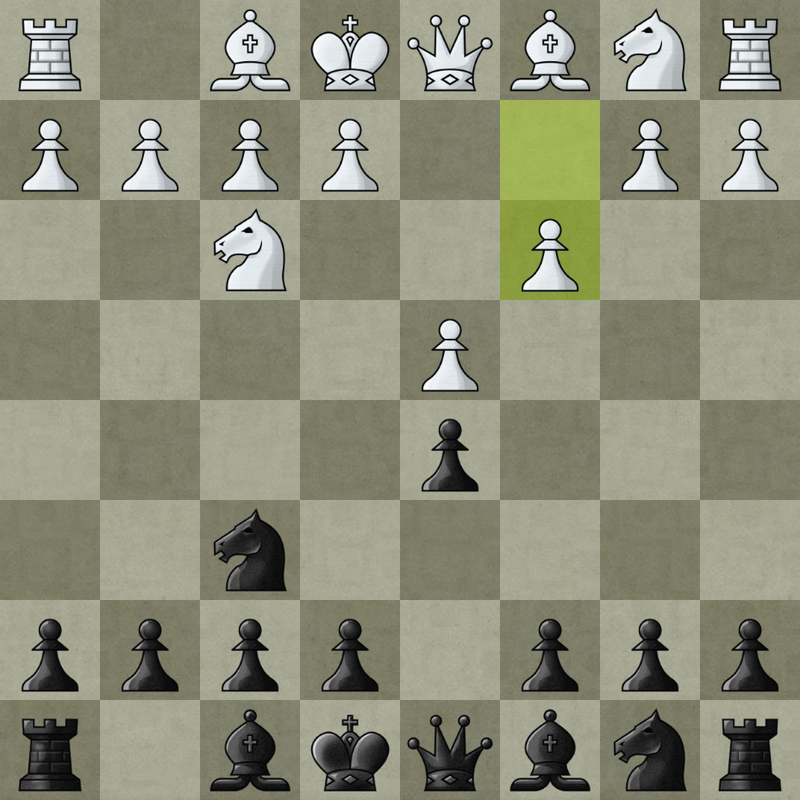
If we decide to play 3... c5, White intends to capture on c5, and hold onto the pawn with b4 or Be3, and we will have a hard time proving compensation. Even though 4. dxc5 doesn't happen as often as you'd expect, when it does, it's not very fun. So what are the other options?
Since White's last move didn't put any pressure on Black's position, and didn't create any threats, Black has a handful of moves to choose from:
- 3... e6 - engine's favourite. After 4. Bf4 it transposes to a normal London System and White accomplishes their goal of avoiding early c5. If you are comfortable there, nothing's wrong with e6
- 3... c6 is just boring, at best Black can get is a symmetrical London *yikes*
- 3... g6 might be worth exploring for you Catalan folks, just not my style.
- 3... Bf5 is an interesting concept, Black tries to use the fact, that White wasted a move, but a pretty common response 4. Qb3 gives White a very good score
- 3... Bg4 runs into the same issue, with White having an option to go Ne5 aswell.
So what's left? Since we can't get anything dynamic going in the traditional way, we have to get creative.
There are 3 interesting ideas I found:
- 3... h6 4. Bf4 g5 looks very promising, but White's bishop is safer on g3, and White can undermine this structure with h4-Ne5.
- 3... Qd6!? stopping Bf4, and after 4. g3 -> 5. Bf4 the point is to get the queen to b6 pressuring b2. Sadly, after most narutal Qb3, all we have is a symmetrical position.
- And then there is 3... Nc6. From my analysis, it's the only move that can quickly punish mindless, natural moves. We prepare Bf5 by giving ourself an option to guard b7 with the rook (after Qb3).
If allowed we want to get Ne4-g5-h5. This doesn't work all the time, but when it does, it works wonders. So let's look at theese wonders!
Otherwise, we will focus on a rare break in the London - e5, instead of the typical c5.
e3-Bd3-O-O (most popular moves)
After 6. Bd3, White can't put more pressure on the knight with 7. Nbd2, as the Bishop is undefended (due to 3. c3). This allows us to get the typical Jobava London attack rolling with 7... g5!
The point is pretty simple. If White goes back with 8. Bg3, we play 8... h5, and White is in big trouble. However, White has a resource 8. Bxe4! followed by Nxg5 seemingly winning a pawn. Well... it's not that simple. But first let's look what happens if the bishop moves.
8. Bg3
This move barely doesn't lose. White must find an only move (played about 10% times) to not be lost, but even then, Black is significantly better
Even if White finds 9. Ne5! Black has a clear development with g5-Bh6 and Qe7-O-O-O, with an attack soon to follow. Otherwise, if White goes for something like 9. h3 or 9. h4, OPEN THE KINGSIDE, doubled pawns after 10. Nxg3 are the least of White's concern.
But g3 isn't the only square White can retreat the bishop to.
8. Be5
Whilst rare, it has an interesting point behind it.
On one hand, the pawn on f6 disconects our bishop and queen from h4, so 10... gxh4 isn't as effective. On the other hand, it reinforces g5, meaning we don't have to rush with the trades, and can continue developing. If you don't rush, this position plays itself.
Now let's look at the trickiest White's reponse 8. Bxe4!
8. Bxe4
White accepts the pawn sacrifice, and we will have to prove why we played g5 in the first place.
This is a very unhuman idea of restricting White's pieces, and it's very difficult to play against. It's a weird zugzwang attempt, where despite Black being down a pawn, and having doubled isolated pawns on the e-file, White can't finnish development, as Black can prevent c4-Nc3 with Na5-b5.
The position is very rare, but fun to analyze. Who knows, maybe one day I'll get something like this in a random online blitz game at 2:44 AM.
But that wraps up the fun part. If your opponent has any experience against the Jobava London, they should realize, that stopping Ne4 is their priority.
e3-Nbd2 with Ne5
More experienced players will prevent any Ne4 ideas with Nbd2, intending on capturing on e4, which isn't ideal for us. That doesn't mean White can't go wrong. Typical Ne5, if played to early, causes more harm than good.
We play Nxe5/Bxe5-Nd7 with big pressure on the weak e5 pawn.
Instant Ne5
Worst case scenario for White.
I tried to cover every way White can defend the pawn, and I hope I didn't miss any. This is the easiest move to play against, since the weakness is very clear, and difficult to defend with White. Even if you don't manage to in a pawn instantly, you are always better, and can focus on queenside advance.
Bg3-Ne5
Delaying Ne5 lets White play f4 without giving up the bishop. But these positions always favor Black, it isn't scary.
With how many possible mistakes there are for White, I think Ng4 is a better move, as the worst case is we get an equal position. The line is very forced, the threats very clear, so it's easy to understand and remember.
If White wants to play Ne5, they should delay it even further, play it only when we are threatning to go e5.
Last chance Ne5
Now this is slightly annoying, we spent two moves preparing e5 (O-O-Re8), and White says no. They accept, the worse structure for the time they got, a bishop pair, and more space on the kingside.
And they are sort of right. At least from engine's point of view, but I did my best to explain the unique position, and the plans to you, as the position isn't very easy to handle for either side.
The easiest (and I think the best) setup here is a5-a4-Nc5-Ne7-c6-h6. It's pretty systematic, Black holds on to the light-squares for dear life, and targets the b2 pawn. Typical ideas are
- Hiding the bishop on h7, or getting it to e4/d3 instead (supported by the knight)
- Qb6 attacking the b2 pawn
- Nd3/Ne4 targeting a weakness, if one is created (b2, c3, White's DSB on f2/g3)
Of course, I can't explain such a complicated position in few bullet points, but I tried my best to show you (and myself) the key ideas and squares (e4 and d3) in the position.
Lastly, it's time to see what happens, if White decides against Ne5, and let's us break the centre open.
Succesful e5 break
If we get to play e5, we get a very familiar structure, that can arrise from Rubinstein French, Caro-Kann, or the Scandi. But with reverse colors, How bad can it be?
Im nowhere near being knowledgeable, or experienced enough to teach you about the strategical intricacies of this pawn structure, but I'm sure with some research you can find great resources on this.
Just play your game, and don't blunder a pawn ;) (probably without the queenside pawns, the position is still holdable for black, so don't worry that much).
The end of London studies
Finally! Honestly, it felt more like an obligation, than a fun hobby. Don't get me wrong, I enjoyed finding and analysing these ideas. But getting myself to do that wasn't fun. In some previous blogs (I think even in part 1) I stated, that I want to make a 4-part series on the London. In the meantime I found so many other ideas I wanted to work on instead, but I felt like I can't, I must do this instead. And I didn't always want to. So I was stuck not doing what I want, because it's not what I should, and not doing what I should, because it's not what I want.
But it's over now. And I'm proud. Mostly proud of the Jobava lines, as I've seen GM Olekandr Bortnyk and GM Naroditsky (yk, the guys with a course on the Jobava, speed chess gods) blunder in my lines multiple times.
These studies made me feel really confident against 1. d4. I want to cover Bg5 openings in the near future, so I'll be prepared against every d4 sideline and this is the last one left. But I'm not guaranteeing anything.
And if you have an opening you are struggling against (and are a tactical player), message me, I can share some ideas with you, and if I don't have any (yet) and your repertoire aligns with mine, I will find something ;) (I always do :p)
Btw I compiled everything London related to one megastudy. Sadly lichess didn't put it on the front page :(
I think that's all I wanted to say. Thank you for reading, and I really hope you will add some of these lines into your own opening book.
Cya ;*
You may also like
 CkickyCheck
There Are No Good Anti-Scandinavians
You must accept the Scandi! CkickyCheck
I Will Never Again Play a Move as Beautiful as This
A real game position, that could be a puzzle instead CkickyCheck
"Define tactical mess"
A perfect game of chess always ends in a draw... right? CkickyCheck
Beating the Accelerated London
Another weird line, this time for the Black pieces. Very dynamic, and punishes natural moves. ChessMonitor_Stats
Where do Grandmasters play Chess? - Lichess vs. Chess.com
This is the first large-scale analysis of Grandmaster activity across Chess.com and Lichess from 200… CM HGabor