
How Do FIDE Ratings Work? A Comprehensive Guide
We’ll dive deep into how FIDE ratings work, their significance, and how you can improve your rating over time.Chess is a game of strategy, intellect, and precision. For many players, the ultimate measure of their skill and progress is their FIDE rating. The Fédération Internationale des Échecs (FIDE), the international governing body of chess, assigns ratings to players based on their performance in official tournaments. These ratings are not just numbers; they are a reflection of a player's strength, consistency, and competitive ability.
What is a FIDE Rating?
A FIDE rating is a numerical representation of a chess player's strength, calculated based on their performance in FIDE-rated tournaments. The higher the rating, the stronger the player. The system was introduced by Professor Arpad Elo in the 1960s and is often referred to as the Elo rating system. FIDE adopted this system to standardize the measurement of chess players' abilities worldwide.
Ratings typically range from around 1000 for beginners to over 2800 for the world's elite players. For context, a rating of 1200-1400 is considered intermediate, while 2000+ is the mark of a strong club player or master.
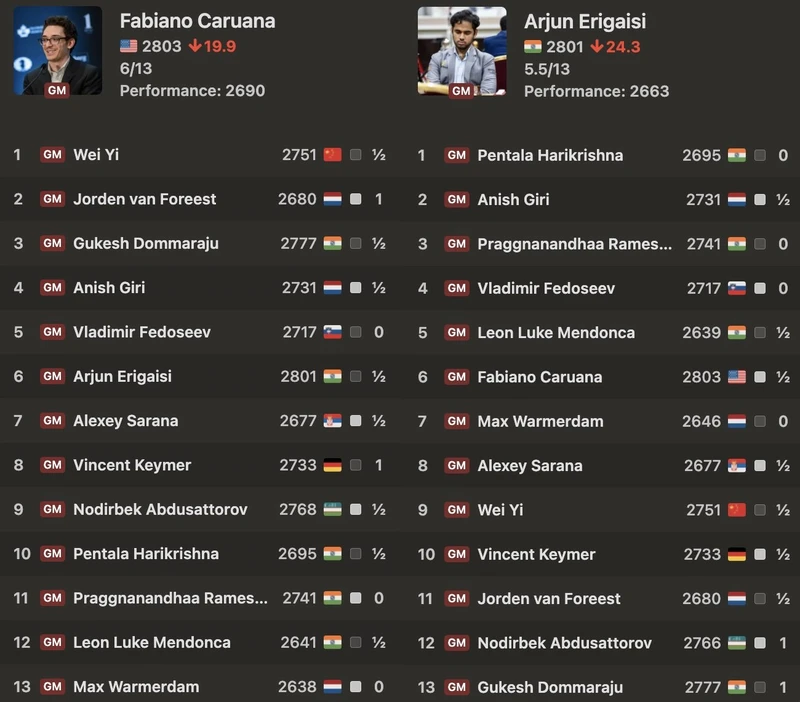
(Photo courtesy: Chess.com)
How Are FIDE Ratings Calculated?
The FIDE rating system is based on a mathematical formula that adjusts a player's rating after each game. Here’s a step-by-step breakdown of how it works:
1. Initial Rating
- New players start with a provisional rating after playing a minimum of 5 games in FIDE-rated tournaments. This rating is calculated based on their performance against rated opponents.
- Once a player completes at least 9 games, they receive an established rating.
2. Rating Difference and Expected Score
- The system compares the ratings of two opponents before a game. The difference in their ratings determines the expected score for each player.
- For example, if Player A has a rating of 1800 and Player B has a rating of 1600, Player A is expected to score more points (e.g., 0.76) than Player B (e.g., 0.24).
3. K-Factor
- The K-factor is a multiplier that determines how much a player's rating changes after a game. It varies based on a player's experience and rating:
- K=40 for new players (until they complete 30 games).
- K=20 for players with established ratings below 2400.
- K=10 for players with ratings above 2400.
- A higher K-factor means larger rating changes, allowing new players to improve their ratings quickly.
4. Rating Change Formula
- After each game, the player's rating is updated using the following formula:
New Rating=Old Rating+K×(Actual Score−Expected Score)New Rating=Old Rating+K×(Actual Score−Expected Score) - For example, if Player A (1800) wins against Player B (1600), their actual score is 1, and their expected score is 0.76. With a K-factor of 20, the rating change would be:
1800+20×(1−0.76)=1800+4.8=1804.81800+20×(1−0.76)=1800+4.8=1804.8 - Player A’s new rating would be rounded to 1805.
5. Performance Rating
- In tournaments, a player’s performance rating is calculated based on their results against all opponents. This is a useful metric to gauge how well a player performed relative to their current rating.
Key Factors Affecting FIDE Ratings
- Strength of Opponents
- Beating higher-rated opponents results in larger rating gains, while losing to lower-rated opponents leads to significant rating drops.
- Consistency
- Consistent performance against similarly rated players helps maintain or gradually improve a rating.
- Tournament Frequency
- Playing regularly in FIDE-rated tournaments ensures that your rating reflects your current strength.
- Rating Floor
- FIDE has a minimum rating floor (currently 1400), meaning your rating cannot drop below this threshold.
Why Are FIDE Ratings Important?
- Measuring Progress
- FIDE ratings provide an objective measure of a player’s improvement over time.
- Tournament Eligibility
- Many prestigious tournaments require a minimum FIDE rating for participation.
- Title Norms
- Achieving certain rating milestones is a prerequisite for earning FIDE titles like Candidate Master (CM), FIDE Master (FM), International Master (IM), and Grandmaster (GM).
- Global Recognition
- A FIDE rating is recognized worldwide, making it easier for players to compete internationally.
Tips to Improve Your FIDE Rating
- Study and Practice
- Regularly analyze your games, work on your openings, and solve tactical puzzles. Consider enrolling in a chess academy like the Caissa School of Chess to receive structured training.
- Play Stronger Opponents
- Competing against higher-rated players can accelerate your rating growth, provided you perform well.
- Participate in Rated Tournaments
- The more you play, the more opportunities you have to improve your rating.
- Stay Consistent
- Focus on maintaining a steady performance rather than chasing quick rating gains.
- Learn from Losses
- Analyze your losses to identify weaknesses and avoid repeating mistakes.
Common Misconceptions About FIDE Ratings
- Ratings Are Static
- Ratings are dynamic and change after every rated game. A single tournament can significantly impact your rating.
- Higher Ratings Mean Better Players
- While higher ratings generally indicate stronger players, they don’t account for factors like creativity, intuition, or psychological resilience.
- Ratings Are Only for Professionals
- Players of all levels, including amateurs, can obtain a FIDE rating by participating in rated tournaments.
FIDE Titles and Ratings
FIDE awards titles based on a combination of rating and performance norms. Here’s a quick overview:
- Candidate Master (CM): Requires a rating of at least 2200.
- FIDE Master (FM): Requires a rating of at least 2300.
- International Master (IM): Requires a rating of at least 2400 and three IM norms.
- Grandmaster (GM): Requires a rating of at least 2500 and three GM norms.
Achieving these titles is a dream for many chess players and requires dedication, hard work, and strategic planning.
How Caissa School of Chess Can Help You
If you’re serious about improving your chess skills and boosting your FIDE rating, the Caissa School of Chess is an excellent resource. With experienced coaches, personalized training programs, and a focus on both tactical and strategic development, Caissa provides the tools you need to succeed. Whether you’re a beginner aiming for your first rating or an advanced player chasing a title, Caissa’s comprehensive approach can help you achieve your goals.

FIDE ratings are more than just numbers; they are a testament to a player’s dedication, skill, and growth in the world of chess. Understanding how the rating system works can help you set realistic goals, track your progress, and ultimately become a stronger player. Remember, improving your rating is a journey that requires patience, practice, and perseverance. So, keep playing, keep learning, and who knows? You might just earn that coveted FIDE title someday.
For those looking to take their game to the next level, don’t forget to explore the resources and training programs offered by the Caissa School of Chess. Happy playing!
Website: https://circlechess.com/
Copyright Disclaimer:
The images used in this blog are for illustrative and educational purposes only. All visual content is copyrighted to its respective owners, and proper credit has been given to the original sources wherever applicable. If you are the owner of any image and believe its use on this blog infringes upon your copyright, be sure to get in touch with us immediately, and we will promptly address the issue by either providing additional credit or removing the image. We do not intend to violate any intellectual property rights and strive to respect the creative works of others.
You may also like
 CircleChessTeam
Inside Michal Mazurkiewicz's World Record: 16 Chess Games While Diving 700 Times
Chess has been played on mountaintops, in zero gravity, and even by mail - but nothing compares to t… GM Avetik_ChessMood
The Right (and Wrong) Way to Build Your Opening Repertoire
Here’s how to build your opening repertoire smartly and avoid 5 common mistakes. FM CheckRaiseMate
What Good Opening Prep Really Looks Like
There are no prizes for memorizing random moves CircleChessTeam
Chess and Intelligence: How Playing Chess Can Boost Cognitive Abilities
This blog delves into the fascinating findings of a research paper titled "Intelligence and Chess" b… CyberShredder
How to improve at Chess960 ?
How many books should you read? CircleChessTeam