
The Queen's Pawn Opening: The Solid Strategic Foundation in Chess
Opening Insights: Chess Openings Series
Hi, it's me Jason!
Yesterday, I talked about The King's pawn Opening, today, Let's talk about The Queen's Pawn Opening.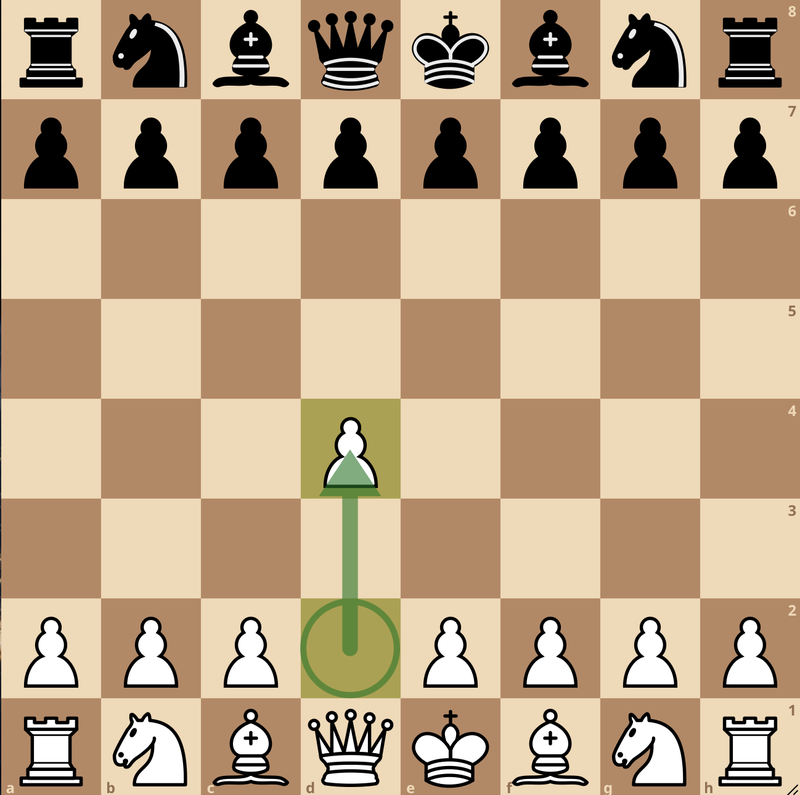
Thanks @tpr very much!!! He(She) gave me so many good advice!
@You all please give me more and more suggestions, and make my blog better. Thanks!
@tpr The picture is created by AI, I can't change it, but thank you, and please find out more wrong place.
One of the most popular openings, the Queen’s Pawn Game (1. d4) aims to control the center, opening up lines for the dark squared bishop and putting a pawn on the queenside, instead of the kingside as seen in the King’s Pawn Game. The move discourages 1... e5 and 1... Nc6 which could otherwise be seen from the King’s Pawn Game.
The Queen’s Pawn Game can branch out in a variety of ways, including 1... d5, 1... Nf6, 1... e6, or 1... f5, typically sending games in more aggressive and strategic directions. For instance, the Grünfeld Defense initially concedes the center, giving rise to imbalance positions where both sides aim to fight for a win. On the other hand, openings such as the Triangle Slav attempt to mount an impenetrable defense against any of white’s potential advances, also leading to sharp fighting games.
For white, there are also many plans, including some system style approaches, including the London System (2. Bf4), or approaches that seek to fight for the center, namely 2. c4.
Definition and Core Characteristics of the Queen's Pawn Opening
Basic Definition
The Queen's Pawn Opening specifically refers to the opening system where White starts with 1.d4. It is one of the two major mainstream openings in chess, alongside the King's Pawn Opening (1.e4). The term "Queen's Pawn" in the name comes from the fact that the d - pawn is in front of the original position of the "Queen". It is an indirect means for White to control the center (as opposed to 1.e4 which directly occupies the e4 - square).
Core Objectives
Control Center:
After 1.d4, White directly controls the e5 square and indirectly influences the c5 square, paving the way for building a central advantage in the subsequent moves through c4 (expanding the queenside) and e3/e4 (consolidating the center).
Coordinated Development of Pieces:
In the Queen's Pawn Opening, one usually doesn't rush to open the center. Instead, through moves like Nf3, Bf4, and Nc3, the pieces are gradually mobilized, forming a rhythm of "pieces first, center later".
Strategic Flexibility:
White can choose different systems (closed center, semi - open center, or open center) according to Black's response, adapting to players of different styles.
Historical Evolution: From the Margins to the Mainstream
The popularity of the Queen's Pawn Opening came later than that of the King's Pawn Opening. However, towards the end of the 19th century, it gradually became the mainstream in top - tier tournaments. Its development was closely related to the contributions of several legendary chess players:
Early Exploration:
Before the 19th century, chess players preferred the open tactics of 1.e4. However, players like Paul Morphy had already started to experiment with 1.d4, demonstrating its strategic potential.
Theoretical Foundation:
The first world champion, Wilhelm Steinitz, systematically studied the central control theory of the Queen's Pawn Opening and put forward the view that "in a closed position, the pawn structure takes precedence over the activity of pieces."
The Golden Age:
In the early 20th century, José Capablanca pushed the endgame techniques of the Queen's Pawn Opening to the peak with his masterful application of the Symmetrical Defense (1.d4 d5). Subsequently, Mikhail Botvinnik enriched the competitiveness of the Queen's Pawn system through his innovation of the King's Indian Defense.
Modern Development: Players such as Bobby Fischer and Garry Kasparov combined the Queen's Pawn Opening with complex tactics, making it both stable and aggressive, and turning it into an "evergreen" in contemporary competitions.
The core characteristics of the Queen's Pawn Opening (compared with the King's Pawn Opening)
| dimensionality | Queen's Pawn Opening (1.d4) | The King's Pawn Opening (1.e4) |
|---|---|---|
| Nature of the center | Mostly closed or semi - closed centers (d5/e6 or d6/e5 structures) | Mostly open or semi-open centers (e5/d6 or e6/d5 structures) |
| The proportion of tactics and strategy | Strategic dominance (pawn structure, space, piece coordination) | Tactics-dominated (open lines, piece conflicts, pawn sacrifice attacks) |
| Complexity of the position | The long - term strategy is complex, while the short - term tactics are relatively mild. | The short - term tactics are intense, and the situation changes rapidly. |
| Relevance of the endgame | The opening choice directly affects the direction of the endgame. | The endgame has a relatively weak connection with the opening. |
| Applicable styles | Patient, strategic players with strong endgame skills | Aggressive, tactical, and strong - calculating chess players |
The main variations of the Queen's Pawn Opening (classified according to Black's responses)
Black has a wide variety of choices in response to 1.d4. Different responses reflect different strategic ideas. The following are several of the most mainstream systems:
Symmetrical Defense: 1.d4 d5 (Black mirrors White's move, closing the center)
Black chooses 1...d5, forming a symmetrical central structure (where the d-pawns of both sides face each other). The goal is to offset White's first-move advantage by equally controlling the center. White's common responses and branches are as follows:
(1) Queen's Gambit: 2.c4 (White actively opens the queenside)
White plays 2.c4, intending to challenge Black's d5-pawn with the c4-pawn. It is one of the most aggressive branches in the Queen's Gambit. Black has three core responses:
- Accept the Queen's Gambit:
2...dxc4 (Black temporarily accepts the c4-pawn, seeking a central counterattack) White can then regain the c4-pawn through 3.e3 (preparing to recapture the pawn with Bxc4) or 3.Qa4+ (tactical pinning). The position enters a semi-open center. White has an extra pawn but needs to guard against Black's central counterattack (such as...e5 breakthrough). - Slav Defense:
2...c6 (Black consolidates the d5-pawn, retaining the option of...dxc4) Black supports the d5-pawn with 2...c6, avoiding opening the center too early. White's common continuations are 3.Nf3 Nf6 4.Nc3, and both sides fight for control of d5 and c4. The position is closed and has great strategic depth. - Classical Defense:
2...e6 (Black prepares to support the d5-pawn with e6 and develop the kingside bishop) After Black plays 2...e6, White can choose 3.Nc3 (a classic continuation) or 3.Nf3. Subsequently, it may transition into the "Cambridge Springs Defense" (Black pins with...Nf6 and...Bb4) or the "Tarrasch Defense" (Black actively plays...c5 to break the symmetry).
(2) Classical Defense: 2.Nf3 (White develops pieces first, maintaining central flexibility)
White's 2.Nf3 avoids defining the center too early. Black's common continuation is 2...Nf6 (mirror development), forming a "symmetrical development" position. Subsequently, White can play 3.c4 (transitioning into the Queen's Gambit system), 3.e3 (closing the center, developing steadily), or 3.Bf4 (activating the light-squared bishop, controlling e5).
Indian Defense System:
1.d4 Nf6 (Black moves the knight first, responding flexibly) Black's 1...Nf6 is one of the most popular responses. By moving the knight, it indirectly challenges White's d4 pawn (threatening...e5 counter - attack) while retaining various central layout options. White usually responds with 2.c4 (expanding the queenside), forming the core structure of the "Indian Defense". Black's subsequent choices determine the specific branches:
(1) King's Indian Defense: 2...g6 (Black fianchettoes on the kingside, controlling the center)
After Black plays 2...g6, the plan is 3...Bg7 (developing the kingside bishop) and 4...d6, constructing the "King's Indian pawn structure" (d6 + e5). White's common continuation is 3.Nc3 0 - 0 4.e4, forming the "Classical Variation" - White builds an advantage in the center with e4 + d4, while Black counter - attacks on the queenside with...c5 or breaks through in the center with...e5. The position is full of offensive and defensive tension and is a favorite of attacking players like Kasparov.
(2) Neo - Indian Defense: 2...e6 (Black balances the kingside and queenside) After Black plays 2...e6, it prepares 3...b6 (developing the queenside bishop) or 3...d5 (transforming into a closed center).
After White plays 3.Nc3, Black plays 4...Bb4 to form the "Benoni Variation", restricting White's central expansion by pinning Nc3; or 3...Be7 leads to the "Orthodox Neo - Indian", where both sides develop their pieces slowly, with the focus on central control.
(3) Benko Defense: 2...c5 (Black counter - attacks on the queenside, sacrificing a pawn to seize the initiative)
Black's 2...c5 is an aggressive choice. By sacrificing a pawn with 3...cxd4, it gains a pawn advantage on the queenside and opens lines. After White accepts the pawn sacrifice with 3.d5, Black plays 3...e6 4.dxe6 fxe6. White's central pawn structure is broken but its pieces are active, while Black has queenside space and control of the e5 square, resulting in intense tactical conflicts.
Strategic and Tactical Themes of the Queen's Pawn Opening
The core charm of the Queen's Pawn Opening lies in its strategic diversity. The following are the key ideas to master:
- The Struggle for Central Control:
White expands the center through e4 and c4, while Black counterattacks with...e5 and...c5. "Whoever breaks through in the center first" often determines the direction of the situation. - The Advantages and Disadvantages of Pawn Structures:
Common pawn structures such as the "isolated d-pawn" (White's d4 pawn has no adjacent pawn support), the "hanging pawns" (c4 + d4 isolated), or the "doubled pawns" (e4 + e5) directly affect the scope of piece activity. One should prioritize avoiding one's own weaknesses. - The Efficiency of Piece Mobilization:
The development of the queenside bishop (bishop on c1) (through b3 or e2), the position of the kingside knight (knight on f3) (controlling e5 or g5), and the activity of the queen (avoiding premature development) are crucial. Black, on the other hand, needs to pay attention to the development of the kingside bishop (especially in the Indian Defense). - Typical Tactical Means:
Although it is mainly strategic, there are classic tactics such as the "central pawn breakthrough" (e4 - e5 or c4 - c5), the "pinning of pieces" (Bc1 - b2 pinning Black's d6 pawn), and the "pawn maneuver" (opening lines through a3/b4 or h3/g4), etc.
Summary
The Queen's Pawn Opening (1.d4) is the epitome of the strategic art of chess. It doesn't pursue the flashy tactics of an immediate opening kill. Instead, it accumulates advantages through patient piece mobilization, precise pawn structure control, and long - term strategic planning. Whether it's beginners learning the center theory or advanced players honing their strategic thinking, the Queen's Pawn Opening is an essential part of study. Mastering its core variations and strategic logic can not only improve practical results but also provide a profound understanding of the essence of "slow chess" in chess - strategic victories often stem from accurate judgment of the situation at every step.
Okay, that is all!
Looking forward to my next blog.
The next: Zukertort Opening


