Writing Lichess Opening Pages
We would like to document all named openings with a text description. If you are here, you are probably interested in helping out and writing some original content for Lichess!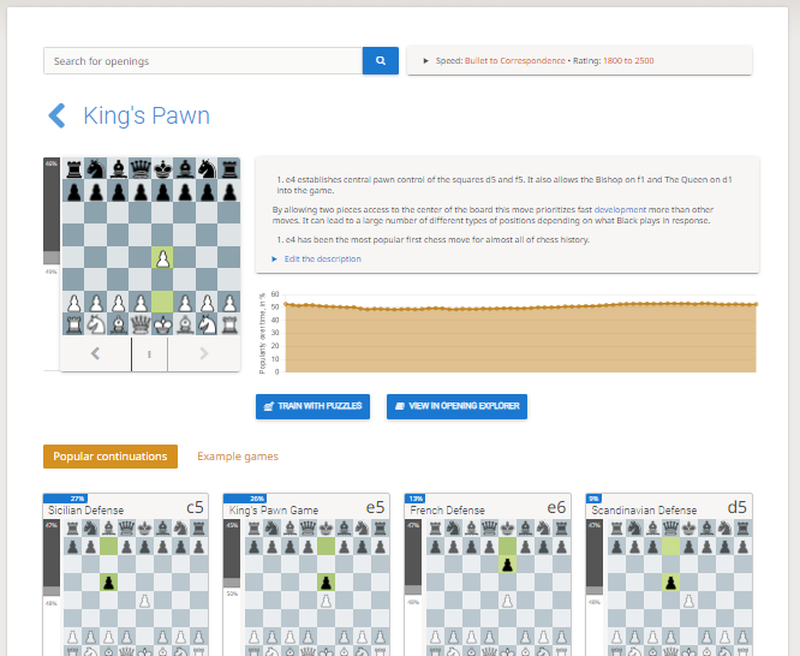
Style
In order to better serve readers, we want to have some consistent rules about how descriptions are written. We’d like the writing to be informative, but also interesting and fun to read if possible. Don’t hesitate to try to be creative when possible, instead of just reciting facts.
Lichess Opening Pages will be used mostly by lower-rated players, thus the explanations should be kept at that level. All text should accomplish the following 4 tasks in this precise order. Our first goal is to complete all pages that make up at least 0.01% of the database.
- What the move does, very concretely. Maximum of 2 or 3 sentences with no long variations. Include pieces attacked or defended and basic strategic goals like central control, castling, and development.
- Move order issues. One opening is now impossible but we could still get different one.
- What type of opening is this? Sharp or strategic? Aggressive or solid? Theoretical or unusual?
- History and other interesting facts about the opening. More appropriate for “keystone pages.”
It may be appropriate to skip one of steps 2-4, but please keep them in the proper order. For example, sometimes there is only one reasonable move in a position, so talking about move order issues wouldn’t make much sense. Sometimes a move is more of a “move order” and less of an opening, that is to say the “type” of opening is far from decided and other things are more relevant. An example of this would be 1.d4 e6, which can lead to lots of different openings so it makes no sense to talk about “what sort of opening is this.”
Different Move Orders
A comment may or may not make sense depending on what move order is used to reach a position. For example, after 1. e4 e5 2. Nc3 Nf6 3. Nf3 Nc6 you may write “Black defends their pawn from attack,” however that position can also be reached by 1. e4 e5 2. Nf3 Nc6 3. Nc3 Nf6, and in that case the comment would make no sense with the final move 3...Nf6. Fortunately Lichess is able to deal with this problem.
Users reaching that position from different move orders will go to slightly different URLs.
In this case it would be
https://lichess.org/opening/Four_Knights_Game/e4_e5_Nc3_Nf6_Nf3_Nc6
and
https://lichess.org/opening/Four_Knights_Game/e4_e5_Nf3_Nc6_Nc3_Nf6
You will only write one piece of text for the position, but you can choose to hide or show certain parts of it to different users depending on which move order they use. In this case, anything you write on a paragraph that starts with “- Nc6:” will only appear to users who arrive at the position via the 3... Nc6 move-order and is invisible for everyone else. Anything written on a paragraph after “- Nf6:” will only appear to users who have just chosen 3... Nf6. We should also account for any reasonable move order to reach this position, even something strange like 1. Nc3 Nf6 2. Nf3 Nc6 3. e4 e5
For this position one might write:
- Nc6: Black develops a knight and protects the pawn on e5 from attack
- Nf6: Black develops a piece and puts pressure on the e4 pawn
- e5: Black puts a pawn in the center and allows the bishop on f8 and queen on d8 to develop
Keystone Pages
These are pages that deserve more attention and generally more text because of their importance in chess history and culture. Openings like the Ruy Lopez, The Sicilian, The Queen's Gambit, etc. Don’t worry too much about if an opening is important enough to write a lot about, if you have a lot to say then go for it. Conversely expect to write less for non-keystone pages.
Example Text
What the moves does, concretely:
“This move attacks the pawn on e5 and develops the knight.”
“This move ignores development to try and build a pawn center with a later d4.”
“This move castle
Move order issues:
“After 1.g3, white can still play many different setups. The game could become a Catalan, King's Indian, Gruenfeld, English, or others."
“After 2. Nf3 white can still play c4 later and transpose back into mainline Indian games, although some lines are prevented."
What type of opening is this:
“The Najdorf is a highly aggressive opening that has built up a lot of theory at the top level.”
“The Queens Gambit declined generally results in a slower buildup from both sides with early tactical fireworks unlikely."
History:
“The Stafford gambit is named after Joseph C. Stafford who famously...”
“The King's Indian Defense is one of a new wave of hyper-modern openings that rose in popularity in the 1920s...”
Markdown
Markdown (links, lists, bold, italic, titles (only ## and ###, NEVER # )) is supported. If you use a draft blog on Lichess, then markdown editor will give you text that can be pasted into the opening pages
Submitting your written text
There is no built-in way for players to suggest changes to the opening text.
If you're interested in contributing send a direct message (DM) on Lichess to @AAArmstark stating your interest and any areas you feel you might be most capable to help with.
Applicants must be 16 or older and their Lichess account(s) must be in good standing (no ToS violations).