"Even if we disassembled the rocky planets, converted them into fusion reactors, and fueled them with the gas giants — we still couldn't hold a candle to the Sun".
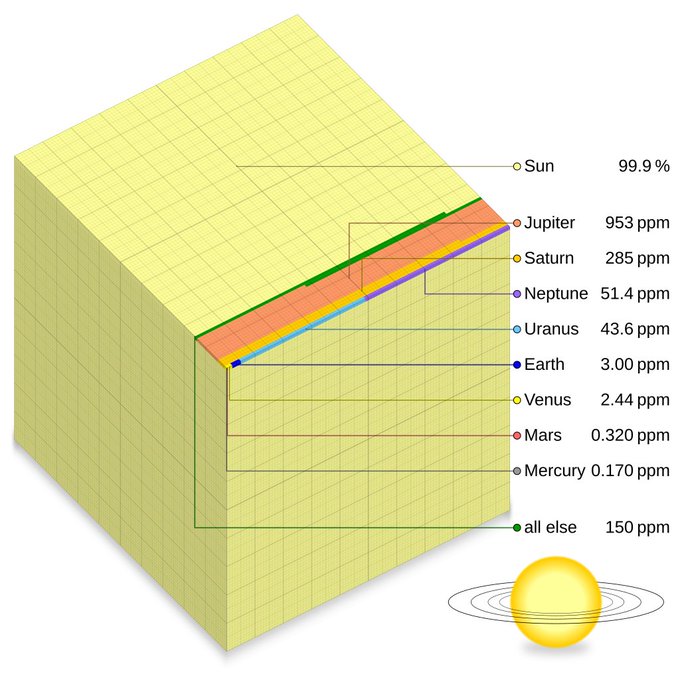
"Even if we disassembled the rocky planets, converted them into fusion reactors, and fueled them with the gas giants — we still couldn't hold a candle to the Sun".

I'm in favor of harnessing the power of the sun = Solar Satellites! Ideally, if we can have alot of high functioning solar panels in space, assuming low maintaince, then coupled with battery technologies and rocket ships in the future - we can have virtually boundless energy from these energy resources, as they swap out the batteries in space for the batteries at home, powering the electric grid. It's a good idea in theory, but I'm definately not Elon Musk where i could prioritize that and make it happen.
Given the need for electricity to power anything these days - they could put alot of work at home offices on a mars colony as well as mall like structures with artifical climate zones. The real challenge would be how to grow food on mars - where if we had food replicators, converting free energy into food, then that could be the gateway to sustaining life on mars and beyond; otherwise, the best humankind can sustain in uninhabitable or harsh climates would be sustaining life on greenland imo. in greenland, they have the need to import everything!
I'm in favor of harnessing the power of the sun = Solar Satellites! Ideally, if we can have alot of high functioning solar panels in space, assuming low maintaince, then coupled with battery technologies and rocket ships in the future - we can have virtually boundless energy from these energy resources, as they swap out the batteries in space for the batteries at home, powering the electric grid. It's a good idea in theory, but I'm definately not Elon Musk where i could prioritize that and make it happen.
Given the need for electricity to power anything these days - they could put alot of work at home offices on a mars colony as well as mall like structures with artifical climate zones. The real challenge would be how to grow food on mars - where if we had food replicators, converting free energy into food, then that could be the gateway to sustaining life on mars and beyond; otherwise, the best humankind can sustain in uninhabitable or harsh climates would be sustaining life on greenland imo. in greenland, they have the need to import everything!
#2
Besides erratic production outside of specific places on Earth, solar energy has storage issues (lithium energy density is poor compared to hydrocarbons) and mining lithium has appalling environmental impacts. The Chinese dominate the market because they're prepared to tolerate the consequences more than most. Even then, they are looking to outsource the industry to Africa to supply increasing global demand without causing more damage to their country. And God help you if the batteries catch fire.
We need to consume drastically less energy as a species. But humans can't collectively moderate themselves. Our species behaviour is virus-like, regardless of the energy source. Which means reducing the number of humans.
As for Mars:
Martian soil is ultra-fine toxic dust, Martian air is toxic, the surface is 40 or more times as radioactive as Earth's, dust storms can last for weeks and months, we have no idea if humans could develop and survive in low G, Elon Musk will be there. Overall it might even be worse than living in somewhere like Detroit. Not sure how much use space mirrors and solar panels will be in this situation.
I recommend the book 'A City on Mars' by Kelly and Zach Weinersmith on the subject.
#2
Besides erratic production outside of specific places on Earth, solar energy has storage issues (lithium energy density is poor compared to hydrocarbons) and mining lithium has appalling environmental impacts. The Chinese dominate the market because they're prepared to tolerate the consequences more than most. Even then, they are looking to outsource the industry to Africa to supply increasing global demand without causing more damage to their country. And God help you if the batteries catch fire.
We need to consume drastically less energy as a species. But humans can't collectively moderate themselves. Our species behaviour is virus-like, regardless of the energy source. Which means reducing the number of humans.
As for Mars:
Martian soil is ultra-fine toxic dust, Martian air is toxic, the surface is 40 or more times as radioactive as Earth's, dust storms can last for weeks and months, we have no idea if humans could develop and survive in low G, Elon Musk will be there. Overall it might even be worse than living in somewhere like Detroit. Not sure how much use space mirrors and solar panels will be in this situation.
I recommend the book 'A City on Mars' by Kelly and Zach Weinersmith on the subject.
Ig Dyson had something to say abt harnessing the power of the sun.
Ig Dyson had something to say abt harnessing the power of the sun.
@BrokenJester Graphene batteries are coming...
@BrokenJester Graphene batteries are coming...
Wow, I always thought the sun was a sphere, not a cube! You learn something new every day!
Wow, I always thought the sun was a sphere, not a cube! You learn something new every day!
The problem is that over 90% of the world's graphene is in China and Brazil, both marxists.
They are good at copying ready products, and providing cheap labor, but they are extremely disgusting on research.
As a Brazilian I can tell, very little will come from here. We don't have any good scientists...
The problem is that over 90% of the world's graphene is in China and Brazil, both marxists.
They are good at copying ready products, and providing cheap labor, but they are extremely disgusting on research.
As a Brazilian I can tell, very little will come from here. We don't have any good scientists...
@celinofj said in #7:
The problem is that over 90% of the world's graphene is in China and Brazil, both marxists.
They are good at copying ready products, and providing cheap labor, but they are extremely disgusting on research.
As a Brazilian I can tell, very little will come from here. We don't have any good scientists...
Erm.. No ? Graphene is just carbon in a specific lattice and it's not something you mine. You make graphene from carbon. You can even make graphene at home with a pencil (carbon) and some cellotape (I did). And carbon is one of the most common elements.
I'm pretty sure you got graphene mixed up with something else.
https://www.bbc.com/news/science-environment-11478645
"How sticky tape trick led to Nobel Prize"
"Professor Geim described the method thus: "You put [sticky tape] on graphite or mica and peel the top layer. There are flakes of graphite that come off on your tape...."
There are now, of course, more sophisticated methods to make graphene.
Fun fact, I met this guy. I came along when a couple of my students went to interview him.
@celinofj said in #7:
> The problem is that over 90% of the world's graphene is in China and Brazil, both marxists.
> They are good at copying ready products, and providing cheap labor, but they are extremely disgusting on research.
> As a Brazilian I can tell, very little will come from here. We don't have any good scientists...
Erm.. No ? Graphene is just carbon in a specific lattice and it's not something you mine. You make graphene from carbon. You can even make graphene at home with a pencil (carbon) and some cellotape (I did). And carbon is one of the most common elements.
I'm pretty sure you got graphene mixed up with something else.
https://www.bbc.com/news/science-environment-11478645
"How sticky tape trick led to Nobel Prize"
"Professor Geim described the method thus: "You put [sticky tape] on graphite or mica and peel the top layer. There are flakes of graphite that come off on your tape...."
There are now, of course, more sophisticated methods to make graphene.
Fun fact, I met this guy. I came along when a couple of my students went to interview him.
@Approximation said in #2:
I'm in favor of harnessing the power of the sun = Solar Satellites! Ideally, if we can have alot of high functioning solar panels in space, assuming low maintaince, then coupled with battery technologies and rocket ships in the future - we can have virtually boundless energy from these energy resources, as they swap out the batteries in space for the batteries at home, powering the electric grid. It's a good idea in theory, but I'm definately not Elon Musk where i could prioritize that and make it happen.
Given the need for electricity to power anything these days - they could put alot of work at home offices on a mars colony as well as mall like structures with artifical climate zones. The real challenge would be how to grow food on mars - where if we had food replicators, converting free energy into food, then that could be the gateway to sustaining life on mars and beyond; otherwise, the best humankind can sustain in uninhabitable or harsh climates would be sustaining life on greenland imo. in greenland, they have the need to import everything!
Using batteries in space would be very inefficient - there are ways to transfer power remotely
@Approximation said in #2:
> I'm in favor of harnessing the power of the sun = Solar Satellites! Ideally, if we can have alot of high functioning solar panels in space, assuming low maintaince, then coupled with battery technologies and rocket ships in the future - we can have virtually boundless energy from these energy resources, as they swap out the batteries in space for the batteries at home, powering the electric grid. It's a good idea in theory, but I'm definately not Elon Musk where i could prioritize that and make it happen.
>
> Given the need for electricity to power anything these days - they could put alot of work at home offices on a mars colony as well as mall like structures with artifical climate zones. The real challenge would be how to grow food on mars - where if we had food replicators, converting free energy into food, then that could be the gateway to sustaining life on mars and beyond; otherwise, the best humankind can sustain in uninhabitable or harsh climates would be sustaining life on greenland imo. in greenland, they have the need to import everything!
Using batteries in space would be very inefficient - there are ways to transfer power remotely
Simple response:
Big isn't always best. Mere mass is not enough.
A whale is HUGE.
But it's not the best food for humans.
(Neither is horse or dog, by the way. Indeed, I wish people would even stop eating guinea pigs).
By the way, it felt nice to give @wowbagger an upvote. It made me break into song: 'it's beginning to look a lot like CHRISTmas...."
I must caution, though, that that while graphene CAN be produced -- and I have high hopes that we'll get better and better at that -- it's apparently not yet easy to produce "in scale."
Consider Wiki: "While small amounts of graphene are easy to produce using the method by which it was originally isolated, attempts to scale and automate the manufacturing process for mass production have had limited success out of concern for cost-effectiveness and quality control..."
But humanity seems to be very resilient and creative -- and storage technology will slowly but surely improve with time, I think.
But remember one thing: cheap energy is at the FOUNDATION of supporting large populations without misery. And while sunlight is free -- collecting, transmitting and storing its energy, and cleaning up after what is done to make this possible, is not remotely free.
@Brokenjester's cautions seem well-founded.
Simple response:
Big isn't always best. Mere mass is not enough.
A whale is HUGE.
But it's not the best food for humans.
(Neither is horse or dog, by the way. Indeed, I wish people would even stop eating guinea pigs).
By the way, it felt nice to give @wowbagger an upvote. It made me break into song: 'it's beginning to look a lot like CHRISTmas...."
I must caution, though, that that while graphene CAN be produced -- and I have high hopes that we'll get better and better at that -- it's apparently not yet easy to produce "in scale."
Consider Wiki: "While small amounts of graphene are easy to produce using the method by which it was originally isolated, attempts to scale and automate the manufacturing process for mass production have had limited success out of concern for cost-effectiveness and quality control..."
But humanity seems to be very resilient and creative -- and storage technology will slowly but surely improve with time, I think.
But remember one thing: cheap energy is at the FOUNDATION of supporting large populations without misery. And while sunlight is free -- collecting, transmitting and storing its energy, and cleaning up after what is done to make this possible, is not remotely free.
@Brokenjester's cautions seem well-founded.


