@zzc3308 said in #29:
I tried playing this position out on chess.com, black flags when white has mate-in-one, but a draw is still declared. This is a bit weird since white can force mate.
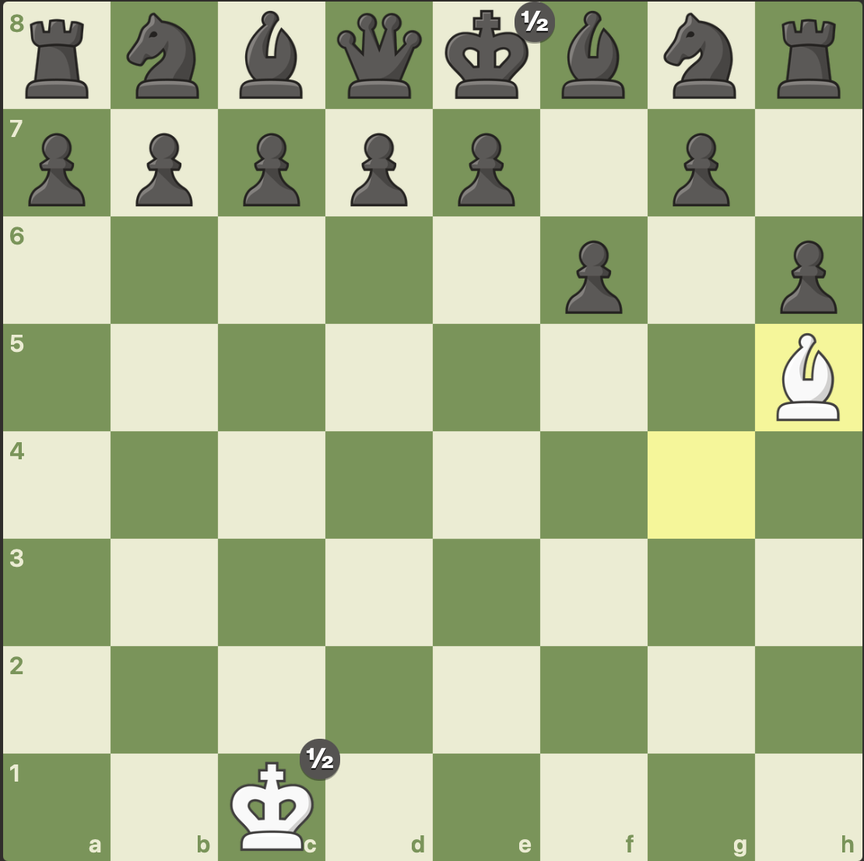
Reminds me that I once saw someone suggest flagging yourself when you have a rook pawn and a trapped king, about to get mated by a lone knight.
@zzc3308 said in #29:
> I tried playing this position out on chess.com, black flags when white has mate-in-one, but a draw is still declared. This is a bit weird since white can force mate.
> 
Reminds me that I once saw someone suggest flagging yourself when you have a rook pawn and a trapped king, about to get mated by a lone knight.
I like the FIDE rules if you can potentially win you are considered for a win. Consider in the Eric Rosen game if he had a pawn on d2 it would be the same thing or even if we got this position. https://lichess.org/editor/6k1/6p1/P5P1/1PPPPP1P/2RKNN2/2BRQ3/2B5/8_b_--0_1?color=white black could still win this position while having no buissness winning this there is no way black has a higher chance of winnning this that in a 2 knights endgame at least there in low time you can force the king into the corner and adjacent square keep him premoving there for a bit then reroute the knights to set up checkmate. Plus would white then not be able to win this position? https://lichess.org/editor/k7/8/NKn5/8/8/8/7Q/q7_w--_0_1?color=white techincally yes by USCF rules but the same couldn't be said on chess com.
What I would like though is to potentially see a lichess bug fix so that the pawn endgames with a pawn fortress are considered a draw. I think it wouldn't be a huge bug fix just ask if the pawns are frozen then consider all the squares not accessible to the kings (or any bishops) due to pawns and determine if the kings (or bishops) can reach pawns if not then draw. Basically if pawns can move -> win/loss possible; else if exist N,R,Q -> win/loss possible; else if K,B can reach pawns win/loss possible else draw. You have to consider both sides pieces since if any of the pawns can get captured that opens possiblilities for the other side to infiltrate.
I like the FIDE rules if you can potentially win you are considered for a win. Consider in the Eric Rosen game if he had a pawn on d2 it would be the same thing or even if we got this position. https://lichess.org/editor/6k1/6p1/P5P1/1PPPPP1P/2RKNN2/2BRQ3/2B5/8_b_-_-_0_1?color=white black could still win this position while having no buissness winning this there is no way black has a higher chance of winnning this that in a 2 knights endgame at least there in low time you can force the king into the corner and adjacent square keep him premoving there for a bit then reroute the knights to set up checkmate. Plus would white then not be able to win this position? https://lichess.org/editor/k7/8/NKn5/8/8/8/7Q/q7_w_-_-_0_1?color=white techincally yes by USCF rules but the same couldn't be said on chess com.
What I would like though is to potentially see a lichess bug fix so that the pawn endgames with a pawn fortress are considered a draw. I think it wouldn't be a huge bug fix just ask if the pawns are frozen then consider all the squares not accessible to the kings (or any bishops) due to pawns and determine if the kings (or bishops) can reach pawns if not then draw. Basically if pawns can move -> win/loss possible; else if exist N,R,Q -> win/loss possible; else if K,B can reach pawns win/loss possible else draw. You have to consider both sides pieces since if any of the pawns can get captured that opens possiblilities for the other side to infiltrate.
@zzc3308 said in #29:
I tried playing this position out on chess.com, black flags when white has mate-in-one, but a draw is still declared. This is a bit weird since white can force mate.
I encountered that situation when I was able to mate with a Knight agaist a King and a Pawn. It was not mate in one, but it was still a forced mating sequence.
In my view, a time flag should always be a loss, and draw should be declared automatically if both players have insufficient material to force mate (i.e. King, King + Bishop or King + Knight).
@zzc3308 said in #29:
> I tried playing this position out on chess.com, black flags when white has mate-in-one, but a draw is still declared. This is a bit weird since white can force mate.
I encountered that situation when I was able to mate with a Knight agaist a King and a Pawn. It was not mate in one, but it was still a forced mating sequence.
In my view, a time flag should always be a loss, and draw should be declared automatically if both players have insufficient material to force mate (i.e. King, King + Bishop or King + Knight).
@Ramen_Eater said in #33:
In my view, a time flag should always be a loss, and draw should be declared automatically if both players have insufficient material to force mate (i.e. King, King + Bishop or King + Knight).
I agree with the general yeast of this: in essence, flagging is a loss. (And this really is the general philosophy behind the fide rules.)
However, you have to be extremely careful how you phrase this. for instance: "draw should be declared automatically if both players have insufficient material to force mate" implies that, for instance, a B+N vs lone king would be won for the defending side if the B+N side runs out of time. I can't imagine that was your intention.
@Ramen_Eater said in #33:
> In my view, a time flag should always be a loss, and draw should be declared automatically if both players have insufficient material to force mate (i.e. King, King + Bishop or King + Knight).
I agree with the general yeast of this: in essence, flagging is a loss. (And this really is the general philosophy behind the fide rules.)
However, you have to be extremely careful how you phrase this. for instance: "draw should be declared automatically if both players have insufficient material to force mate" implies that, for instance, a B+N vs lone king would be won for the defending side if the B+N side runs out of time. I can't imagine that was your intention.
@Molurus said in #34:
In my view, a time flag should always be a loss, and draw should be declared automatically if both players have insufficient material to force mate (i.e. King, King + Bishop or King + Knight).
I agree with the general yeast of this: in essence, flagging is a loss. (And this really is the general philosophy behind the fide rules.)
However, you have to be extremely careful how you phrase this. for instance: "draw should be declared automatically if both players have insufficient material to force mate" implies that, for instance, a B+N vs lone king would be won for the defending side if the B+N side runs out of time. I can't imagine that was your intention.
First, a clarification: King + Bishop against King + Knight would not be draw, as a mate is still possible. Which brings me to the second point: as soon as one side has enough material to give mate, it often also has enough material to enable to opponent to give mate. A lone king cannot give mate, so a rule that says that if you flag against an opponent with a lone king, the game is declared a draw. Any expansion of such a rule is difficult, in my view, as a mate is most likely possible whenever one player has sufficient material and the other has more than the King.
@Molurus said in #34:
> > In my view, a time flag should always be a loss, and draw should be declared automatically if both players have insufficient material to force mate (i.e. King, King + Bishop or King + Knight).
>
> I agree with the general yeast of this: in essence, flagging is a loss. (And this really is the general philosophy behind the fide rules.)
>
> However, you have to be extremely careful how you phrase this. for instance: "draw should be declared automatically if both players have insufficient material to force mate" implies that, for instance, a B+N vs lone king would be won for the defending side if the B+N side runs out of time. I can't imagine that was your intention.
First, a clarification: King + Bishop against King + Knight would not be draw, as a mate is still possible. Which brings me to the second point: as soon as one side has enough material to give mate, it often also has enough material to enable to opponent to give mate. A lone king cannot give mate, so a rule that says that if you flag against an opponent with a lone king, the game is declared a draw. Any expansion of such a rule is difficult, in my view, as a mate is most likely possible whenever one player has sufficient material and the other has more than the King.
@Ramen_Eater said in #35:
First, a clarification: King + Bishop against King + Knight would not be draw, as a mate is still possible. Which brings me to the second point: as soon as one side has enough material to give mate, it often also has enough material to enable to opponent to give mate. A lone king cannot give mate, so a rule that says that if you flag against an opponent with a lone king, the game is declared a draw. Any expansion of such a rule is difficult, in my view, as a mate is most likely possible whenever one player has sufficient material and the other has more than the King.
I got that that was your intention. I'm merely pointing out that the way you phrased it it wouldn't work out that way. ;)
That said: why go through all the trouble of defining a list of specific exceptions? It seems to me that the way FIDE defines it is in essence much simpler, fairer and less ambiguous:
Flagging is a loss, except in cases where the oponent cannot win. Not even with the worst possible moves by the side that flagged.
I'd say this covers all situations in a way that makes sense and is fair.
PS: when I say 'simpler', I mean: simpler for humans. It's amazingly hard for software to cover all cases. But I don't consider this problem large enough to change the rules for.
@Ramen_Eater said in #35:
> First, a clarification: King + Bishop against King + Knight would not be draw, as a mate is still possible. Which brings me to the second point: as soon as one side has enough material to give mate, it often also has enough material to enable to opponent to give mate. A lone king cannot give mate, so a rule that says that if you flag against an opponent with a lone king, the game is declared a draw. Any expansion of such a rule is difficult, in my view, as a mate is most likely possible whenever one player has sufficient material and the other has more than the King.
I got that that was your intention. I'm merely pointing out that the way you phrased it it wouldn't work out that way. ;)
That said: why go through all the trouble of defining a list of specific exceptions? It seems to me that the way FIDE defines it is in essence much simpler, fairer and less ambiguous:
Flagging is a loss, except in cases where the oponent cannot win. Not even with the worst possible moves by the side that flagged.
I'd say this covers all situations in a way that makes sense and is fair.
PS: when I say 'simpler', I mean: simpler for humans. It's amazingly hard for software to cover all cases. But I don't consider this problem large enough to change the rules for.
Hi guys, what's up
@AARAVG_CHESS said in #37:
Hi guys, what's up
@AARAVG_CHESS said in #37:
> Hi guys, what's up
@AARAVG_CHESS said in #38:
Hi guys, what's up
@AARAVG_CHESS said in #38:
> > Hi guys, what's up
@Molurus said in #36:
I got that that was your intention.
I was just thinking about the simplest set of rules possible, with actually only one objective: to avoid tedious 50 move draws whenever possible. I actually wouldn't mind if running out of time simply loses the game, period. (That was my assumption when I started playing chess btw.) If you have an advantage, you should be able to save a draw, at least, and if you spent too much time to get into an advantageous position, then it's your responsibility to deal with the consequences.
@Molurus said in #36:
> I got that that was your intention.
I was just thinking about the simplest set of rules possible, with actually only one objective: to avoid tedious 50 move draws whenever possible. I actually wouldn't mind if running out of time simply loses the game, period. (That was my assumption when I started playing chess btw.) If you have an advantage, you should be able to save a draw, at least, and if you spent too much time to get into an advantageous position, then it's your responsibility to deal with the consequences.

