
Chatgpt
K-Factor in FIDE Chess Rating – Flowchart and examples
K factor is like a Turbo boost to the rating of the player at the initial stages of tournament upto 30 rated games and for players less than 18 years of age. Things get tougher as the K factor lowers down. An understanding of K factor is important for a serious tournament player.K-Factor in FIDE Chess Rating – Flowchart and examples
Introduction
Understanding the FIDE K-Factor can feel like defending a rook versus rook-and-bishop endgame — something you believe you know, until reality hits. Many of my students understood the K-Factor better than I did, as they are playing actively in tournaments.
This blog explains the K-Factor clearly using flowcharts, examples, and a graph.
What is the K-Factor?
The K-Factor determines how fast your rating changes after each rated game.
Official FIDE link: FIDE Rating Regulations
Section 8.3.3 discusses the K as the development coefficient.
Take the K-Factor Quiz
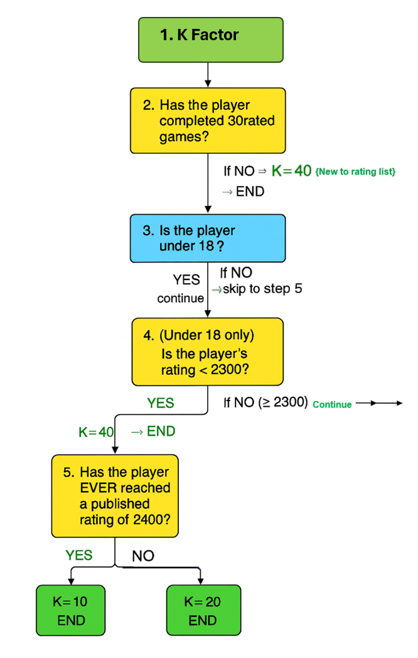
If you got all the answers correct, you may not need to read further. For the lesser mortals, I’ve made a flowchart. People learn differently — some read well, some see well, some hear well, and some are fine with all. The quiz highlights many real-world scenarios.
Flowchart and Quiz Comparison
View the flowchart below and reattempt the quiz. Compare your results before and after to see how your understanding improves.
K-Factor acts like a turbo boost for players in the early stages — especially when they’ve played fewer than 30 rated games. Players under 18 enjoy this boost even beyond 30 games.
Lessons from the K-Factor
Younger Players (Under 18)
Young players should capitalize on the K-Factor advantage before turning 18. Do not wait until college to chase rating gains — the best time is now.
Adult Players (18 and older)
Players over 18 get the K=40 boost for their first 30 rated games. Play actively to make the most of this window.
After 2300
Once a player reaches 2300, the K-Factor drops to 20. Accept the slower rating changes.
After 2400
At 2400 ELO, players join the 2400+ Club, where the K-Factor permanently becomes 10. Then one may consider focusing on knowledge rather than the rating itself.
Older Players
The life of older players is difficult (who said that it wasn't ). They do not gain many rating points due to low K-Factor, but they also lose less.
Maximum Rating Gain Rule (700-Point Cap)
The benefit of K-Factor is limited to a maximum of 700 ELO points per calendar year. Beyond that, rating gains are not permitted.
Visualizing the K-Factor
The graph below illustrates how a higher K-Factor leads to steeper rating changes.
New Rating = Old Rating + K × (Score - Expected Score)
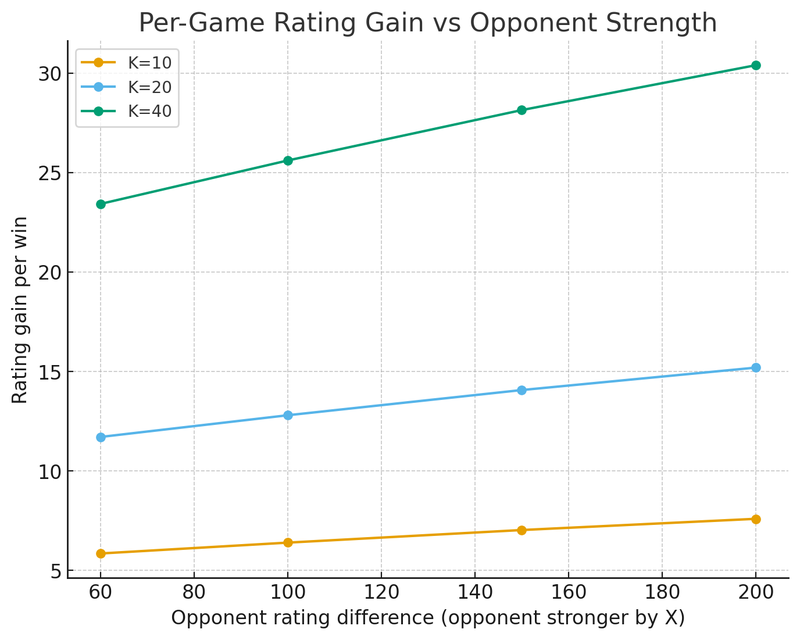
The above graph shows rating gain per win based on opponent strength and K-Factor
Conclusion
These insights aim to clarify the K-Factor and its impact. If you spot any errors in interpretation, feel free to message me on Lichess or on chesstraining.in@gmail.com Also, feel free to share your quiz results or feedback — I’d love to hear from fellow players.
You may also like
 CM HGabor
How titled players lie to you
This post is a word of warning for the average club player. As the chess world is becoming increasin… ChessMonitor_Stats
Where do Grandmasters play Chess? - Lichess vs. Chess.com
This is the first large-scale analysis of Grandmaster activity across Chess.com and Lichess from 200… thibault