
Chess with some data visualization
Focused on premoves in 1+0 bullet gamesBefore reading this post
The games in this analysis were lichess-annotated 60+0 games from April 2023. More about the data can be found at the lichess open database. Lichess does not annotate all their games in the database file, only a few games are annotated. Especially, 60+0 games with annotations compose less than 5% of the total 60+0 games. Annotations are done using Stockfish according to lichess. The analysis will not dig deeper into questioning the authenticity of the analysis. I wanted to show some visualizations that are not readily available in lichess. Enjoy :)
What are pre-moves?
Premove asks the server to make a move automatically without delay given certain situations. Probably the scientific definition of pre-move (if there is any) should be a move that takes 0 time. Unfortunately, there is already a limit to this analysis. In lichess pgn documentations, all game time is formatted in HH:MM:SS as we all know. So anything that took less than 1 second will be considered 0 seconds. Of course, if you go to the lichess analysis board and search the game, it says a move took 0.83 seconds but we will say that move took 0 seconds for our comfort. In this analysis, pre-move = move that took 0 second according to the PGN.
Visualizations
Basic information about pre-moves
Now that I clarified the definition for this analysis. We can look at some statistics on pre-moves.
| pre-moves | non pre-moves ( Time Spent > 0) |
|---|---|
| 21.26% | 78.73% |
Most moves are made after spending some clock time but a good 20% of the moves are made with 0 second used in 60+0 time format.
Pre-moves and Move Numbers
If you visualize this by move numbers, you get what you expect. Most of the pre-moves are made earlier in the game. The following graph is the distribution of pre-moves by move number (meaning the bars all add up to 1).
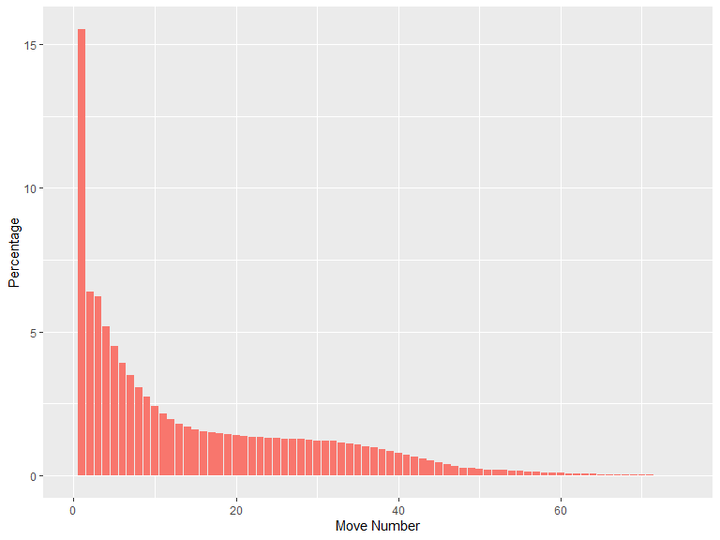
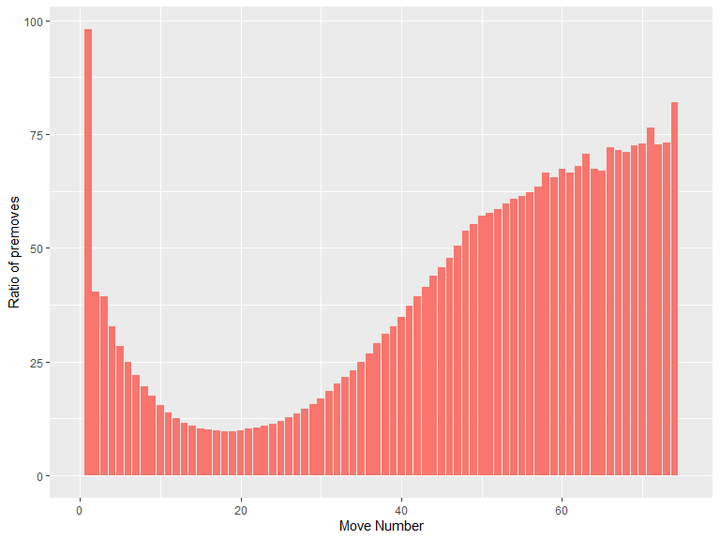
However, this plot does not show you all the information. Intuitively, in the later part of the game like move number 40+, we should be under time pressure and would be making moves really fast. This is well reflected in plot 2 which shows us how much of the moves at the given move number were pre-moves. We can see that the middle game from move number 10 - 30 is when people take their time making every move.
Pre-moves and Time
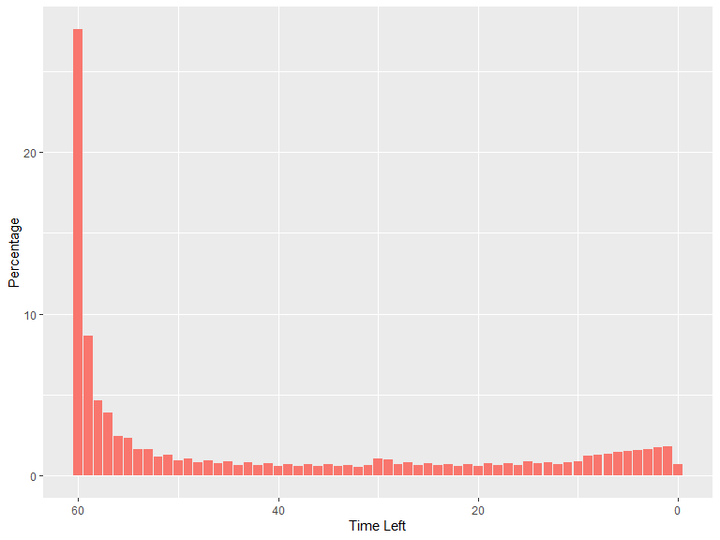
Given the plots above, we can expect similar plots but with Time Left as the x-axis. After all, Time Left is the biggest variable we take into account when spending time. The following is the distribution of pre-moves by Time Left on the clock (the bars add up to 1).
The more interesting is the ratio of pre-moves made by each time (This graph does not add up to 1).
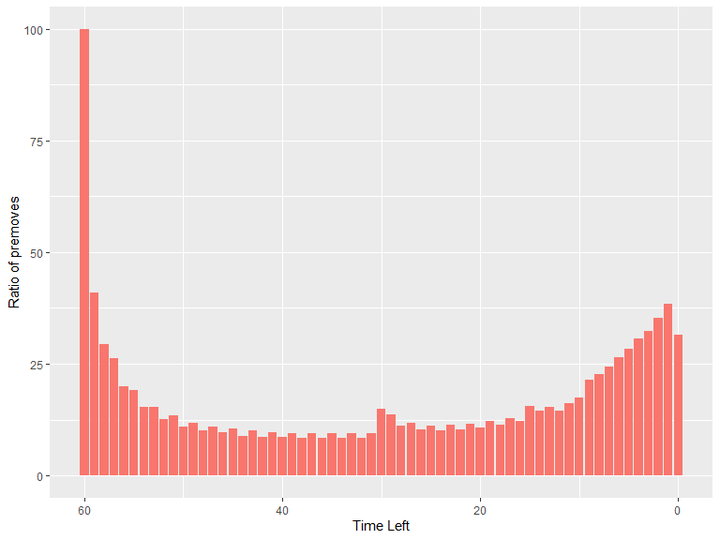
It is somewhat interesting to see the behavior changes with 30 seconds left and 10 seconds left. Maybe those are the milestones most people take into consideration when managing time.
Do we perform worse with pre-moves?
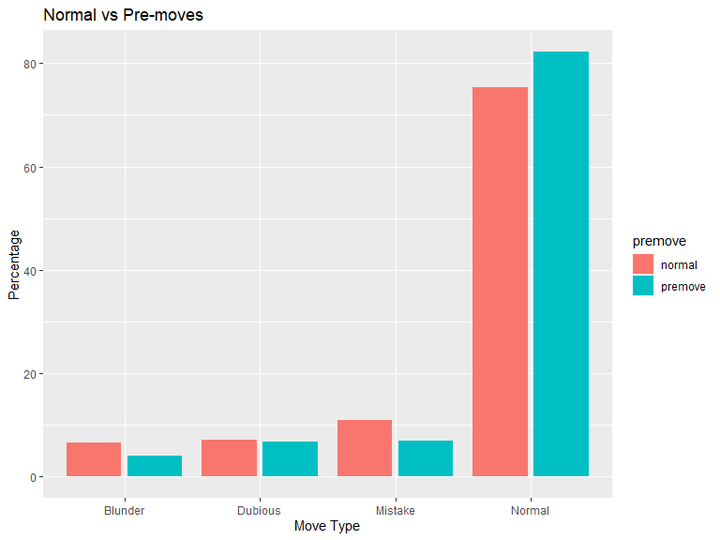
The shorter answer seems to be No. The starting question might be "Do we blunder more with pre-moves?". The answer is No.
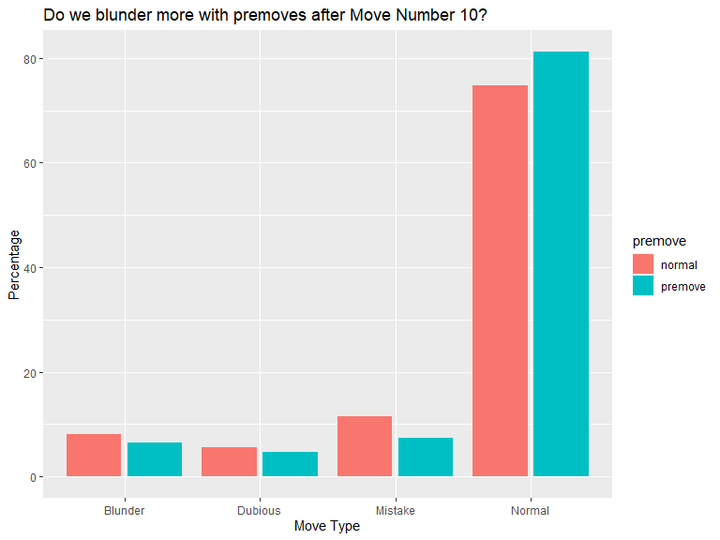
Now you might suspect is this because of the majority of pre-moves being in the opening. So I filtered this for Move Numbers after 10. I am sure some of you have deeper opening preparations but I am just choosing a number.
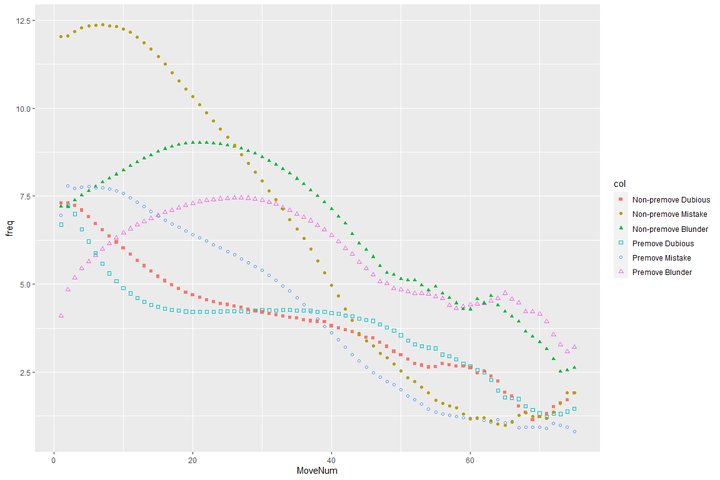
Maybe if you didn't like me choosing a number, here is a greater scheme of things. This graph must be interpreted carefully. It is NOT the frequency of blunders on Move Number X. It is the frequency of cases that happened for Move Number ≥ X. You can think of it as a cumulative distribution.
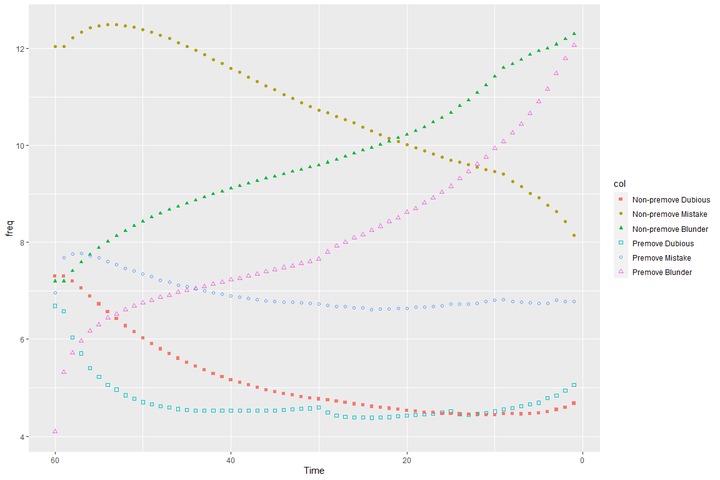
Same cumulative distribution but is based on Time and it is X ≥ Time. So a dot might represent a Non-pre move dubious move ratio at Time 20 or under.
Discussions
If there is anything weird you find in the data and want me to go over it once more and edit, feel free to leave comment and I will try to go over it. My goal for this blog post is to provide some insights that is not readily available. I have some more analysis that I wanted to include but the blog post will be too long for it.
Future posts?
I will also try to analyze some other time format data or maybe just more interesting insights as I dig into chess data. Feel free to comment about anything I have done wrong or topics you wish me to dive deeper into.
You may also like
 oortcloud_o
Cheater gameplay? - part 1
How do they differ in 1+0 Bullet games oortcloud_o
Linking top players based on openings
Using relatedness network on opening choices of top grandmasters thibault
How I started building Lichess
I get this question sometimes. How did you decide to make a chess server? The truth is, I didn't. oortcloud_o
A short literature review
chess opening similarity and more oortcloud_o
Which openings are related?
simulating opening connectivity graphs with known techniques oortcloud_o