
How Opening Advantages Translate into Results in Online Games
Measuring conversion rates in online blitz and bullet games for 1200 to 2400 rated playersEveryone knows that a position which is winning according to the engine is often difficult to convert in practice, especially in faster time controls. So I wanted to see how players of different levels score in different time controls, based on the evaluation on move 10.
I used 3000 games for each time control of each rating level. I used the Lichess database to get the games and all ratings are the Lichess ratings for the game mode (bullet rating for the 1+0 and 2+1 games and blitz rating for the other time controls).
1200 rated players
I decided to look at 1200, 1600, 2000, 2200 and 2400 rated players, to see how things change as one goes through the ranks.
So let’s start by looking at the 1200 rated players. Note that as I only chose games where both players are close to the given rating, I only show the score of the player who had a better position, as the picture would just be mirrored for the player standing worse.
Also remember that all the evaluations are taken from move 10 of the games.
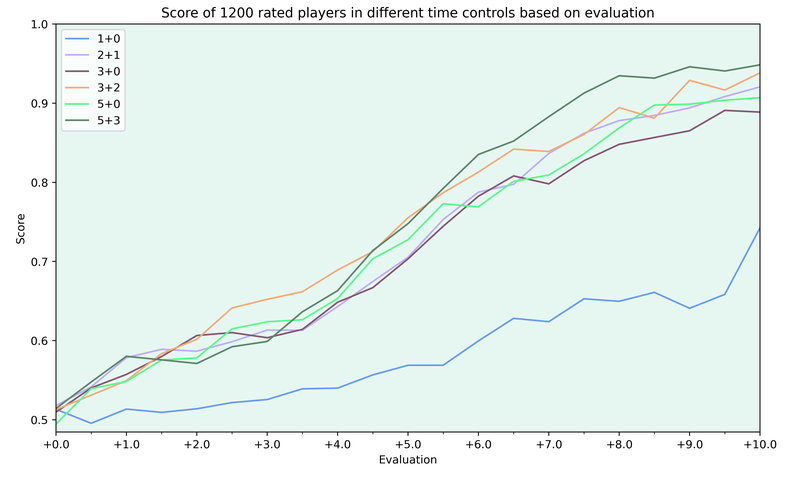
Unsurprisingly, converting an early advantage in 1+0 games is difficult, but it’s still surprising to see that a +6 advantage on move 10 as just enough to score 60% in the games.
There isn’t a big difference between the 5 other time controls, but one thing that stood out to me is that it’s apparently easier to convert a big advantage in 2+1 games than in 3+0 games. This surprised me a bit, as players have generally more time in 3+0 games, unless they last over 60 moves. So the failure to convert some of the 3+0 games may be due to bad time management, which doesn’t get punished as severely in games with increment.
1600 rated players
Continuing with the 1600 games, one can see that the higher level translates to a better conversion of advantages, especially in the 1+0 games.
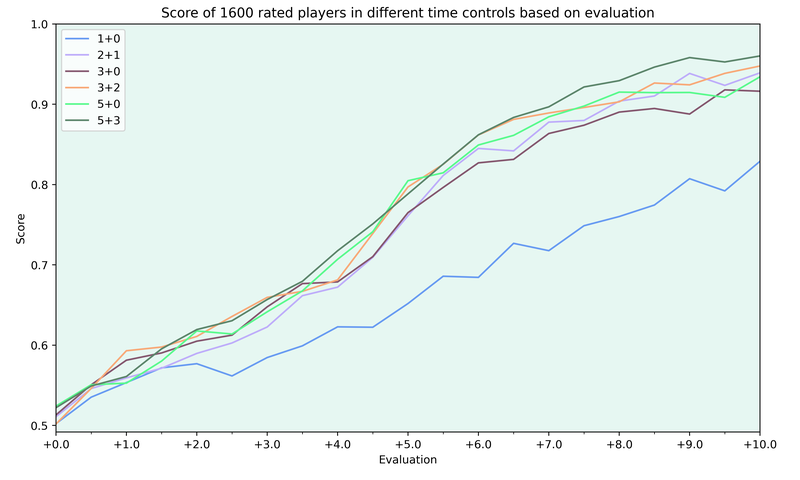
The score in bullet games is now much steeper than in the previous graph, which means that a higher evaluation out of the opening translates more directly into a better score.
Until now, the curves were more or less linear. If you’ve seen my previous post about the expected score in classical grandmaster games based on evaluation, you might have expected the curves to have a more sigmoid shape and reach a plateau at some point. The curves for the slower time controls taper off slightly, but it seems like at this level, every increase in evaluation leads to better outcomes.
2000 rated players
The first real plateau appears for players rated around 2000 on Lichess.
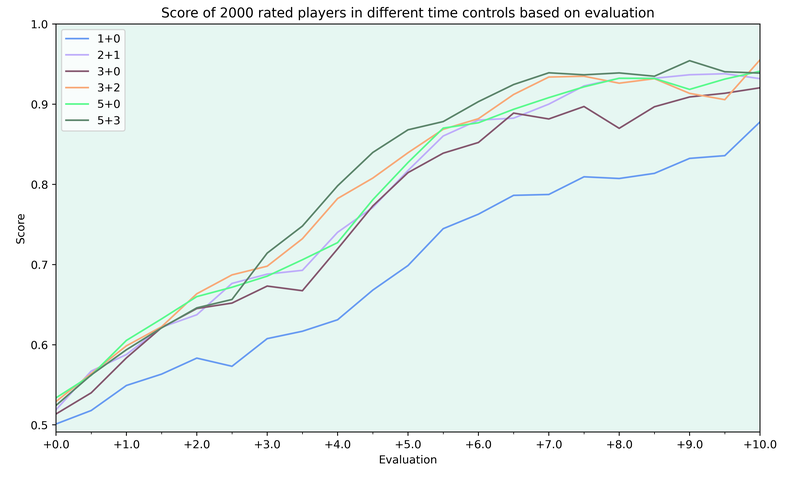
Apart from the flatter plateaus, the biggest difference to the previous picture is that the gap in score between 1+0 games and the other time controls has narrowed. The stronger the players are, the closer the score reflects the objective evaluation, even in 1+0 games.
Another pattern I’ve noticed so far is that there isn’t a clear separation between the time controls apart from 1+0. I’d assumed that there would be a stark difference between 3+0 and 5+3 games, but until now, there isn’t too much difference in the scores in these games.
One thing to point out is that there may be a difference between 2000 rated blitz players that play mainly 3+0 and 2000 rated blitz players that play mainly 5+3. This may explain the missing gap, but it’s difficult to check if this is really the case.
2200 rated players
I decided to reduce the rating jump from 400 to just 200 points, as there seem to be more drastic changes once one gets above the rating of 200.
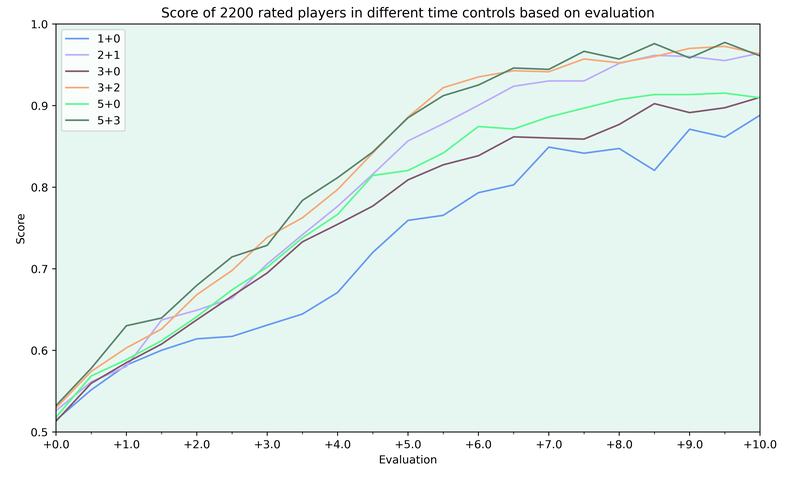
Now we get a clear separation between the time controls with increment (including the bullet time control 2+1) and the time controls without any increment. This makes a lot of sense since one will always lose some 3+0 and 5+0 games on time.
Furthermore, the score for a given evaluation has generally improved, which means that higher rated players are better at converting these advantages, even against stronger opposition.
2400 rated players
Finally, let’s get to the 2400 players.

Compared to the previous graph, it’s interesting to see that the scores in 3+0 and 5+0 games seem to level off earlier than for 2200 rated players, but also in the 85-90% score range.
One surprising thing is that the score in 1+0 games is similar to the score in 3+0 and 5+0 games for the biggest advantages. But this may be due to a smaller sample size for these games (2400 players aren’t often completely lost out of the opening) and the difference in blitz and bullet ratings.
This is also the first time where one can see that converting advantages between +1 and +4 is much easier in 5+3 games, which makes a lot of sense, but doesn’t show up for any of the lower ratings.
Conclusion
There are obviously a lot of things that can go wrong in online blitz and bullet games, so I expected that the conversion rate would be pretty low. But I was surprised that the point of diminishing returns for the evaluation arrives so late.
Using this data, one can also create a formula for the expected score of a given engine evaluation for different levels and time controls, like I did for OTB grandmaster games. I haven’t done this in this post, as there are endless combinations one could look at, but when I’m analysing some specific blitz games, it might come in handy.
Let me know if you’d be interested in some other ratings or time controls.
If you've enjoyed this post, check out my Substack.
You may also like
 thibault
How I started building Lichess
I get this question sometimes. How did you decide to make a chess server? The truth is, I didn't. jk_182
How the World Cup Format impacts Results
Taking a look at all matches from previous world cups jk_182
Do Attacking Players play more Forcing Moves?
Finding forcing moves and looking through the games of world champions jk_182
How does the Clock impact the Rate of Mistakes?
Looking at the relative number of mistakes depending on the time left on the clock ChessMonitor_Stats
Where do Grandmasters play Chess? - Lichess vs. Chess.com
This is the first large-scale analysis of Grandmaster activity across Chess.com and Lichess from 200… CM HGabor