
WIN with the Tan Gambit! (Collab w/@SolangeloForever)
Looking for a new, fresh way to play the Marshall Defense? Here's a sideline gambit that is completely safe and playable, whether your opponent accepts or declines!
A long, long time ago, the amazing @SolangeloForever made a study on the Tan Gambit! Unfortunately, a combination of loads of classes and just the worst time management on earth has led to me completing most of this blog and then letting it sit forever just rotting away in drafts. I've decided today that I'm finally going to finish it. And yes, this is my first time writing a blog on an opening so it's probably not going to turn out that great.
This blog is a brief overview of the Tan Gambit only, and I'm just hoping to get you interested in playing it. Click here for the original study, which will go much more in depth.
What is the Tan Gambit?
The Tan Gambit is a sideline in the Marshall Defense (1. d4 d5 2. c4 Nf6). Instead of taking back with the knight or the queen after 3. cxd5, we gambit a pawn with c6!
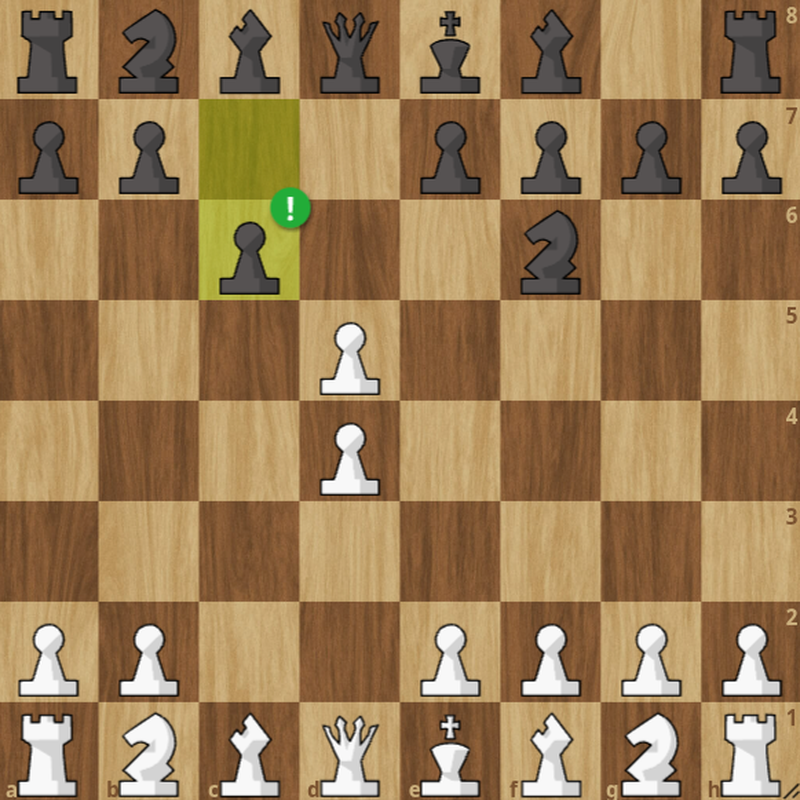
The Tan Gambit
If white chose to accept this gambit, you would recapture back with your knight on b8 and be a move ahead in development. You would also have plenty of opportunities later on to put pressure on the d pawn and even win it back at some point.
Why should you play the Tan Gambit?
The Tan Gambit is rare and only played in about 2% of the games featured in the Lichess database. This gives you an advantage over your opponent - even if you don't know all the lines, at least you'll be bringing them into unknown territory. Furthermore, unlike most gambits, which feature dubious lines relying mostly on traps, Stockfish shows an almost equal position after 3. c6, ensuring that even with best play, your opponent will not be able to secure any sort of easy win. There is no "countergambit" to the Tan Gambit, and you don't need to worry about surprise lines. You are the surprise! :)
So...you have a gambit that's easy to play and memorize, completely safe, and also relatively unknown. What do you have to lose?
What if they decline?
Unlike some gambits that rely on your opponent accepting the gambit before any advantage can be gained, the Tan Gambit still works completely fine if it is declined. You will not have wasted any moves, and you will be able to consolidate quite easily.
White has two major ways to decline the gambit - Nc3 and Nf3.
Nf3 - After cxd5, we will have transposed to the Exchange Slav. From here, we will just follow normal chess rules - develop your pieces, control the center, etc.
Nc3 - Again, keeping it very simple here. We'll just take the pawn back.

Your goal will be to eventually get to a position like this, where you are able to fully control e4.
Example Games
The Tan Gambit has been used occasionally at the professional level.
It can even win games!
Now let's practice!
Here's a random puzzle based off of a position in the Tan Gambit where a pin on e4 gave you an extra piece - now all you have to do is keep it. It should be fairly easy.
You can find practice on memorizing the lines themselves on the study mentioned in the beginning!
Conclusion
I would honestly encourage many people to study this gambit and just quickly learn the ideas of it, as you may find many opportunities to surprise your opponents with it. Since it is a very safe gambit, there is not much theory to memorize here for tactics - all you need to know are these three central ideas.
1. Try to get a knight on e4.
In many Tan Gambit positions, there will be a hole on the e4 square. Use this to give your knight a comfortable outpost, preferably by eliminating any piece that could trade your knight off first.
2. Be careful of Qb3.
Because you are looking for fast development, your queenside bishop usually leaves the b-pawn vulnerable to attack from White's queen. Make sure you can either block this attack or neutralize it so that you do not need to waste a move protecting your pawn.
3. Development is KEY!
I know, I know, I've emphasized it a hundred times over, but it really is one of the most important parts about this. You are going to be down a pawn, so your goal is to develop so fast that you are able to either win back the pawn or get greater compensation for it than the value of the pawn you lost. Make sure all of your moves serve a purpose: getting your pieces out as fast as possible. You want to have a chance to play against the isolated d-pawn, slowly putting pressure on it throughout the game and possibly eventually even winning it back.
And of course, if you're still not won over by this opening and refuse to play it, perhaps you will listen to this kitten and try it anyway? ;)
Photo by Nirzar Pangarkar on Unsplash
You may also like
 FM MathiCasa
Chess Football: A Fun and Creative Variant
Where chess pieces become "players" and the traditional chessboard turns into a soccer field greenteakitten
The (Green) Tea Room || Ep. 0
Join the family here! https://lichess.org/team/cherrys-yapping-corner greenteakitten
Why You Should Boycott FIDE
The lukewarm response FIDE gives to everything can no longer be tolerated. ChessMonitor_Stats
Where do Grandmasters play Chess? - Lichess vs. Chess.com
This is the first large-scale analysis of Grandmaster activity across Chess.com and Lichess from 200… greenteakitten
Critical Thinking Isn't Critical Anymore || The (Green) Tea Room, Ep. 1
Join here! https://lichess.org/team/cherrys-yapping-corner CM HGabor