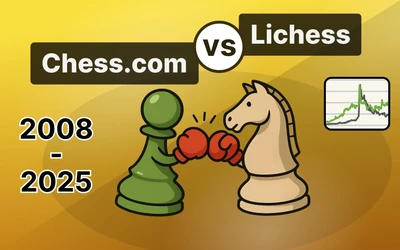
Why do people even play bullet chess?
Why do we keep playing bullet chess, even when it fries our brains and ruins our sleep schedule? As a regular bullet addict myself (@bombing_knight on Lichess), I wanted to dig deeper. What makes this 1-minute madness so irresistible — and is it actually helping our chess, or just messing with our minds?Why Do People Play Bullet Chess?
A Dive into the Psychology, Popularity, and Controversy Behind the 1-Minute Madness
If you’ve spent time on chess platforms like Lichess or Chess.com, you've probably noticed something odd: tens of thousands of players glued to 1+0 or 2+1 games — the ultra-fast format known as bullet chess. The board barely settles before it’s over, and yet millions are hooked.
So why do people play bullet? Is it good for your chess? Is it just an ego rush? Let’s break it down — with psychology, data, and some real-world insight.
1. The Instant Gratification Loop
Bullet chess delivers dopamine hits fast. According to psychologists, rapid-reward systems (like slot machines or social media likes) activate the brain’s reward center. Bullet mimics this by compressing entire games — decision-making, conflict, reward — into a one-minute experience.
“Fast feedback loops reinforce behavior more strongly,” says Dr. Ethan Kross, psychologist at the University of Michigan. “It’s not the depth, it’s the speed of the loop that forms habits.”
This is why bullet can feel compulsive. Win or lose, you want to play one more.
2. It Feels Like a Real-Time Battle
In classical or rapid chess, you often feel like a scientist: analyzing, calculating, and controlling. In bullet, you feel like a fighter pilot — fast reflexes, intuition, instincts.
“Bullet is pure chaos. And chaos is fun,” says GM Andrew Tang, nicknamed ‘Penguingm1’, one of the world’s fastest bullet players. His games are often more about intuition and pattern recognition than calculation.
This “battlefield energy” is appealing. You’re not just playing chess; you’re fighting the clock, the opponent, and your own nerves.
3. Bullet Suits the Modern Attention Span
Studies suggest the average human attention span has dropped from 12 seconds in 2000 to around 8 seconds today (Microsoft Canada study, 2015). Bullet chess fits perfectly into our fast-paced, digital world.
You don’t need 45 minutes. You don’t even need 10. Got a break between classes? One bullet game. On a train? Three bullet games. Done.
Chess.com reported in 2024 that bullet and blitz formats made up over 65% of total games played. It’s convenient, it’s mobile-friendly, and it scratches the itch quickly.
4. It Trains Pattern Recognition — But With a Caveat
Surprisingly, bullet does help some skills. Rapid pattern recognition, opening familiarity, and board vision can improve.
“Playing lots of bullet helped me recognize structures faster,” says IM Eric Rosen, known for his chill YouTube videos and frequent bullet games.
However, overindulging in bullet can damage deep thinking skills. Research shows that playing only fast time controls leads to shallow thinking and increased blunders in slower formats.
A 2020 ChessBase article highlighted that top bullet specialists often perform worse in long time controls unless they deliberately train both styles.
5. It’s Social and Entertaining
On Twitch and YouTube, bullet chess is a spectator sport. Streamers like Hikaru Nakamura, GothamChess, and BotezLive frequently play bullet games — not because it's the most instructive, but because it's fun to watch.
People love seeing:
- Crazy blunders
- Bullet comebacks with 0.1 seconds left
- Emotional reactions from streamers
It’s viral, engaging, and competitive — like e-sports.
6. Ego, Rating, and Identity
Bullet ratings can become part of identity. Someone may be 1500 in classical but 2100 in bullet — and feel proud of it. High bullet ratings give a sense of mastery and a confidence boost.
But it can also lead to rating addiction, where people tie their self-worth to numbers and chase bullet games even when exhausted or tilted.
So... Is Bullet Chess Good for You?
Let’s summarize the pros and cons:
| Benefits | Risks |
|---|---|
| Improves speed, pattern recall | Encourages shallow thinking |
| Fun and entertaining | Can become addictive |
| Great for tactical sharpness | Harms strategic/positional training |
| Fits busy schedules | Promotes poor time management habits |
| Builds intuition under pressure | Undermines focus in classical games |
Best advice from most titled players?
Balance it. Use bullet to stay sharp or warm up — but train slow to play strong.
Final Thoughts
People play bullet because it’s fast, fun, and fits modern life. It’s like junk food — great in small doses, terrible if it’s all you consume.
If you love bullet? Enjoy it. But if you want to grow as a chess player — don’t forget to slow down sometimes, breathe, and really think.
at the...end, this is @bombing_knight signing off!