
How should we play middlegames with opposite coloured bishops?
For many people, opposite coloured bishops mean that a draw is the likely outcome of the game. Lets see why this is not the case.
Introduction
Opposite coloured bishops have a reputation for turning many interesting positions into drawish ones. However, that is not so - they represent a material imbalance just like any other, and there are certain guidelines that can help us navigate these positions. In this post, I will provide some examples and explanations to help you better understand how to approach these positions.
What does the presence of opposite coloured bishops bring to a middlegame?
When opposite coloured bishops are present in the middlegame, there are two main things to consider:
- Who is attacking (or has attacking chances)?
- Which side has the better bishop? Very often, it is necessary to sacrifice a pawn or two in order to improve the bishop's activity.
Have a clear anwser to these questions, and you will have a clear direction to aim for. Of course that chess is a concrete and complex game and there might be other factors in play but, in many opposite coloured bishops positions, they will be the main stars of the game. This is obviously true when it is a middlegame in which the only light pieces are the bishops, but also happens quite often that, even with knights on the board, these questions have great importance on the overall evaluation.
Lets try to understand why these two questions are so deeply related to opposite coloured bishops:
Attacking chances
Attack in chess is a big topic which you could write many articles about. However, for the sake of simplicity, lets just introduce some of the basic aspects of a successful attack. When an attack is happening, the location of the game being played shifts from the entire board, to the zone in which the attack is happening and, with this shift, so does the value of the pieces on the board. If a king gets mated on the kingside, the game immediately meets its abrupt ending, and it does not matter at all how many queens were standing on the queenside. When an attack is happening, the "material count" becomes much more localized around the king (for example, it becomes much more important how many pieces are on the kingside rather than on the whole board).
This is an elaborate way of saying that, for a successful attack, we generally need more attackers for the attacking side than defending side can bring defenders to the war zone. Now, how does this relate to opposite coloured bishops?
A very typical way of attacking is focusing the attack on a specific colour complex - the one the attacking side controls best, or the defender struggles the most to defend. You see where this is going - opposite coloured bishops are the perfect opportunity to exploit this concept to the maximum. If an attacker is attacking on the same colour complex as the bishop it possesses, they will be basically attacking a piece up, as the opponent's bishop will be completely powerless to do anything. Lets see some examples:
Sousa, A - Romaris, J, Famalicao Open 2024
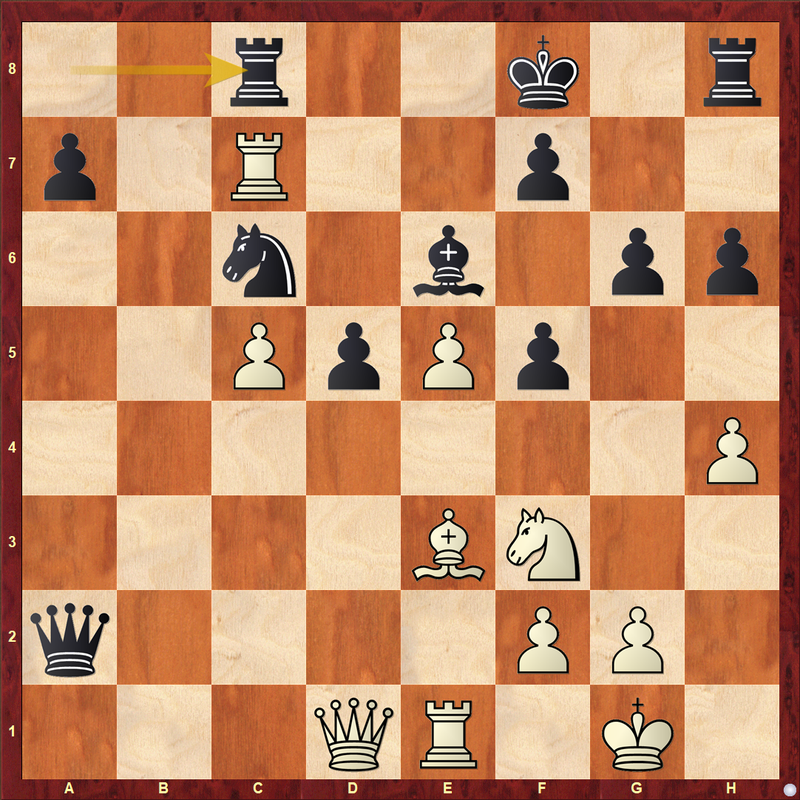
This position has been featured on a previous post of mine, but it is a perfect example of a massive attack based on opposite coloured bishops. In the diagram position, White should (and did) play 21.Rxc8+ Bxc8 22.e6! Bxe6 23.Nd4 exchanging the last defender of the dark squares and going for a pure opposite coloured bishop middlegame. We should then ask the questions: Who has better attacking chances? White, definitely, look at the king. Who has the better bishop? No need to think hard about this one. Hence, White is totally winning. After the moves 23...Qa6 24.Nxc6 Qxc6 we get the following position:
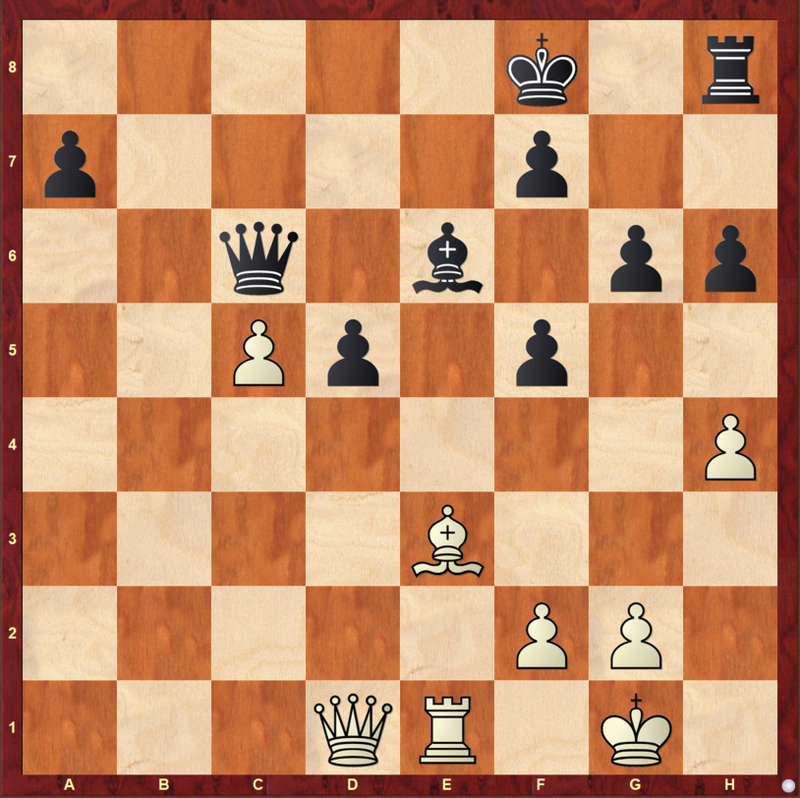
Please fully appreciate that after a move like 25.Qd4 white is practically attacking a piece up. Black is totally busted and lost quickly.
Halkias, S - Sousa, A, Maia Open 2023
 White to play. How would you evaluate this position?
If you thought White is better, you underestimated White's chances. White is totally winning being, to all effects, a piece up. Any reasonable move is +3 but the swiftest victory is 33.Re6! and after 34.Bd5 or 34.Be4+, depending a bit on what Black does, White will checkmate Black.
Bishop's activity
The previous topic on attacking chances is a more concrete analysis of the broader topic that is bishop's activity. In general, if a bishop is much better than it's counterpart, it is very likely that the position is advantageous. It is simply even more advantageous when there are attacking chances involved. However, in this section, we will look at two games where checkmate was not the main plan of the stronger side.
Conclusion
We have seen some examples of the importance of the difference between opposite coloured bishops. I believe that if during a game we pay close attention to who has attacking chances and who has the better bishop, we are better equipped with dealing with these type of middlegames (and sometimes endgames). Also, it is important to understand that pawns are not so important when considering the bishop's activity - if you get a monster bishop, it is almost like playing a full piece up! Definitely worth sacrificing a pawn or two.
I also hope that these examples helped debunk the idea that any position with opposite coloured bishops have drawish tendencies. This notion applies almost solely to pure opposite coloured bishop endgames and, as long as there are other pieces to benefit from the power of the bishop, it is a "normal" game of chess, with all results on the table.
You may also like
 GM Avetik_ChessMood
10 Things to Give Up to Enjoy Chess Fully
Discover how embracing a lighter mindset can help you enjoy chess again and achieve better results. IM HelloItsDmitri
Is a rook on an open file a good piece?
Rooks on open files are not the full story when it comes to define whether a rook is well placed. In… ChessMonitor_Stats
Where do Grandmasters play Chess? - Lichess vs. Chess.com
This is the first large-scale analysis of Grandmaster activity across Chess.com and Lichess from 200… IM HelloItsDmitri
What are pawns used for in chess?
It has been said that pawns are the soul of chess. But what exactly is the job of the weakest, yet m… Mcie
McieCalculate until the end.. and one move more!
Blunder or brilliancy, sometimes it all hinges on one more move. FM MathiCasa