
Chess for beginners
If you're starting to learn about chess and play it, you'll see some good tips in this blog.
Chess pieces and their movement
- The king moves one square in any direction. There is also a special move called castling which moves the king and a rook. The king is the most valuable piece—it is illegal to play any move that puts one's king under attack by an opponent piece. A move that attacks the king must be parried immediately; if this cannot be done, the game is lost. The king is also known as "K".
- A rook can move any number of squares along a rank or file. A rook is involved in the king's castling move. The rook is also known as "R".
- A bishop can move any number of squares diagonally. The bishop is also known as "B"
- A queen combines the power of a rook and bishop and can move any number of squares along a rank, file, or diagonal. The queen is also known as "Q"
- A knight moves to any of the closest squares that are not on the same rank, file, or diagonal. (Thus, the move forms an "L"-shape: two squares vertically and one square horizontally, or two squares horizontally and one square vertically.) The knight is the only piece that can leap over other pieces. The Knight is also known as "N" instead of "K" so that there is no confusion between king and the knight.
- A pawn can move forward to the unoccupied square immediately in front of it on the same file, or on its first move it can optionally advance two squares along the same file, provided both squares are unoccupied (diagram dots). A pawn can capture an opponent's piece on a square diagonally in front of it by moving to that square (diagram crosses). It cannot capture a piece while advancing along the same file, nor can it move to either square diagonally in front without capturing. Pawns have two special moves: the en passantcapture and promotion. The pawn doesn't have any notation letter so it takes the square name.
Check and Checkmate
Check
When a king is under immediate attack, it is in check. A move in response to a check is legal only if it results in a position in which the king is no longer in check.
Ways to counter a Check:
- Capture the checking piece.
- Interpose a piece between the checking piece and the king (possible only if the attacking piece is a queen, rook, or bishop and there is a square between it and the king).
- Move the king to a square where it is not under attack
Checkmate
The object of the game is to checkmate the opponent; this occurs when the opponent's king is in check, and there is no legal way to get it out of check.
Special moves
King:
Castling
Kings can castle once per game. Castling consists of moving the king two squares toward either rook of the same color and then placing the rook on the square that the king crossed.
Castling is possible only if the following conditions are met:
- Neither the king nor the rook has previously moved during the game.
- There are no pieces between the king and the rook.
- The king is not in check and does not pass through or finish on a square controlled by an enemy piece.
Castling is still permitted if the rook is under attack, or if the rook crosses an attacked square.
In olden chess it was considered illegal to castle if the king had been given a check.
Pawn:
Promotion
when a pawn advances to its last rank, it is promoted and replaced with the player's choice of a queen, rook, bishop, or knight. Usually, pawns are promoted to queens; choosing another piece is called underpromotion. If the required piece is not available (e.g. a second queen), an inverted rook is sometimes used as a substitute, but this is not recognized in FIDE-sanctioned games.
En passant
when a pawn makes a two-square advance to the same rank as an opponent's pawn on an adjacent file, that pawn can capture it en passant ("in passing"), moving to one square behind the captured pawn. A pawn can only be captured en passant on the turn after it makes a two-square advance.
End of the game
Win
A game can be won in the following ways:
- Checkmate: The opposing king is in check and the opponent has no legal move.
- Resignation: A player may resign, conceding the game to the opponent. If, however, the opponent has no way of checkmating the resigned player, this is a draw under FIDE Laws. Most tournament players consider it good etiquette to resign in a hopeless position.
- Win on time: In games with a time control, a player wins if the opponent runs out of time, even if the opponent has a superior position, as long as the player has a theoretical possibility to checkmate the opponent were the game to continue.
- Forfeit: A player who cheats, violates the rules, or violates the rules of conduct specified for the particular tournament can be forfeited. Occasionally, both players are forfeited.
Draw
There are several ways a game can end in a draw:
- Stalemate: If the player to move has no legal move, but is not in check, the position is a stalemate, and the game is drawn.
- Dead position: If neither player is able to checkmate the other by any legal sequence of moves, the game is drawn. For example, if only the kings are on the board, all other pieces having been captured, checkmate is impossible, and the game is drawn by this rule. On the other hand, if both players still have a knight, there is a highly unlikely yet theoretical possibility of checkmate, so this rule does not apply. The dead position rule supersedes an older rule which referred to "insufficient material", extending it to include other positions where checkmate is impossible, such as blocked pawn endings where the pawns cannot be attacked.
- Draw by agreement: In tournament chess, draws are most commonly reached by mutual agreement between the players. The correct procedure is to verbally offer the draw, make a move, then start the opponent's clock. Traditionally, players have been allowed to agree to a draw at any point in the game, occasionally even without playing a move. More recently efforts have been made to discourage early draws, for example by forbidding draw offers before a certain point.
- Threefold repetition: This most commonly occurs when neither side is able to avoid repeating moves without incurring a disadvantage. The three occurrences of the position need not occur on consecutive moves for a claim to be valid. The addition of the fivefold repetition rule in 2014 requires the arbiter to intervene immediately and declare the game a draw after five occurrences of the same position, consecutive or otherwise, without requiring a claim by either player. FIDE rules make no mention of perpetual check; this is merely a specific type of draw by threefold repetition.
- Fifty-move rule: If during the previous 50 moves no pawn has been moved and no capture has been made, either player can claim a draw. The addition of the seventy-five-move rule in 2014 requires the arbiter to intervene and immediately declare the game drawn after 75 moves without a pawn move or capture, without requiring a claim by either player. There are several known endgames where it is possible to force a mate but it requires more than 50 moves before a pawn move or capture is made; examples include some endgames with two knights against a pawn and some pawnless endgames such as queen against two bishops. Historically, FIDE has sometimes revised the fifty-move rule to make exceptions for these endgames, but these have since been repealed. Some correspondence chess organizations do not enforce the fifty-move rule.
- Draw on time: In games with a time control, the game is drawn if a player is out of time and no sequence of legal moves would allow the opponent to checkmate the player.
- Draw by resignation: Under FIDE Laws, a game is drawn if a player resigns and no sequence of legal moves would allow the opponent to checkmate that player.
Chess Notation
There is a chess notation for every square in the chess board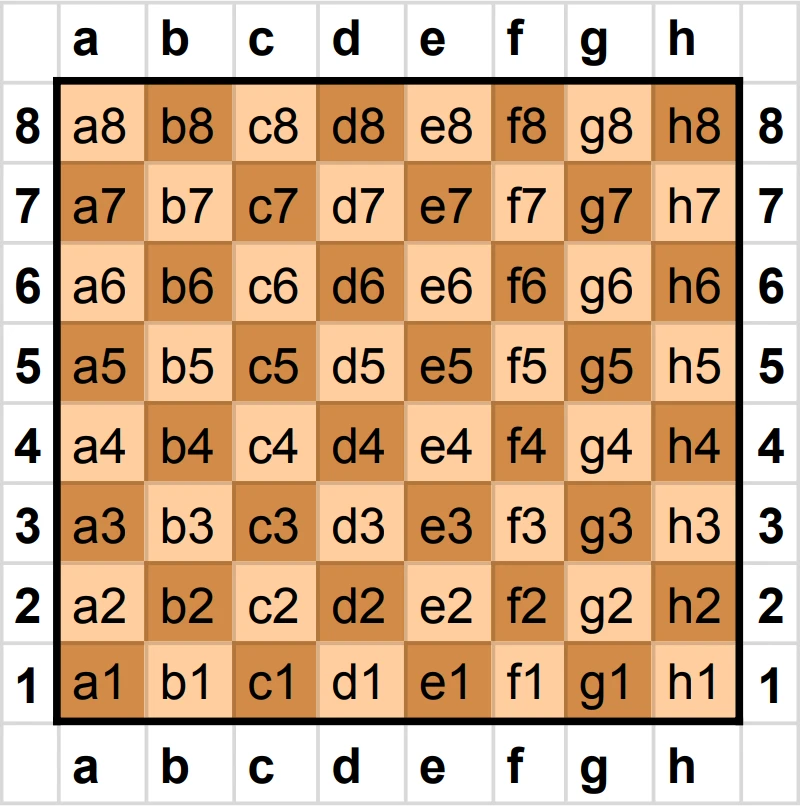
These notations are useful to know what move has been played on the board. we add the notation name of the piece before the notation of the square to which the piece has moved. For example: Qg3; we will know that the queen has moved to 'g3'. But for the pawn only 'e4' the notation of the square. For capturing it can be Qxg3 (queen has captured on g3). dxe4 on the other hand means the pawn captures on e4. So, they use the pawn's old square letter with the new one. "x" refers to capture. If notation for promotion it can be e8=Q. For example, imagine you have two rooks on the same file or rank. It can be Rag1 or R1a7. Remember the letter comes before the number!
You may also like
 Divyashree27201311
What is Chess?
What is Chess, and why do we play Chess? Maddly
"Chess Like Tal: Thinking Outside the Box (Even When You're Not a Pro)"
Chess is a game of strategy, creativity, and endless possibilities, and it's not just for grandmaste… Maddly