"Nunn convention"
"Nunn convention"
"Nunn convention"
"! good move" - Nunn's Chess Openings
see that right move?
while dissasembling I see reason behind it right away, but while game it's kinda hard to recognize what to dohttps://lichess.org/AQk5iXHs/black#77
and no, it's not quitestion of amount of time per turn
Watch the entirety of Daniel Naroditsky endgame youtube video series, especially the ones on pawn endgames. Then you will see that a6 does nothing while g5 or Kg4 does something
Really that position is super intuitive and needs no calculation at all
@StevenEmily said ^
see that right move?
while dissasembling I see reason behind it right away, but while game it's kinda hard to recognize what to dohttps://lichess.org/AQk5iXHs/black#77
and no, it's not quitestion of amount of time per turnWatch the entirety of Daniel Naroditsky endgame youtube video series, especially the ones on pawn endgames. Then you wi...
I know I just reflexively was in haste to make fancy move
I didn't read all that stuff
So, im a 1800 FIDE, 2700 lichess hence I feel i'm fit for writing this.
Anyways,that position is something commonly known as "Steinitz Rule"
That means, when there are equal number of pawns on both sides, and whichever side runs out of tempi will lose (mostly, its with kings on either side of a pawn)
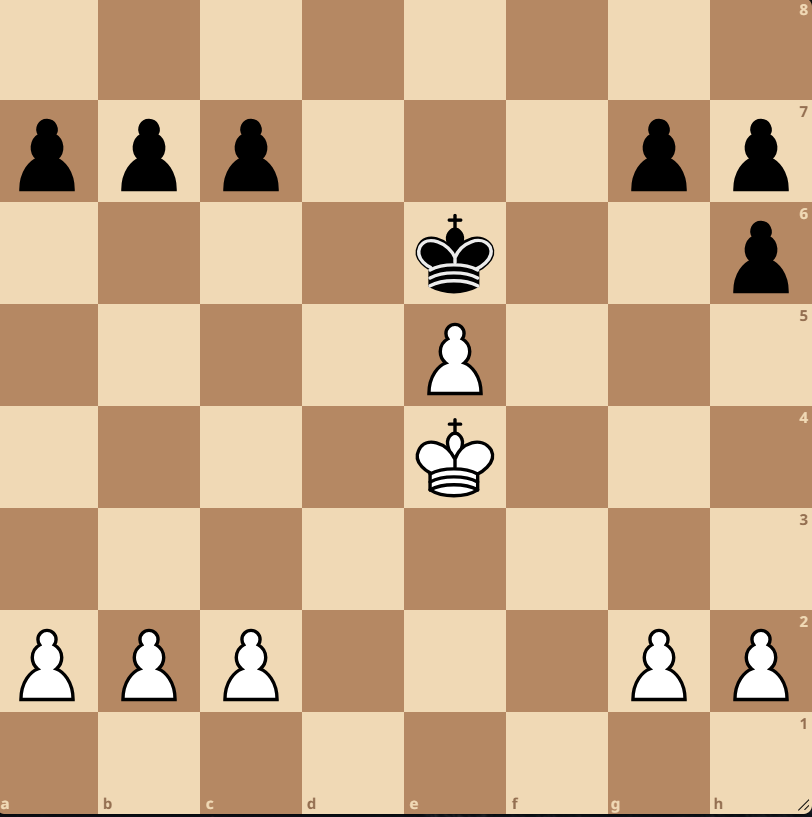
so the rule in these type of positions is to move pawns on the side where you have LESSER PAWN MOVES. because that means you will also restrict your opponents moves, and you will be winning.
Like in the above mentioned position, you have lesser moves on the k/side, so g4 is best.
Thats it
I liked the option of Kg4 more than g5, but apparently it make the position completely drawish
@CSKA_Moscou said ^
I liked the option of Kg4 more than g5, but apparently it make the position completely drawish
Yes, Kg4 looks logical.
But if you spend 2-3 minutes looking at the position, you will realize that there can be the zugzwang ideas i mentioned.
For example: 39.g5 40.hxg5 Kxg5 41.Kf3 Kf5! 42.Ke3 g5 where we create an outside passer, sacrifice the pawn and our king gobbles up the queenside pawns.
But in 39.Kg4 40. a6 g5 41. hxg5 Kxg5 42.f3
If you see the two lines, in one, black gains a tempo.
In one case, white's pawn is on a6 and its black to play, in the other, black's pawn is on a6 and its white to play.
Additionally, if you see Kg4,Kxg5 loses a move, making it slightly illogical compared to g5 (if your idea is to play g5 after Kg4)
Thats it.
@BLUNDERkingTHAgoat said in #36:
... there can be the zugzwang ideas i mentioned.
For example: 39.g5 40.hxg5 Kxg5 41.Kf3 Kf5! 42.Ke3 g5 where we create an outside passer, sacrifice the pawn and our king gobbles up the queenside pawns. ...
The machine seems to think that, in this line, Tudka would have been able to draw by going for 43 Kf3 h4 44 g4+. Apparently, 42...Kg4 would be a lot better than 42...g5.
hmm yeah, I missed that.
42...Kg4 basically puts white in zugzwang.
But again, these positions are all calculation.
The rule I mentioned only clears out pawn moves on one side; in this case: a6.
Now whether g5 is winning or Kg4 is winning is all based on A) logic B) calculation
In this case: if you tried to guess on moves 39,41,42 in 41.f3 and 41.Kf3, where you have 3 candidates,2 candidates and 2 candidates; you have a 10% chance to succeed.
But if you applied logic, for g5; as I stated, the tempi and outside passer ideas (as although you have lesser pawn moves on the queenside, this is a rather special case where the king is misplaced. Hence, you don't need to immediately use it, as you have open squares {g4} for entry, which the king must block. Then, you can use your tempi on the queenside.)
Then, in 41.f3; you have no entry, so move the side with lesser pawn moves (logic- move 41)
In 41.Kf3; opposition (logic-move 41)
39.g5 40.hxg5 Kxg5 41.f3 a6 42.Kf2 h4! requires some effort in calculation, where if you calculate, you will see that 43.gxh4 Kxh4 44.Kg2 Kg5! 45.Kg3 Kf5! (46.f4? fails to Ke4) 46.Kf2 Kf4 47.Kf2 g6! , is a proper case of zugzwang in Steinitz rule
Position on the board after 47.g6
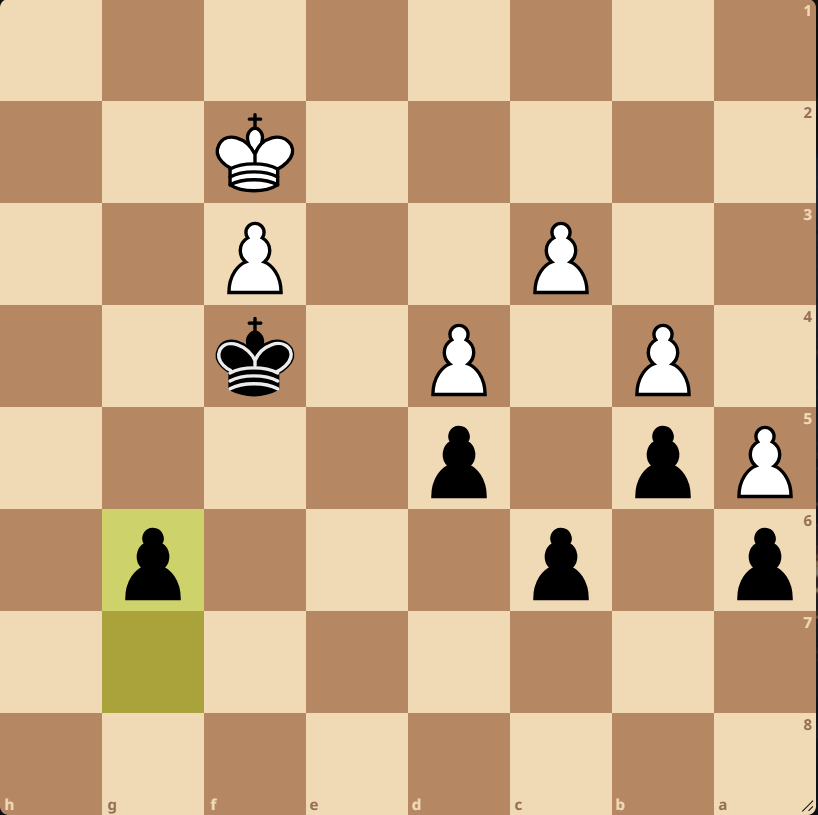
Where 48.Ke2 allows Kg3 49.Ke3 g5! (this is why its important to keep a reserve tempo in hand, if we played g5 directly we wouldn't get this idea.) 50.Ke2 Kg2! 51.Ke3 Kf1! (this concept is known as "Uprooting" where you bring the King out of its safe little corner from behind, note that 52.f4 fails to g4, queening by force.)
48.Kg2 would allow us to safely capture all the queenside pawns and queen before White.
So, if you apply Logic and Rules, you have a 50% success rate, increasing by 5x
Thats why, know your rules!
@BLUNDERkingTHAgoat said in #38:
... 46.Kf2 Kf4 47.Kf2 g6! ...
Something seems a little wrong there.


