
UZBEKISTAN & CHINA ARE THE 2026 OLYMPIAD CHAMPIONS
The 2026 Chess Olympiad has come to an end, with Uzbekistan winning the Open section and China taking gold in the Women’s event. After eleven rounds, two fascinating title races and countless decisive moments, Uzbekistan celebrated a historic victory in front of their home crowd, while China confirmed once again the extraordinary depth of their women’s chess by winning the tournament despite arriving without several of the country’s biggest stars.
Open: Uzbekistan Do It Again
Uzbekistan entered the final round knowing that the title was in their hands, and they did not let the opportunity escape. Their 2.5–1.5 victory over Ukraine secured another Olympiad gold, with Mukhiddin Madaminov producing the decisive win against Roman Dehtiarov. It was the perfect ending for the hosts: playing at home, leading the tournament going into the final day and finding the victory they needed when the pressure was at its highest.
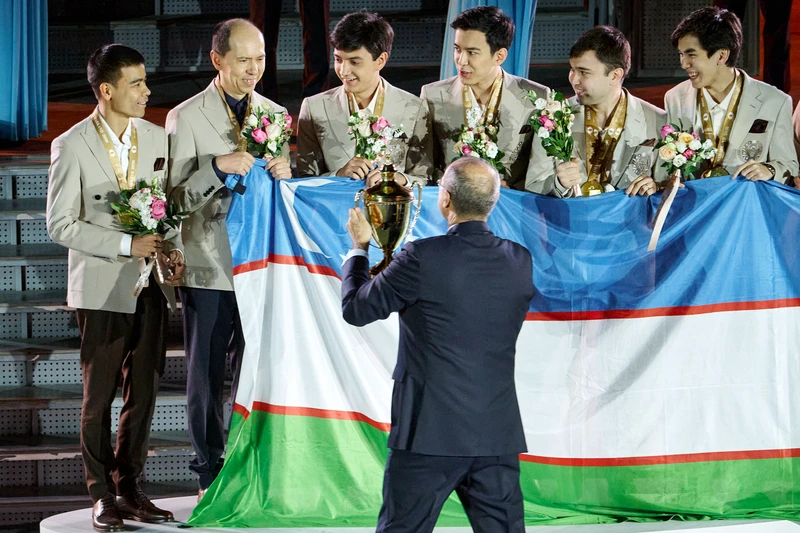
This gold also confirms that what Uzbekistan have achieved over the last few years is much bigger than one exceptional tournament. They won the Olympiad in Chennai in 2022, followed it with bronze in Budapest in 2024 and have now returned to the top of the podium in Samarkand. Two gold medals and a bronze in three consecutive Olympiads is an incredible record, especially for a team whose core is still young enough to remain at the top for many years.
The rise of Uzbek chess is clearly not happening by accident either. The country has invested heavily in the game, hosted this Olympiad and continues to give its best players enormous institutional support. One of the most striking examples came with the announcement that each player from the gold-medal team would receive $200,000, while the coach would receive $50,000. Those numbers show the importance that chess has acquired in Uzbekistan, and when that level of investment is combined with a generation containing players such as Nodirbek Abdusattorov, Nodirbek Yakubboev and Javokhir Sindarov, the results become easier to understand.
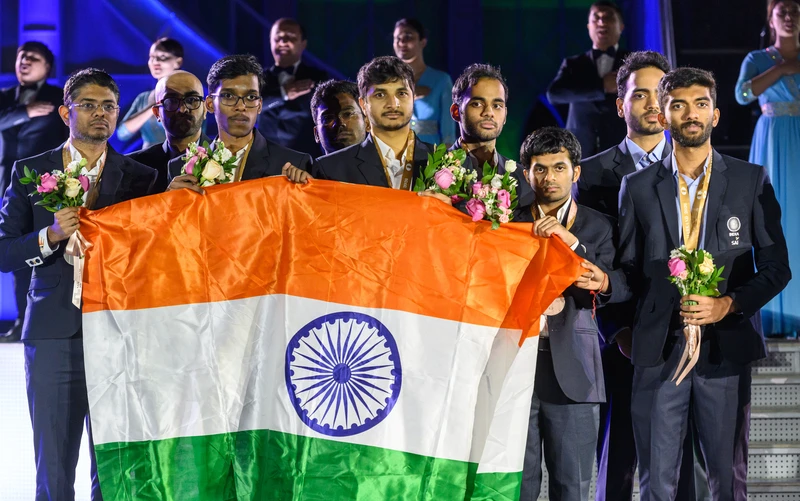
India were the team that pushed them closest. After winning the previous Olympiad, they arrived in Samarkand with another incredibly strong squad and remained in contention until the final round, eventually taking silver. There will obviously be some disappointment when you come so close to defending the title, but finishing second at an Olympiad after winning gold two years earlier is still an outstanding result. Making the podium in an event this strong is never something that should be taken for granted, regardless of how powerful your team looks on paper.
There will also be moments India look back on and wonder what could have happened differently. Nihal Sarin’s game against Nodirbek Yakubboev in the direct encounter with Uzbekistan is one of them, as Nihal had chances before the game eventually turned around. In a tournament decided by such small margins, one result can completely change the title race. India nevertheless fought until the end, and Arjun Erigaisi finished their Olympiad with another victory in the final round.
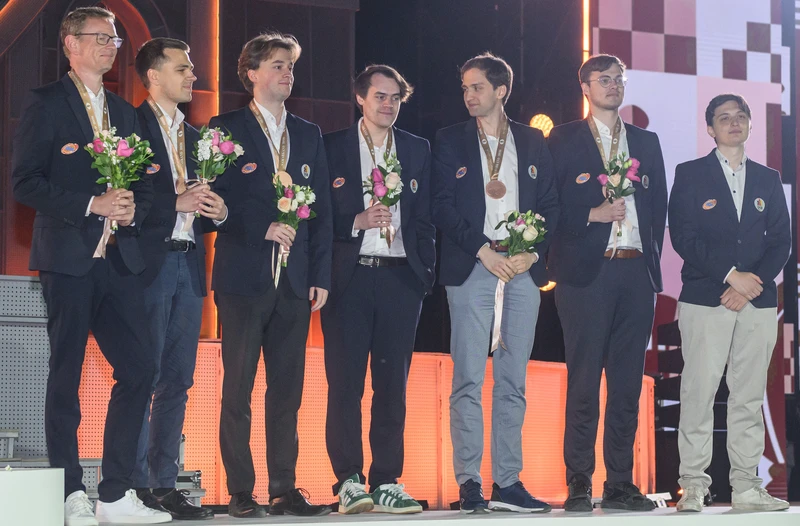
Germany completed the podium after what I thought was one of the best team performances of the entire Olympiad. I did not expect them to be fighting this high before the tournament, but they proved throughout the event that they belonged among the contenders and were actually the only team to defeat Uzbekistan. They had opportunities to put themselves in an even stronger position during the final stages, but bronze is still a fantastic result and a deserved reward for the tournament they played.
Matthias Bluebaum gave them one final important victory against Jorden van Foreest as Germany defeated the Netherlands 2.5–1.5 in the last round and secured third place.
Beyond the podium, there were several other performances worth mentioning. Spain finished inside the top ten after a very solid Olympiad, which was obviously great for me to see as a Spanish player, and Daniil Yuffa added an individual silver medal to an excellent tournament.
The United States, on the other hand, were one of the teams from which I expected more. They still finished fourth, which objectively is a very strong result at an Olympiad, but the expectations were understandably enormous considering the depth of their squad. When a team can have a player of Levon Aronian’s level on board four, anything outside the medals is going to feel like a missed opportunity. They have also been waiting for another Olympiad title since 2016, and this was another edition in which an incredibly strong American team was unable to return to the top of the podium.
In the end, however, the Open section belongs to Uzbekistan. Three consecutive Olympiad medals, two of them gold, have established this generation as one of the defining teams of modern chess.
Women: China’s Incredible Depth
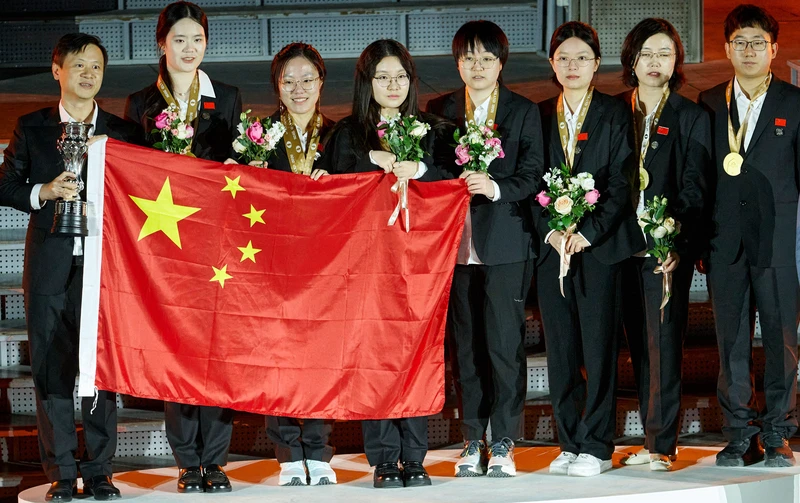
If the Open section produced a close battle until the final day, China’s victory in the Women’s Olympiad felt very different. They were the strongest team throughout the event and finished without losing a single match, with their only draws coming against Kazakhstan and India, the two teams that eventually joined them on the podium.
What makes that achievement particularly impressive is the team China brought to Samarkand. Several of the biggest names in Chinese women’s chess were absent, including Ju Wenjun, Lei Tingjie and Tan Zhongyi, while Hou Yifan remains inactive. China did not simply replace those players with the next three names on a ranking list and scrape their way to gold; they brought another group of extremely strong players and still controlled the Olympiad.
That depth is what separates China from almost every other country in women’s chess at the moment. Russia would obviously add another major contender if they were participating, but even taking that into account, China’s pool of elite female players is extraordinary. They can leave several world-class players at home and still arrive at an Olympiad with a team capable of winning gold.
Zhu Jiner was the leader of that team and one of the outstanding players of the entire tournament. She was incredibly reliable on board one and finished the Olympiad undefeated, before helping China complete the job against Vietnam in the final round.
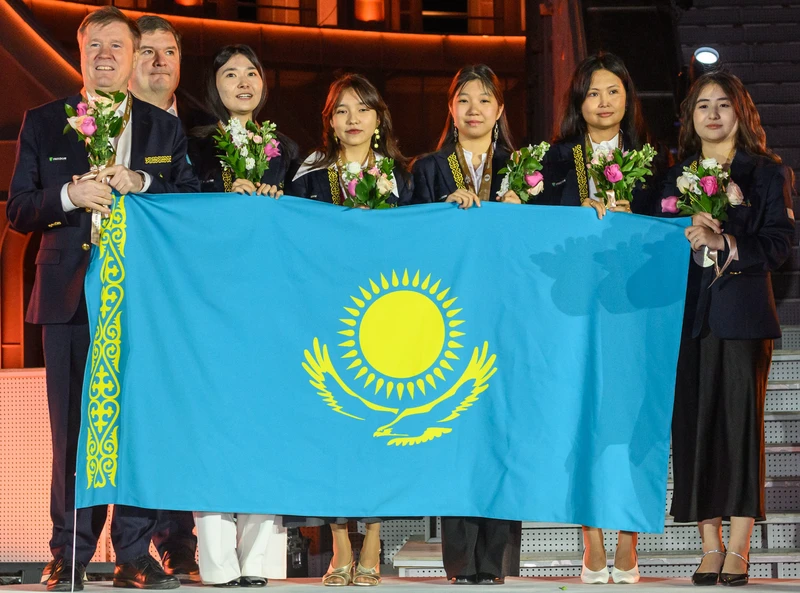
Kazakhstan took silver for the second consecutive Olympiad, and their progression in recent years has also been extremely impressive. They have built a young team with several players who already compete at a very high level, while at the same time continuing to invest heavily in the development of women’s chess. After silver in Budapest and another silver here, they are no longer simply a dangerous outsider; they have established themselves as one of the strongest women’s teams in the world.
Their tournament was not without difficult moments. The match against France could easily have changed their entire Olympiad, particularly after the huge mistake that gave Kazakhstan a crucial victory, but surviving those moments is also part of a team event. They continued collecting points and eventually finished alone in second place, with Elnaz Kaliakhmet completing her tournament with another important victory in the final round.
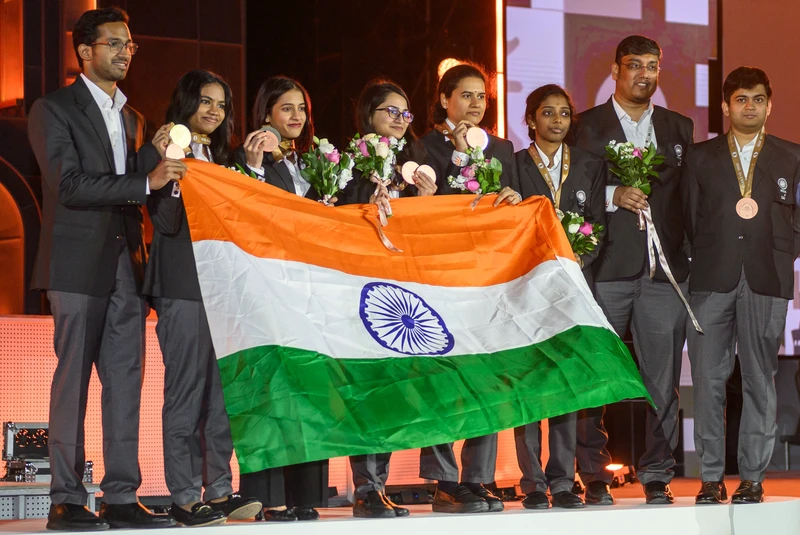
India completed the podium, although I think they will feel that they had opportunities to achieve more. Their defeat against Poland was particularly damaging in the title race, because most of the team actually played a good tournament. Humpy Koneru was extremely solid on the first board, the lower boards contributed important points and Savitha Shri had an outstanding event, but Vaishali Rameshbabu never really found her best form.
I also think India could have managed their lineup better. Personally, I would have rested Vaishali one round earlier when it became clear that she was struggling, while later in the tournament, after Vantika Agrawal lost and Vaishali had already spent several rounds out of the team, I would have considered bringing her back. Of course, these decisions are always much easier to judge after the games have been played, but the rotations were one aspect of India’s tournament that I did not completely understand.
Despite that, bronze remains a strong result, and Humpy finished India’s Olympiad with a very nice victory against Nana Dzagnidze in the final round.
The United States once again finished close to the podium, and just as in the Open section, I expected slightly more from them before the tournament. Most of the team performed reasonably well, but they needed more from Irina Krush to seriously challenge China, Kazakhstan and India over eleven rounds.
Ultimately, though, the story of the Women’s Olympiad was China. Winning gold is already difficult enough; doing it while leaving so many of your strongest players at home shows just how extraordinary the depth of Chinese women’s chess has become.
The End of My Olympiad Coverage
And with that, my coverage of the 2026 Chess Olympiad comes to an end. I streamed seven of the eleven rounds live on my YouTube channel, basically every round that I could cover when I was not playing tournaments myself, and during the entire event I also analysed some of the most interesting and important games from each day.
It has been a lot of work, but I have genuinely loved covering this tournament. The Olympiad is one of my favourite events in chess because there is always something happening: the best players in the world, countries that you do not normally see competing at the very top, huge upsets, individual stories and a completely different atmosphere from a normal individual tournament.
I have also put together a Lichess Study containing all the games I analysed during the Olympiad, so if you missed any of the previous articles or want to go through the games yourself, you can find everything there. All of my videos and the streams from the tournament are also available on my Youtube Channel
The next truly huge event will be the World Championship match between Gukesh and Sindarov. I will not be streaming every game live as I did during the Olympiad, but I plan to make extensive recaps and analysis throughout the match.
Before then, the content on my channel will become a little more personal as well. I want to show more of my own life as a chess player: the tournaments I play, how I train, what I am working on and the entire process of trying to reach International Master and eventually Grandmaster.
For now, though, that is the end of an amazing Olympiad. Congratulations to Uzbekistan and China, the two Olympic champions, and thank you to everyone who followed the tournament with me.
See you at the next one.
You may also like
 thibault
How I started building Lichess
I get this question sometimes. How did you decide to make a chess server? The truth is, I didn't. FM BuendiaChess
21 days to be IM
I have 21 days to reach 2400 and finally become international master, to make that i going to play 2… CM HGabor
How titled players lie to you
This post is a word of warning for the average club player. As the chess world is becoming increasin… IM Lizard1
Magnus Pushes the H-Pawn And Destroys a GM
Magnus spends the opening pushing his h-pawn instead of developing his pieces, and somehow that same… NM ZugAddict
Are you rated 1600? Good.
It's good to be 1600 and I will explain why FM MathiCasa